

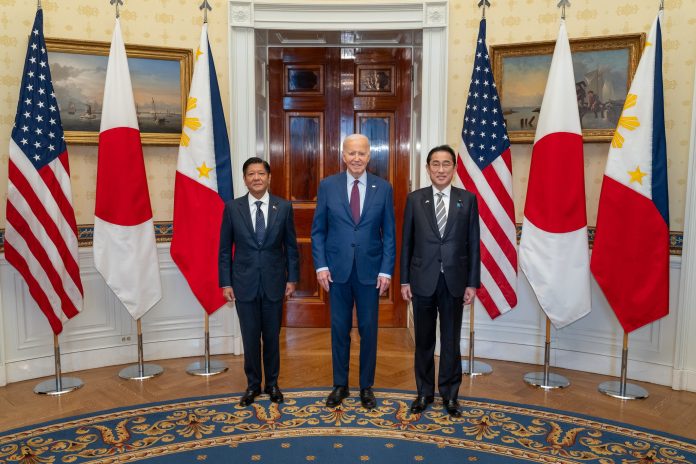
The leaders of Japan, the Philippines, and the United States met in Washington April 11 for the first ever trilateral summit with a deep focus on Indo-Pacific security and economic cooperation.
Coming just eight months after a similar U.S.-sponsored Camp David trilateral summit involving Japan and South Korea last August, the unmistakable culmination of these diplomatic efforts is to establish a nearly indestructible defensive bulwark against Chinese, as well as North Korean, encroachment in the region while boosting America’s already substantial Pacific reach and presence, as well as trade and investment.
The April 11 trilateral Summit followed several busy days in Washington for Japanese Prime Minister Fumio Kishida, on a full state visit, including a speech to Congress, multiple high-level economic and bilateral defense consultations and a star-studded White House state dinner. There was also the announcement of an agreement to send a Japanese astronaut to the moon under the NASA-led Artemis program.
Writing a new trilateral story
The Philippines’ leader President Ferdinand Marcos Jr. joined Kishida and U.S. President Joe Biden for the April 11 trilateral summit with a focus on publicly establishing in Beijing’s calculus that further encroachment in the South China Sea would meet determined resistance. A quick read of the three leaders’ joint vision statement issued after the summit should make that clear.
“A great deal of history in our world will be written in the Indo-Pacific in the coming years,” President Joe Biden said opening the summit, stating that the three nations will be writing that story together. Senior U.S. officials had worked ahead of the summit to make it known to the international media that the summit itself was a direct response to China’s coercion in the South China Sea and was intended to send Beijing a “crystal clear” message of unity.
Biden stressed this at the summit, saying “I want to be clear. The United States defense commitments to Japan and to the Philippines are ironclad. They are ironclad. Any attack on Philippine aircraft, vessels, or armed forces in the South China Sea would invoke our mutual defense treaty.”
The Philippines’ Marcos said, “Today’s summit is an opportunity to define the future that we want and how we intend to achieve it together.” Japan’s Kishida said that “multilayered cooperation between allies and like-minded countries was essential” in order to maintain and bolster a free and open international order based on the rule of law.
All of the leaders noted their intention to continue holding regular trilateral summits.
The U.S. envisions using both Japan and the Philippines as depot centers to respond to natural disasters across the Indo-Pacific. One disaster relief hub will be established in Japan, while another similar logistics hub will be built at one of the nine Philippine military bases the U.S. currently has access to under the new Enhanced Defense Cooperation Agreement signed last year.
Economic deliverables to boost Philippines’ economy announced
The economic component of the trilateral summit deserves further examination in view of the steady roll out of the so-called Partnership for Global Infrastructure and Investment (PGI), which is the latest American-driven G-7+ response to China’s Belt and Road Initiative.
The summit was used to announce the PGI Luzon Economic Corridor, which will become the first PGI corridor in the Indo-Pacific. Luzon is the largest and most populous island in the Philippines archipelago and location of the country’s sprawling capital city Manila.
The Luzon Economic Corridor project will support connectivity between two former U.S. base locations with large airfields — Subic Bay and Clark, the national capital Manila, and Batangas. Projects are planned to upgrade ports, rail links, clean energy facilities and semiconductor supply chains.
The three countries will set up a steering committee to accelerate work on the Luzon corridor and the U.S. Development Finance Corporation (DFC) will open its first regional office in the Philippines.