

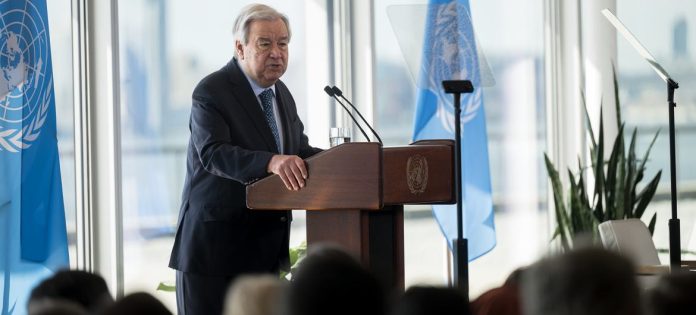

Ahead of COP30, UN Secretary‑General António Guterres said the world has passed the point of no return in shifting to renewables, urging governments to deliver bold new climate plans before the November climate summit in Belém, Brazil.
In a special address at UN Headquarters in New York on July 22, Guterres said the fossil fuel era is nearing its end. “Today, we are releasing a special report with the support of UN agencies and partners — the International Energy Agency (IEA), the IMF (International Monetary Fund), IRENA (International Renewable Energy Agency), the OECD (Organization for Economic Co-operation and Development) and the World Bank. The report shows how far we have come in the decade since the Paris Agreement sparked a clean energy revolution. And it highlights the vast benefits – and actions needed – to accelerate a just transition globally,” Guterres said in his speech, “A Moment of Opportunity: Supercharging the Clean Energy Age.”
He noted that renewables already nearly match fossil fuels in global installed power capacity. “Last year, almost all the new power capacity built came from renewables. And every continent on Earth added more renewables capacity than fossil fuels. The clean energy future is no longer a promise. It’s a fact. No government. No industry. No special interest can stop it. Of course, the fossil fuel lobby of some fossil fuel companies will try – and we know the lengths to which they will go,” the UN Secretary‑General proclaimed.
“The energy transition is unstoppable. But the transition is not yet fast enough or fair enough. OECD countries and China account for 80 percent of renewable power capacity installed worldwide. Brazil and India make up nearly 10 percent. Africa — just 1.5 percent. Meanwhile, the climate crisis is laying waste to lives and livelihoods. Climate disasters in small island states have wiped out over 100 percent of GDP. In the United States, they are pushing insurance premiums through the roof. And the 1.5-degree limit is in unprecedented peril. To keep it within reach, we must drastically speed up the reduction of emissions – and the reach of the clean energy transition,” Guterres said.
He noted that “with manufacturing capacity racing, prices plummeting, and COP30 fast approaching. This is our moment of opportunity. We must seize it,” he said.
UN chief presses nations for new climate plans before COP30 summit
Guterres urged governments to use new national climate plans to go all-out on the energy transition. “Too often, governments send mixed messages: Bold renewable targets on one day. New fossil fuel subsidies and expansions the next. The next national climate plans, or NDCs, are due in a matter of months. They must bring clarity and certainty. G20 countries must lead. They produce 80 percent of global emissions. The principle of common but differentiated responsibilities must apply but every country must do more. Ahead of COP30 in Brazil this November, they must submit new plans. I invite leaders to present their new NDCs at an event I will host in September, during General Assembly High-Level week,” he said.
Trade and investment policies must support climate policy
Guterres said countries committed to the new energy era must come together to ensure that trade and investment drive it forward by building diverse, secure, and resilient supply chains, by cutting tariffs on clean energy goods, by unlocking investment and trade – including through South-South cooperation and by modernizing outdated investment treaties – starting with Investor-State Dispute Settlement provisions.
“Today, fossil fuel interests are weaponizing these provisions to delay the transition, particularly in several developing countries. Reform is urgent. The race for the new must not be a race for the few. It must be a relay – shared, inclusive and resilient. Let’s make trade a tool for transformation,” the UN chief said.
“Sixth and finally, this is our moment of opportunity to unleash the full force of finance – driving investment to markets with massive potential. Despite soaring demand and vast renewables potential — developing countries are being locked out of the energy transition,” he said, adding that Africa is home to 60 percent of the world’s best solar resources but it received just 2 percent of global clean energy investment last year.
This week, @antonioguterres delivered a major address on the world’s climate, stressing that renewable energy is the greatest economic opportunity of the 21st century.
“This is our moment of opportunity,” he said.
More on the Secretary-General's speech: https://t.co/dewoiGQy5Z pic.twitter.com/h2JQ6Bz479
— United Nations (@UN) July 27, 2025
Guterres argued that the greatest threat to energy security today is in fossil fuels. “They leave economies and people at the mercy of price shocks, supply disruptions, and geopolitical turmoil. Just look at Russia’s invasion of Ukraine. A war in Europe led to a global energy crisis. Oil and gas prices soared. Electricity and food bills followed. In 2022 average households around the world saw energy costs jump 20 percent. Modern and competitive economies need stable, affordable energy. Renewables offer both. There are no price spikes for sunlight. No embargoes on wind. Renewables can put power – literally and figuratively – in the hands of people and governments. And almost every nation has enough sun, wind, or water to become energy self-sufficient,” Guterres said, adding, Renewables mean real energy security. Real energy sovereignty. And real freedom from fossil-fuel volatility.”