
Amid increasing tension between the U.S. and Venezuela with new U.S. economic sanctions announced on December 11 and the U.S. military’s seizure of the previously sanctioned oil tanker (The Skipper) on the high seas late on December 10, the major news focus of that week was not the positioning of more U.S. military assets in the Southern Caribbean, but the massive political and ethical boost provided for Venezuela’s opposition leader María Corina Machado via her Nobel Peace Prize, also awarded on December 10, in Oslo. This served to highlight domestic and global advocacy for democratic reforms in Venezuela as the world again came to grips with the country’s stolen 2024 presidential elections, leaving leftist regime strongman Nicolas Maduro clinging to power as a clearly illegitimate “President” that nobody, so far, is willing to force into calling fresh elections.
Washington’s pressure on Maduro — which is essentially all that matters — had seemed to plateau for a time after the Nobel Prize announcement, but suddenly on December 17 U.S. President Donald Trump announced that the U.S. would institute a self-declared blockade around Venezuela of what the Trump administration is calling “sanctioned oil tankers.” The latest announcement has clarified one point. It was less about counter-narcotics which had been the major pretext for U.S. interventions earlier, and now much more about Trump administration’s desire to close off much of Maduro’s financial lifeline, Venezuela’s oil exports.
Do sanctions matter?
In view of the tanker seizure and the new blockade, the latest U.S. sanctions on Caracas seem like an afterthought by the usual Treasury Department sanctions lawyers and bureaucrats at the Office of Foreign Assets Control (OFAC).
The Department of the Treasury said on December 11 that it was targeting “Nicolas Maduro’s illegitimate regime in Venezuela, sanctioning three nephews of Maduro’s wife, Cilia Flores; a Maduro-affiliated Panamanian businessman; and six shipping companies operating in Venezuela’s oil sector.” Additionally, Treasury identified six associated vessels that have engaged in deceptive and unsafe shipping practices and continue to provide financial resources that fuel Maduro’s corrupt narco-terrorist regime. Those ships will be classified as sanctioned vessels. The Maduro-affiliated Panamanian businessman noted above (Ramon Carretero Napolitano) had been managing numerous export transactions for the U.S. oil giant Chevron, apparently with Washington’s approval.
Providing further justification and even hinting obliquely at a desire for regime change, Secretary of the Treasury Scott Bessent explained the Trump administration’s case. “Nicolas Maduro and his criminal associates in Venezuela are flooding the United States with drugs that are poisoning the American people,” adding, “These sanctions undo the Biden Administration’s failed attempt to make a deal with Maduro, enabling his dictatorial and brutal control at the expense of the Venezuelan and American people. Under President Trump’s leadership, Treasury is holding the regime and its circle of cronies and companies accountable for its continued crimes.”
The new sanctions include six shipping companies moving Venezuelan oil for the previously U.S. sanctioned Venezuelan state-owned oil company, Petroleos de Venezuela, SA (PDVSA). These six companies are registered in the Marshall Islands, the British Virgin Islands and the United Kingdom.
The new blockade – many questions open
On December 16, Trump ordered a blockade on all “sanctioned” oil tankers entering and departing Venezuela. This is much less than a total blockade as represented in numerous media outlets on the day of the announcement, but leaves a number of questions open. However, oil prices did increase the next day by about one percent in response.
In making the blockade announcement, Trump accused Venezuela of stealing U.S. assets, including oil and land, opening a range of potential new actions against the Maduro regime over time.
As stated, the blockade is basically a question of active U.S. sanctions enforcement although without an adequate basis in international law. It is also unclear if the burden of the Trump interdiction effort will fall on the U.S. Coast Guard or the Navy itself. This is not the first time such actions have been undertaken by various governments in times of conflict, however.
The U.S. sanctioned vessels operate in a global black market, transporting sanctioned oil that has been critical over the years to the ability for Maduro to stay in power. According to the Atlantic Council, more than 30 of the 80 ships in Venezuelan waters in mid-December were listed under U.S. sanctions orders. This trading network delivers oil primarily to China, and to a lesser extent Cuba, employing several tactics, not all of them illegal, to disguise the origin, name, and shipping routes to evade U.S. regulations. Some of these same shadow fleet vessels have also been involved in transporting sanctioned Russian oil. Payments for the oil are often made in cryptocurrency to bypass U.S. sanctions.
Data is not precise, but various shipping outlets estimate that only 40 percent of the vessels transporting Venezuelan crude are actually sanctioned.
Of particular interest is the on-again, off-again Treasury/OFAC license for Chevron to produce oil and export it to the U.S. market from its massive facilities in Venezuela. Upon returning to power the Trump administration terminated the Biden administration’s Chevron export license but in July 2025 a new and yet undisclosed license was approved with direct involvement of President Trump. In theory the license contained safeguards to prevent diversion of the oil and tight controls on foreign currency repatriation to the Maduro regime, but much remains unclear, especially now that Carretero Napolitano has been sanctioned.
True to form, Venezuela’s government declared that it rejected Trump’s “grotesque threat” of embargo and has started using its small number of naval vessels to provide escort support for some tankers. Ironically, in the Second World War, the U.S. actually aided Venezuela to build up its navy as its oil exports to the U.S. were essential to the allied war effort and its tankers were prized targets for Nazi U-boats operating in the Caribbean.
UN Security Council Meeting requested — But please do not forget the Monroe Doctrine
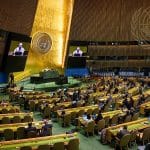
Venezuela on December 17 requested a United Nations Security Council meeting to discuss “ongoing U.S. aggression” against the country, according to a letter to the 15-member body seen by western news outlets. China voiced its support for convening the meeting on December 18, showing a high degree of insensitivity or indifference to the historical legacy of the Monroe Doctrine or the so-called “Trump-corollary.”