

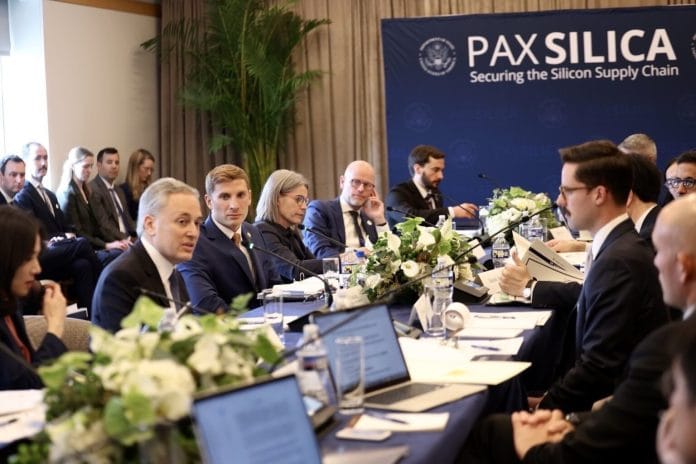

Aiming to unite the countries that host the world’s most advanced technology companies to unleash the economic potential of the new AI age, Under Secretary of State for Economic Affairs Jacob Helberg and representatives from Japan, Republic of Korea, Singapore, the Netherlands, The United Kingdom, Israel, United Arab Emirates, and Australia, alongside guest attendees from Taiwan, the European Union, Canada, and the OECD, inaugurated on December 12 the so-called Pax Silica by signing the Pax Silica Declaration.
Pax Silica is a new kind of international grouping and partnership, advancing U.S President Donald J. Trump’s call for a new era of economic statecraft that produces peace and security for America and its allies through the power of private investment, free enterprise, and economics. Additional signatories are expected to follow.
This is the first time countries are organizing around computer power, silicon, minerals, and energy as shared strategic assets. The U.S. State Department asserts that this is American AI diplomacy at its best: building coalitions, shaping markets, and advancing national interests. According State, President Trump and Secretary Marco Rubio understood earlier than anyone that AI is the new backbone of economic power. The new declaration operationalizes that insight (see full declaration below). Some pundits are even labeling Pax Silica as “Trump’s moon shot.”
Later in the day, the United States, Japan, the Republic of Korea, Singapore, the Netherlands, the United Kingdom, Israel, Australia, the United Arab Emirates, Canada, the OECD, and the European Union gathered for the Pax Silica Summit in Washington, D.C., hailing a new geopolitical consensus: economic security is national security, and national security is economic security. They discussed jointly pursuing multilayered partnerships that strengthen supply chain security, address coercive dependencies and single points of failure, and advance the adoption of trusted technology ecosystems.
At the event, participant countries explored opportunities to partner on flagship projects across global technology stacks, including connectivity and data infrastructure, computing and semiconductors, advanced manufacturing, logistics, mineral refining and processing, and energy.
What is next?
Early efforts will focus on turning diplomatic agreements into concrete projects — from joint ventures and co-investment mechanisms to coordinated policies on export controls and investment screening. The coalition may expand its membership and deepen technical cooperation, particularly in manufacturing capacity, critical mineral processing, and standardized supply-chain frameworks.
A central driver for the initiative is to balance China’s influence in critical minerals, rare earths, and chip supply chains — areas where China currently has deep integration and market power. Critical voices, particularly in China, characterize the initiative as market distortion or a bloc aimed at excluding non-participants from high-end tech ecosystems. Notably, major economies like India and Brazil were not part of the initial grouping.
Despite the new Pax Silica, the earlier U.S.-driven Minerals Security Partnership (MSP) cannot be seen as “dead.” In fact, it remains active and expanding, with ongoing meetings, partner additions, and concrete efforts to deepen cooperation on critical minerals supply chains.
The complete Pax Silica Declaration:
“We affirm our shared commitment to advance mutual prosperity, technological progress, and economic security for our peoples.
We recall President Donald J. Trump’s call for the United States to lead a new era of international economic diplomacy and to forge enduring economic alliances that promote the adoption of trusted technology, strengthen the prosperity of America and its allies and partners, and secure the foundations of free enterprise.
We recognize that a reliable supply chain is indispensable to our mutual economic security. We also recognize that artificial intelligence (AI) represents a transformative force for our long-term prosperity and that trustworthy systems are essential to safeguarding our mutual security and prosperity.
We recognize that the technological revolution in AI is accelerating, increasingly reorganizing the world economy, and reshaping global supply chains. We believe that economic value and growth will flow through and across all levels of the global AI supply chain, driving historic opportunity and demand for energy, critical minerals, manufacturing, technological hardware, infrastructure, and new markets not yet invented.
In this spirit, we declare our shared vision to deepen our economic partnership through shared incentives, infrastructure, and investment security practices.
We encourage efforts to partner on strategic stacks of the global technology supply chain, including, but not limited to, software applications and platforms, frontier foundation models, information connectivity and network infrastructure, compute and semiconductors, advanced manufacturing, transportation logistics, minerals refining and processing, and energy.
We believe in mobilizing the immense creative and financial power of private industry and entrepreneurship to make our citizens more prosperous, our nations stronger, and our supply chains more secure. We seek scalable approaches and solutions to supply chain security by mobilizing the complementary industrial and technological strengths of strategic companies and firms from our respective economies.
We support the promotion of a shared and trusted ecosystem of AI developers and vendors to renew legacy industries and unlock new markets and services for the lasting prosperity of our peoples.
We believe that true economic security requires reducing coercive dependencies and forging new connections with reliable partners and suppliers committed to fair market practices. At the same time, we will endeavor to provide access to trusted partners to the full stack of technological advancements that are shaping the AI economy.
We understand the importance of addressing non-market practices that undermine innovation and fair competition. We believe that coordination is essential to protect private investment from the market distortions of state-backed overcapacity and unfair dumping practices, and to preserve a level playing field for innovation and growth. We understand the importance of coordinating the enforcement of our respective policies to protect sensitive technologies and critical infrastructure from undue access, influence, or control by countries or entities of concern.
In this spirit, we intend to further strengthen economic and national security cooperation, including taking complementary actions as appropriate to address non-market policies and practices of third countries and cooperating on investment security.
We seek to build and deploy only trusted information networks, including information and communication technology systems, fiberoptic cables, and data centers, free from control of countries with countries or entities of concern.
Through this cooperation, we pursue a comprehensive economic partnership to build an economic security order based on trust, technological complementarity, shared interests, and a shared commitment to a more prosperous future.”