


President Donald Trump apparently has no more refined strategy than to disrupt the flow of world business/diplomacy with an outrageous opening salvo to make progress on his so-called “deals.”
Using that same playbook, news trackers everywhere were forced on November 21 to change focus from Black Friday sales across the industrialized world, or perhaps to forget the COP30 endgame, or even the distant G20 meetings in Johannesburg, South Africa, to focus on what first appeared to be a dark echo of last August when Trump met with Russian President Vladimir Putin in Anchorage, Alaska, to resolve the Russia-Ukraine War by themselves.
This was no random reflection or sensor glitch; it was a new American peace proposal for ending the war, complete with another of Trump’s patented ultimata, this time set for November 27, the same date as the U.S. Thanksgiving holiday, which two days later Trump clarified was “not his final offer.”
Munich-style betrayal or a starting point?
World leaders are still unable to verify the source of the so-called “U.S. proposal,” the substance of which was quickly leaked in Washington. Claims and counterclaims were made that the offer was a “Russian wish list,” adopted “to start the ball rolling,” with the Trump White House claiming that it was in fact an American proposal developed by Trump’s Special Envoy, Steve Witkoff, and Secretary of State/National Security Advisor Marco Rubio, and, possibly, their “experts.”
Witkoff, who is not known to have any substantive Russia/Ukraine or foreign policy expertise before this year — a fact clearly visible from the crude non-diplomatic terminology and Russian language syntax found across the “U.S.” proposal — reportedly “consulted” (if that’s how one describes adopting a foreign drafted document) with senior Kremlin official Kirill Dimitriev, a currently sanctioned, Western-educated economist with close ties to Putin’s inner circle, on the proposal.
None of that matters to him, in fact Witkoff was reportedly caught coaching Kremlin officials on how to deal with Trump in a telephone intercept. Hearings to explore Witkoff’s role would make sense, and some in Congress are already calling for Witkoff’s dismissal. In recent days, more has emerged via the Wall Street Journal about the intense Witkoff-Dimitriev discussions in Miami as the new Trump administration proposal was being cooked up, including how potential projects of interest to certain Trump friends in the private sector were woven into the early drafts. Congress will certainly want to examine the process to determine if U.S. Government officials were effectively bypassed, as well as to remind Trump there is a tough bi-partisan sanctions bill almost ready to be sent to his office.
Unsurprisingly, Putin quickly labeled the U.S. plan, loaded with numerous enticing references to future U.S.-Russia economic cooperation, “an acceptable basis for negotiations.” For Putin, the timing is right to reach a deal as Moscow is reportedly now starting to make physical sales from their large gold reserves. War-driven pressure on the economy is increasing massively, although not yet seen to be at any kind of breaking point.
Considering both Trump’s and Witkoff’s lack of significant Russia expertise, it is not inconceivable that they have been “played” by Putin — to the point of offering what seems like a set of tangible rewards for Moscow’s aggression. It is also within the realm of possibility that the “dealmakers” in the Trump White House initially worked from a Russian set of proposals (explaining some of the stranger terminology) to convince Moscow that they were acting as “honest brokers,” knowing full well the Russian demands could not possibly survive the Ukraine and NATO ally meatgrinder — because the demands were impossible to start with.
Terms of the proposal favor Moscow
Among the key points of the 28-point plan, now reportedly shortened to 19, Ukraine is being asked to cede the entirety of Crimea, as well as the Luhansk and Donetsk regions, to the Russian Federation – despite Ukraine still controlling more than a third of the industrial Donetsk region. Kherson and Zaporizhzhia, parts of which have been brutally occupied by Russia’s invading armed forces, would be frozen along the existing lines of conflict.
All of these territorial concessions are considered unacceptable to Kyiv.
Ukraine’s armed forces, Europe’s largest military at roughly 880,000 troops, would be reduced to 600,000 as part of the deal.
Security guarantees are a critical component of the proposed arrangement; however, NATO was not consulted during the plan’s development. The proposal stipulates that “a comprehensive non-aggression agreement will be concluded” between Russia, Ukraine and Europe. Ukraine’s sovereignty will be confirmed, and NATO will cease expanding further. Ukraine must also remain a non-nuclear state.
Kyiv must agree to enshrine in its constitution that it will not join NATO, and NATO must likewise agree to include in its statutes a provision that Ukraine will not be admitted in the future. NATO must also agree not to station troops in Ukraine. European fighter jets will be stationed in Poland, not Ukraine, in this arrangement. The plan also states that Ukraine is eligible for EU membership, a detail the Trump administration, or any future American administration, has no legal jurisdiction to influence.
The plan declares that “Ukraine will receive reliable security guarantees,” and also that “the U.S. will receive compensation for the guarantee.” It warns that “if Russia invades Ukraine, in addition to a decisive coordinated military response, all global sanctions will be reinstated, recognition of the new territory and all other benefits of the deal will be revoked.”
The economic component of the proposal reveals that Trump’s business instincts are deeply in play. Under the plan, “the lifting of sanctions will be discussed and agreed upon in stages and on a case-by-case basis,” which acknowledges that Washington is not alone in the driver’s seat as the sanctions that really harm Moscow’s economy concern energy trade with Europe. Fortunately, Washington has little leverage on those issues.
As noted above, it offers incentives to Moscow, stating that Russia will be invited to rejoin the G8 and promising Moscow another Trump-style, undefined long-term economic cooperation agreement.
Under the American plan, only $100 billion of the frozen Russian assets will be invested in U.S.-led efforts to rebuild and invest in Ukraine, and Europe will be asked to contribute the same amount. The plan calls for the creation of a Ukraine Development Fund with World Bank support. Washington has already set up a similar mechanism, to be partially based on the so-called “minerals deal” earnings.
The remainder of the frozen Russian assets would apparently be released to Moscow in stages and not channeled into projects to fund Ukraine reconstruction. If anything, this plan will certainly disrupt ongoing EU efforts to finalize the financial mechanism to utilize the full set of the frozen Russian assets in Europe as a source to support the Ukrainian economy. Some observers are already pointing to this as a backhanded Putin negotiating ploy to derail progress there, as well as an effort to forestall additional tough U.S. sanctions. Trump’s plan also foresees the creation of a separate U.S.-Russian investment vehicle for these to-be-unfrozen funds. By any measure, the plan in the current form is a huge boost to Moscow, maybe even to some Trump allies on Wall Street, and will certainly be problematic.
President of the European Council António Costa made it clear on November 24 that issues such as the frozen assets directly concern the EU, “and require the full involvement and decision by the EU.”
Negotiations continue
Ukraine has reacted cautiously to the latest Trump administration gambit, knowing the cost of angering Trump by failing to salute his peace efforts. Both Ukrainian President Volodymyr Zelensky and European leaders, who were mostly caught by surprise at the G20 meetings in Johannesburg without an American official present, know the Trump playbook at this point and have successfully presented measured responses, noting that the U.S. plan, intentionally developed without them, is a basis for progress but can and should be improved. Europe has developed new counterproposals, some of which are being integrated into the overall framework, and may have already met with Moscow’s preliminary rejection.
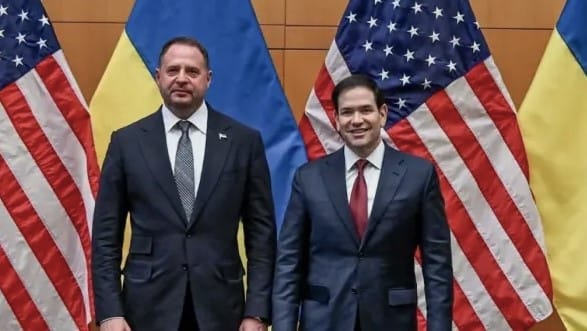
Never one to close off negotiations under pressure he created, Trump dispatched Rubio and Witkoff to meet senior Ukrainian and EU security officials in Geneva on November 23. Rubio’s public readout of the meeting’s progress was extremely positive, calling it a “very good day,” and stating that Trump was satisfied with the progress made, providing a narrative that the U.S. peace proposal was a real basis for a solution.
Briefing the press, Rubio did not mention a ceasefire, and all delegations hastily departed Geneva to consult with their capitals.
Eliminating nine of the 28 points in the original Trump plan is certainly positive news for the West, especially the special provisions for expanded U.S. – Russia economic cooperation. Even so, the real news this week should be about the negotiations with Russia, not about how the Trump team blind-sighted Ukraine and its NATO allies — once again.
Be that as it may, it is never long before this White House delivers a jolt of reality, transatlantic fissures are reopened and the Trump administration appears to be an unreliable ally — once again.
With diplomats sidelined and amateurs like Steve Witkoff, if that is really what he is, at the center of the Trump White House’s Ukraine policy apparatus, it would be unwise to expect anything except another meltdown (likely) at best…or Ukraine’s capitulation after being forced to sign up, at worse.