

Lithuania, which along the other Baltic states Latvia and Estonia disconnected their electricity systems from Russia’s power grid earlier this year, is increasingly transitioning to an independent energy system, avoiding manipulation of energy supplies and prices in the future.
“It has been a constant strategy to phase out the dependencies on Russian energy because we have learned the story very clearly,” Lithuanian Energy Minister Žygimantas Vaičiūnas told NE Global in a recent interview in Athens. “Once you are dependent on Russia supply, Russia is not a reliable supplier and, in any case, you will be paying a political price, or you will be blackmailed. So, this is very clear from our historical experience,” he added.
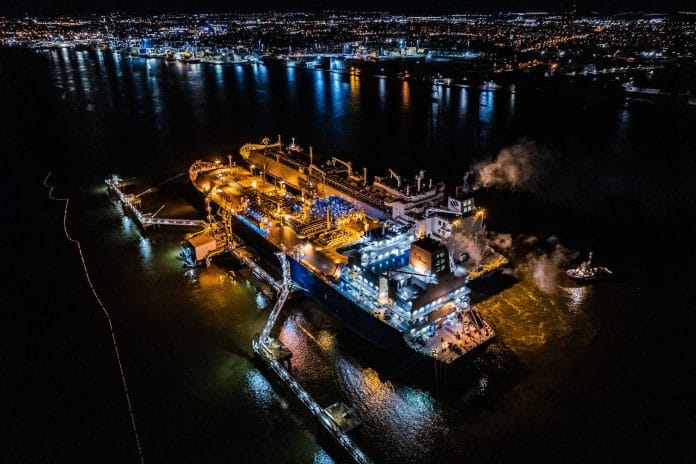
Vaičiūnas noted that Lithuania built the Klaipeda liquified natural gas (LNG) terminal, featuring the Floating Storage and Regasification Unit (FSRU) named “Independence,” which was launched in 2014, for that purpose.
“First of all, we have stopped the import of Russian electricity, stopped the import of Russian oil and in 2022 as the war started, as the aggression of Russia started towards Ukraine, we stopped the import of Russian gas. And this has been due to the fact that we have been preparing for it and already now we have market price for gas but not a politically motivated price,” the Lithuanian Minister argued.
Lithuania took full ownership of the FSRU Independence in December 2024. So far, Lithuania is importing mostly U.S. LNG. “In 2024, 50 percent of gas was coming from the United States, currently this year until now we have 75 percent coming from the United States,” he said.
On November 17, an LNG cargo from the U.S. ordered by a subsidiary of Ukraine’s DTEK Group reached the Klaipėda LNG terminal operated by the international terminal operator KN Energies, the Lithuanian Energy Ministry said in a press release. Approximately 160,000 cubic meters of U.S. LNG were expected to be transferred into the tanks of the FSRU Independence from the LNG carrier GasLog Houston that arrived in Klaipėda port. A share of the LNG cargo delivered to Klaipėda will, after regasification, reach Ukraine via pipelines and international interconnector links.
Lithuania, Latvia and Estonia have planned to integrate the countries’ electricity grids more closely with the European Union and boost security. “This year all the Baltic states have synchronized our electricity networks with the continental European networks,” Vaičiūnas said. This has been a historical change and very important change because now we are energy independent because our frequencies now are no longer managed from Moscow. This is now in our hands, our TSOs (Transmission System Operators) are responsible for the management of the electricity system. This has been the key change in our systems but also it would assure that our long-term approach and our view to change our dependency also made the impact for the generation of renewables,” he added.
“Because we decided to desynchronize from the Russian and Belarussian grids already in 2007 so for more than 18 years, we have dedicated our efforts, and this has been visible from the market perspective. The market knew very well that we will be disconnected and because of that we have to develop our own electricity generation, and this has been the key motivator not only for the governments but also for the market to invest into renewables,” he added.
Vaičiūnas noted that Lithuania, which is the biggest energy consumer among the Baltic states, has seen a significant energy shift, from relying on imports for about 70 percent of its electricity needs to generating roughly 70 percent of its electricity domestically from renewables, with the total installed solar and wind capacity now at 5.5 gigawatts (GW).
“That has been the real strategic and practical change for our systems, for our consumers, for our industries and now the price of the electricity is a lot more competitive. The issue we’re having about the taxes, about the transmission fee, about the distribution fee. For that we’re working to attract the potential investors,” the Lithuanian Energy Minister said.
Lithuania is also investing heavily in energy storage capacities, Vaičiūnas said, adding that as his country seeks to generate all the necessary electricity from renewable resources, the need for the development of a competitive and efficient balancing market is growing.
“In 2019-2020, at that time also I had the opportunity to be a minister of energy of Lithuania, it was quite clear that during the synchronization projects, for the security of supply purposes, we would need to have big storage capacities,” he said, adding that at that time Lithuania successfully developed Europe’s largest battery energy storage system, a 200 megawatts (MW)/200 megawatt-hours (MWh) project.
“It has been a very good instrument, and it has served the operational conditions for the isolated model for the Baltic states before this synchronization and now they are using this partly to balance the grid,” he said, adding, “the market is moving towards the storage direction, they’re investing but it will take some time.”
Turning to the European Union’s revised 2040 climate target, he noted that from the EU and the Member States’ proposals, it’s quite clear the trajectory is not changing. “They’re still moving towards the direction of renewables. There are some needs to adapt this on the short-term basis,” he said, citing as an example the EU’s decision to postpone the implementation of the new Emissions Trading System for buildings and road transport (ETS2) by one year, from 2027 to 2028. “This is, of course, a logical step that the burden on the consumers should be balanced with the development of the renewables. Meaning we have to develop enough of renewables to change the consumers’ system, consumers’ approach and then to make the additional taxes,” he said.
Rapid growth in renewable energy production
“In our case, solar is booming because we have created a very effective and very beneficial system for the prosumers,” he said, adding that prosumers can install PV on roofs or buy shares in remote solar parks, benefiting from financial aid for installation and reduced energy bills. Regarding wind energy, he said production is onshore. “We also have plans to develop the offshore wind capacities. There are two projects secured per 700 MW capacity, 1.4 GW total.”
Regarding hydrogen, Vaičiūnas said this is also one of Lithuania’s strategic projects, noting that his country is participating in the Nordic-Baltic Hydrogen Corridor (NBHC) which will connect Finland’s Gasgrid vetyverkot Oy, Estonia’s Elering, Latvia’s Conexus Baltic Grid, Lithuania’s Amber Grid, Poland’s GAZ-SYSTEM and Germany’s ONTRAS.
Lithuania is also looking at hydrogen generation. “We have some of the smaller projects and we will be creating the next year up to 100 MW capacity of the electrolyzers for the hydrogen,” he said, adding, So, I would say that is not a revolutionary thing but we’re constantly moving to that direction. Of course, the key issue is about the competitiveness of the hydrogen.”