

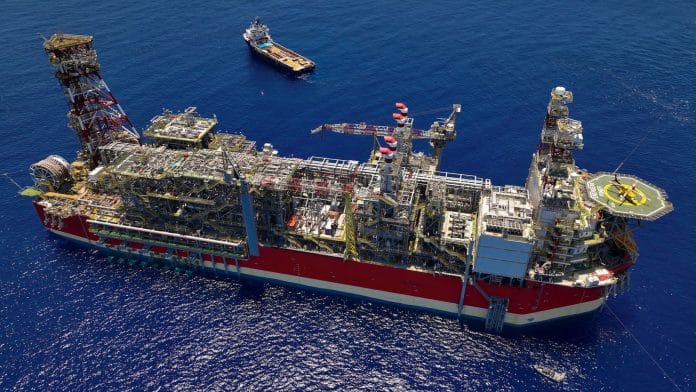
Israel’s planned Nitzana pipeline that will be constructed from Ramat Hovav, near Beersheba in the Negev desert, to the border with Egypt in the Nitzana area is expected to boost regional gas connectivity and long-term energy security in the East Mediterranean.
“It’s extremely important to create infrastructure that will connect all the countries of the Eastern Mediterranean. One of the issues between Israel and Egypt today is that there is a bottleneck,” Mathios Rigas, Chief Executive Officer of London-based Energean, told NE Global on the sidelines of a conference in Athens on October 30, adding that the two existing pipelines – the East Mediterranean Gas (EMG) Pipeline from Israel to Egypt and the pipeline that goes through Jordan – are fully booked. “So, the Nitzana pipeline comes in, to de-bottleneck the system and create more infrastructure, more pipelines that will bring gas from Israel to Egypt,” Rigas said.
On September 16, U.S. energy giant Chevron announced it signed a deal with state-owned pipeline operator Israel Natural Gas Lines Ltd. (INGL) to kickstart construction of the Nitzana natural gas pipeline, which will transport gas already onshore from the Leviathan gas field, to Egypt.
Energean signs transmission deal for Nitzana pipeline
On October 23, Energean Israel Limited signed a transmission agreement with Israel Natural Gas Lines for capacity in the Nitzana pipeline for a 15-year period. “We’re looking at a relatively small amount of 1 bcm (billion cubic meters per year) so that it’s not going to change the equilibrium of gas into the East Mediterranean,” Rigas said, adding that it will be up to the Egyptians whether this gas will stay in Egypt or will be liquified and exported depending on the country’s domestic needs at the time.
Energean said the terms also include rights, during the construction phase, to access available capacity in the Jordan-North pipeline. The Nitzana pipeline, with a capacity of 6 bcm, is expected to be operational no later than 36 months after all three parties sign transmission agreements covering the full capacity of the project.
Energean Israel’s 16.4 percent share of the construction costs for the pipeline and compression station is expected to be approximately $100 million and will primarily be funded via a new unsecured $70 million 10-year term loan facility provided by Israel’s Bank Hapoalim, Energean said. Following an initial 40 percent down payment, the remaining balance will be paid according to construction milestones via drawdown under the Unsecured Term Loan and cash on hand. Energean has signed a non-binding term sheet with an East Mediterranean client for the offtake of its gas.
Rigas said that Energean is also looking for other export routes, including from its Karish, Tanin and Katlan gas fields offshore Israel. “Cyprus is an obvious one. Again, it’s not a very big market. It’s a 1 bcm market. I think it can benefit a lot from gas. Cyprus is a country that has gas and has not yet been able to develop it and it’s still burning diesel. It’s about time that Cyprus gets access to gas, clean energy, affordable energy, stable energy and we can provide the solution,” the Energean CEO said.
Israeli gas exports to Cyprus
On that note, Energean announced on November 3 the signing of a Letter of Intent (LOI) with Cypriot industrial and energy group Cyfield for the potential supply of natural gas to Cyfield’s planned power generation facility at the Mari area of Larnaca. Following the LOI, Energean has proposed to the Cypriot and Israeli governments the export of natural gas from Israel to Cyprus via a new pipeline.
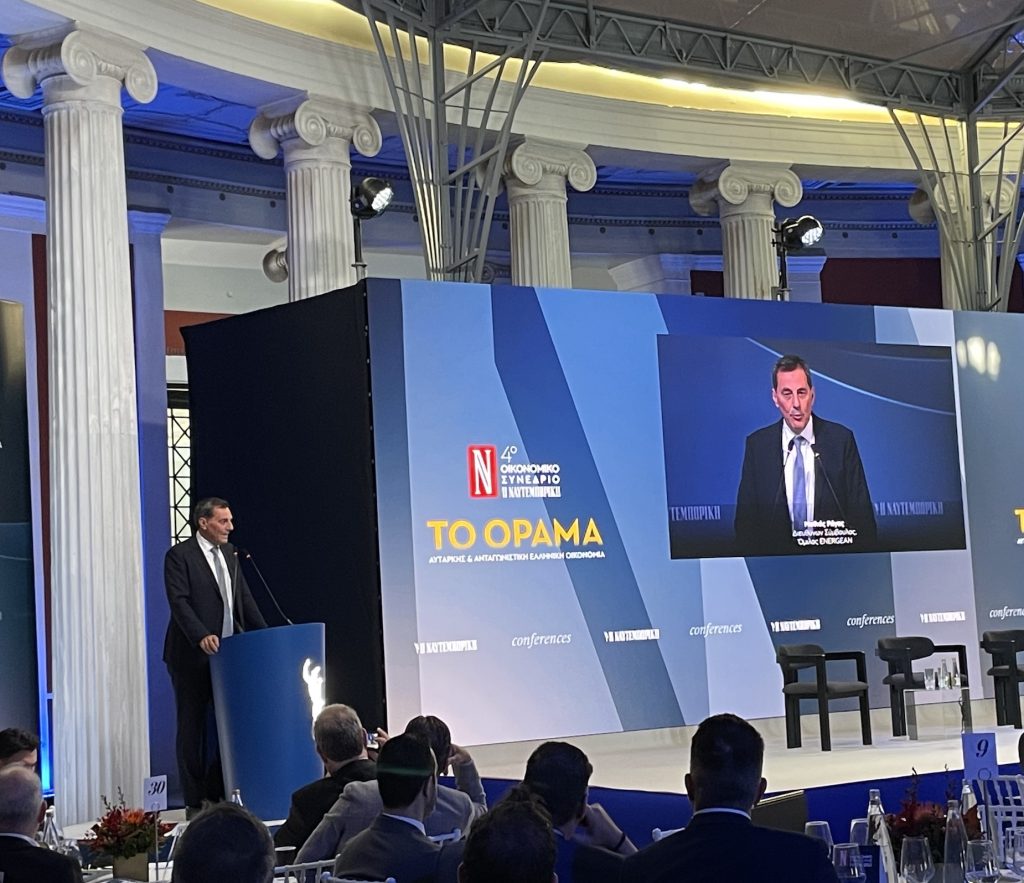
Rigas stressed that every country, whether it is Greece, Israel, Egypt, Cyprus in the East Mediterranean, needs to become self-sufficient and energy independent. “Israel has achieved it. Israel is now looking at the next phase which is how much gas they need to have in the country to remain energy independent for the decades to come because they have a very long-term planning in view. So, I think it’s very important for each country to promote hydrocarbon exploration to become energy independent,” Rigas told NE Global.
He argued that natural gas is an important transmission fuel in Europe’s decarbonization efforts and essential to energy security. “We’ve been saying that all along and that’s why we never ventured into investments in green technology, and we have always stayed true to our vision and mission to produce oil and gas hydrocarbons. So, we are continuing the path to develop as much gas as we can in the East Mediterranean,” he quipped.
Turning to the latest peace deal in the Middle East, Rigas said, “It will definitely create a much more stable environment for all of us investing in the region. It will remove the risk that investors are concerned about which is the geopolitical events affecting businesses and that will create a much better environment to invest and fund big projects.”