

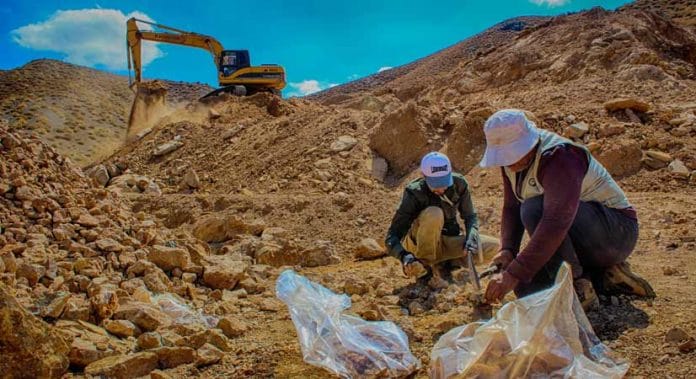

Two noteworthy events took place between late October and November. In late October, the head of the Iran Mine House, Mohammad Reza Bahraman, said, “Iran requires about €55 billion (around $59 billion) in new investment to achieve its planned 13 percent growth target for the mining sector.” Meanwhile, from 10-21 November, the COP30 climate change conference took place in Belém, Brazil.
The two events are obviously interlinked. The global demand for minerals is ever-growing, with rare earth elements and critical minerals being the latest obsession due to their widespread use in new technologies. However, mining is a very polluting and destructive industry. More environmentally friendly mining methods are being developed, but they are not yet widely implemented. Unsurprisingly, mining is closely linked to environmental destruction, and this extractive activity contributes to greenhouse gas emissions through methane releases.
As for Iran, the Iranian government continues to be subject of international sanctions, with few global allies: Russian companies are reportedly “interested” in manufacturing heavy mining machinery in Iran while the Taliban and Tehran are discussing how to improve mutual trade. Manufacturing in the country is limited, and the pillars of the economy are oil, natural gas, and mining. Hence, Reza Bahraman’s statement is not surprising. The state-run media outlet PressTV recently wrote a story praising mining in Nehbandan county, in Khorasan, noting that mining for barite, salt, coal, and gold there is “a vital source of local employment, a catalyst for regional trade, and a powerful engine for the country’s broader economic growth.”
The Iranian government has very little interest in environmental protection, as its focus is on mining to keep the economy afloat. The situation becomes worse for individuals who have been historically treated as second-class citizens by the Iranian regime, specifically non-Farsi groups like the Azerbaijani people who live in the northern regions of Iran, bordering Azerbaijan itself. These regions – East Azerbaijan, West Azerbaijan, Ardebil, and Zanjan – host several mining operations due to their mineral deposits.
For example, Iran’s largest gold reserves are located in Zarshuran, West Azerbaijan. Mohammad Parvin, acting head of the Zarshuran Mining Company reported in December 2024 that the mine’s proven gold ore deposits have increased from 27 million metric tons (mt) to 43 million mt. The operation is the “largest gold mine in West Asia,” and it is owned by the state-run Iranian Mines and Mining Industries Development and Renovation Organization (IMIDRO). Moreover, Tehran has commenced exploration for uranium and rare earth elements in Jang-e Sar, West Azerbaijan province. If sufficient deposits are found, the mine would be key to the future of the country’s controversial nuclear program. More recently, the governor of East Azerbaijan Province, Bahram Sarmast, has proposed establishing an Iran National Gold Company with the province as the headquarters, given the significant gold deposits located there.
Unfortunately and unsurprisingly, Tehran has supported mining operations, without considering the impact on the Azerbaijani populations that live in those areas. Suppose Tehran does manage to obtain the $59 billion it requires for mining operations, then life will get worse, not better, for the Azerbaijani community in Iran, they will suffer from air and water pollution, and it will negatively affect their daily lives and health. Azerbaijanis in Iran are not profiting from the mineral riches under their feet, they are suffering because of them.
The life of Azerbaijanis under Tehran’s rule has been one of constant problems and oppression. Tehran is scared of the country’s non-Farsi population (Azerbaijanis, Kurds, Balochis, Turkmens, among others). The country’s totalitarian government is well known for cracking down on protesters, even by other Iranians, as they wish to retain power. Hence, Tehran has historically treated Azerbaijanis, for example, as second class citizens to keep them in fear and subjugation.
The trials and tribulations Azerbaijanis living in Iran have to endure have been well documented. The government carries out a cultural oppression and assimilation campaign, so young Azerbaijanis cannot learn their native tongue in school, and they do not learn Azerbaijani history in schools. Job opportunities are scarce, and poverty is rampant. When peaceful protests occur, individuals are quickly arrested and sent to prisons where they are abused. Activists are regularly harassed or detained arbitrarily as well.
In May 2024, President Ebrahim Raisi died in a helicopter crash, prompting new elections, which saw Masoud Pezeshkian as the winner. At the time, he was viewed and described as a reformist. However, a year later, little in Iran has changed, including the government’s religious-extremist policies. Pezeshkian’s first in office was summarized by the Middle East Institute, a research center in Washington, DC, as fractured by “familiar political structural constraints, external crises, and a moderate-reformist base forever frustrated with his cautious pragmatism and unfulfilled promises,” adding that the leader “has not made any fundamental difference in how the Islamic Republic is run.”
The August commentary by MEI does not mention Azerbaijanis or other ethnic groups, mining and environmental issues by name, but researchers who follow these issues know the situation in the country has not improved.
As Human Rights Watch has correctly recorded, Iranian authorities tend to issue “heavy prison sentences” against Azerbaijani activists, “without showing real evidence.” Earlier this year, the Tehran Appeals Court, Branch 36, confirmed previously issued sentences against activists over unjust accusations like espionage and promoting propaganda. “Sentences ranged from 3 to 14 years.”
While unjust and unfair accusations and human rights abuses committed by the Iranian regime seldom make the news, the daily challenges that Azerbaijanis living in northern Iran have to live with are an issue less known across the United States and Europe. For example, due to the state’s lack of interest in environmental protection and addressing the needs of non-Farsi groups, Lake Urmia, located in the Azerbaijan provinces of northern Iran, has essentially evaporated. The issue of how massive mining operations are affecting Azerbaijanis deserves much more analysis and action by the international community.
Unfortunately, the COP30 climate conference in Brazil has demonstrated a loss of global momentum in addressing climate change, as several governments around the world have turned away from treating environmental protection as a priority. The repressive regime in Tehran has never shown an interest in global environmental regimes, as demonstrated by its disregard for this issue. Tehran will continue to invest heavily in mining to keep its economy afloat, and the Iranian environment and the large Azerbaijani population living in northern Iran will continue to suffer.