

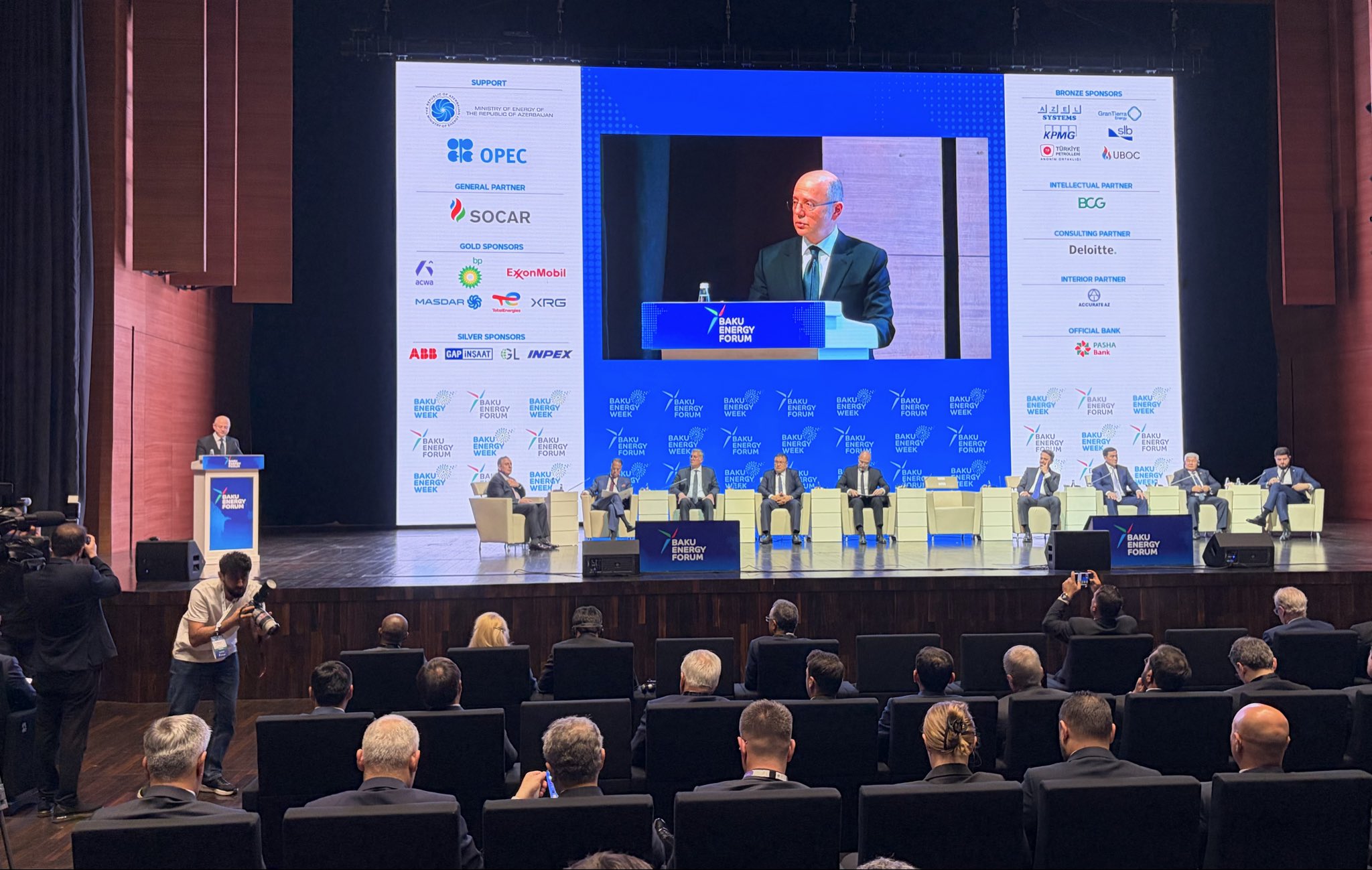
Decision makers from governments, global energy companies and financial institutions as well as leading industry experts gathered in Baku on June 1-3 to discuss the future of energy security and regional cooperation from Central Asia through the South Caucasus to Europe as uncertainty and extremely high volatility dominate global energy markets.
On June 1, Azerbaijan President Ilham Aliyev attended the official opening ceremony of the Baku Energy Week. “The world cannot live without fossil fuels. We all want to have a better climate and save the planet. We all want to live in a better environment. But today we must be very pragmatic and, based on realism, plan our future with respect to energy security while also investing in renewables. I think this is the way to move forward,” Aliyev said in his opening address.
“Oil and gas were the only way for us to survive as an independent country. So, countries should be judged not by whether they have oil or not, but by how they use the revenues, how they invest the funds they accumulate from energy development to develop their countries, provide better living conditions for their people, and invest in green agenda issues,” the President of Azerbaijan said.
Turning to energy security, Aliyev said Azerbaijan’s long-time investments in large-scale infrastructure like the South Gas Corridor and the Baku-Tbilisi-Ceyhan oil pipeline provide energy supplies to a growing number of countries, which is especially important now, when the crisis in the Middle East has largely undermined the energy security of many countries, producers, and consumers.
Addressing the event, U.S Assistant Secretary of State for Economic, Energy, and Business Affairs Caleb Orr read a letter from U.S. President Donald Trump congratulating Azerbaijan for the Baku Energy Week, noting “the United States has been a tremendous supporter of Azerbaijan’s oil and gas industry,” and the two countries’ foundational partnership on global energy security will only become more essential in the years ahead.
At the opening ministerial panel of the Baku Energy Forum, held as part of the Baku Energy Week, at the packed Congress Center titled “International Cooperation for a Sustainable and Diversified Energy Future,” Azerbaijan’s Energy Minister Parviz Shahbazov urged countries to “prepare our future energy security and diversify routes, sources and technologies, highlighting Azerbaijan’s role as reliable, predictable energy supplier and partner. Shahbazov was joined by his fellow energy ministers: Ukraine’s Denys Shmyhal, Türkiye’s Alparslan Bayraktar, Uzbekistan’s Jurabek Mirzamahmudov, Kazakhstan’s Yerlan Akkenzhenov, Kyrgyzstan’s Taalaibek Ibraev, Pakistan’s Ali Pervaiz Malik, Egypt’s Karim Badawi, Moldova’s Dorin Junghietu and Bangladesh’s Iqbal Hassan Mahmood.
The First Meeting of Energy Ministers of the Member States of the Developing Eight Countries Organization for Economic Cooperation (D-8) was also held.
Elchin Amirbayov, Special Representative of the President of the Republic of Azerbaijan, told NE Global in Baku on June 2, “Geopolitical instability to the south and to the north from the South Caucasus, the situation around Iran but also the Russia-Ukraine war has made a lot of observers and stakeholders to think seriously about diversifying their partnerships and their sources of energy, and of course, because of that the significance of this Energy Week in Baku has increased because it is held in a country which has proven already itself over decades as a reliable partner in contributing to European energy security.”
Today, Azerbaijan provides natural gas supplies to 16 countries, and 10 of them are members of the European Union. The most recent additions were Austria and Germany, Amirbayov said, adding that there are quite a few countries in the so-called waiting-list to receive some natural gas from Azerbaijan because they also want to diversify their portfolio of sources.
“No matter what we talk about transition and while it is very important, we still have to be down to earth, very pragmatic as the president mentioned. We need to be realistic. Unfortunately, or fortunately, fossil fuels are still there for some time and at least natural gas it will remain as a transition fuel for years to come. And that’s why for us this an important moment to emphasize the fact that we could be counted on in terms of alternative source for energy,” he said.
“But it’s not only fossil fuels. So, we’re now talking more and more about green energy,” Amirbayov said, adding that Azerbaijan in investing a lot into renewable sources and electricity. “We expect by 2035 about 42 percent of our national grid will be renewables, so this is something that is very important,” Amirbayov said.
“We have an enormous potential solar and wind energy and by replacing some of the natural gas that we use ourselves for internal consumption, we want to free up more volumes of natural gas to be exported to more countries, so this is about Azerbaijan’s role of contributor to energy security,” he said.
Boosting connectivity
Amirbayov stressed that today energy security doesn’t make any sense without connectivity. “That’s why energy coupled with connectivity makes out of South Caucasus an increasingly strategic region because if you look at Europe, Europe also is now in the search for new markets and new also sources of energy for themselves so actually access to Central Asia, which is known for rich resources,” he said.
He noted that Kazakhstan, Uzbekistan are the driving forces in Central Asia but access to Central Asia from Europe passes through South Caucasus, which explains the geoeconomic and geopolitical importance of South Caucasus and of Azerbaijan in particular as a producing and transit country.
Major agreements signed
Amirbayov noted that Azerbaijan’s oil and gas company SOCAR is more and more present in international sphere.
During the Baku Energy Week and the first Azerbaijan–U.S. Economic Dialogue, SOCAR and Azerbaijan’s Ministry of Economy signed agreements and memoranda worth approximately $7.5 billion with partners from the U.S., Türkiye, Serbia, San Marino and France, according to Azerbaijan’s state news agency Azertac.
One of the most significant documents was the “Azerbaijan–United States Framework for Securing Supply in the Mining and Processing of Critical Minerals and Rare Earths,” signed by Economy Minister Mikayil Jabbarov and U.S. Assistant Secretary of State Orr.
A major energy agreement was also concluded between SOCAR, France’s TotalEnergies, UAE’s XRG and Turkey’s BOTAŞ for the sale of 30 billion cubic meters of natural gas from Azerbaijan’s Absheron gas-condensate field to the Turkish market over a 15-year period.