
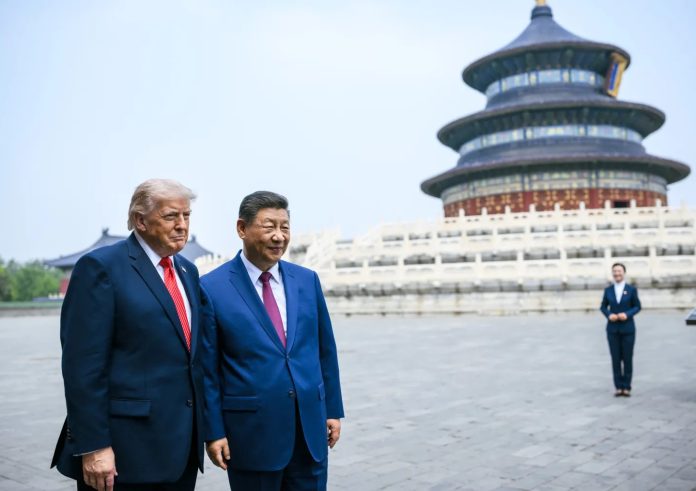
No one should be surprised that U.S. President Donald Trump’s China visit on May 13-15 had a heavy focus on ceremony and symbolic messaging, as many of his trips do. But even for this messaging-focused president, the concrete policy outcomes, which diplomats and policy-makers call “deliverables,” and Trump calls “deals,” were seen as modest. This trip was essentially a highly choreographed prestige event, which for the leaders involved, met their minimum requirements.
Strategic use of spectacle
China’s President Xi-Jinping clearly mastered the strategic use of spectacle for the Trump visit and channeled it to emphasize Chinese institutional continuity, even though not a democratic system, compared with ongoing U.S. political volatility. Projecting China as a stable great power that is increasingly equal or possibly superior to the United States in prestige and patience was another great success of the visit, yielding many to conclude that China is now indispensable to global order. Fortunately for the many, the global order Beijing prefers will require China to focus on keeping global trade routes open and, possibly in the future, ending ongoing armed conflicts.
In terms of China’s “personal diplomacy” toward the U.S. President, the ceremony and spectacle fielded by the Chinese hosts was designed to tap into Trump’s known preferences for symbolic respect, grandeur, elite treatment, and to reinforce his sense of historical stature. Hopefully, this will encourage a less confrontational U.S. stance toward China and clearly from his remarks on Air Force One after departing Beijing, this has had a visible impact in that direction, however temporary.
Was the China trip much more than a “nothing burger?”
Anyone hoping the May 2026 China trip, Trump’s second state visit, would produce major agreements, or facilitate structural breakthroughs, was disappointed. The most concrete geopolitical outcome was a mutual decision to reduce immediate escalation, preserve high-level communications, and continue negotiations when Xi is expected to visit the U.S. later in 2026.
Xi promoted what Chinese officials refer to as “constructive strategic stability,” essentially a managed framework for rivalry rather than actual reconciliation. Xi’s carefully scripted remarks appear to signal that Beijing still sees mutual economic dependence as the safest path forward despite years of escalating tensions. He noted that China and the U.S. “both stand to gain from cooperation and lose from confrontation,” while urging both nations to become “partners, not rivals.”
In a nutshell, while both countries increasingly view each other as strategic competitors, they simultaneously remain economically intertwined in ways that are extremely difficult to unravel.
Trade issues linger
In contrast to the pomp and spectacle of the visit and the Trump administration’s own narrative as well as the large top-level CEO contingent traveling with the U.S. President, few commercial agreements appeared finalized or legally binding on Trump’s departure and markets reacted cautiously to the China trip because details were vague and the scope modest.
Prior to the visit, there had been talk of new Chinese purchases of U.S. agricultural products — particularly important for the U.S. heartland in an election year — and possible additional Boeing sales of 200 aircraft. And that’s all Trump’s team could say on his departure, Friday May 15, for Washington, setting up a tough weekend of “What did you bring us from China?” reports.
Then, late on Sunday May 17, the White House felt confident enough to issue the so far “missing in action” Fact Sheet listing the China trip’s achievements. In addition to the aforementioned 200 Boeings, China is re-opening its markets to U.S. beef and poultry exports and will make purchases of $17 billion per year of U.S. agricultural products (mostly soybeans) though 2028. It also declared that both presidents had agreed to charter two new institutions to optimize the bilateral economic relationship: the U.S.-China Board of Trade and the U.S.-China Board of Investment, both apparently new fora for high-level government management of bilateral economic ties. It will indeed be interesting to see who the White House names to act for U.S. industry.
Even so, the bottom line is that there were far fewer deliverables than Trump secured in his 2017 visit, and markets as well as pundits have taken note. Some last-minute efforts were apparently made to chart the bilateral economic discussions at a high level, as U.S. Treasury Secretary Scott Bessent and Chinese Vice Premier He Lifeng met on May 13 in Incheon, South Korea to lay final groundwork on the specific economic proposals for the Trump-Xi meetings.
In the Beijing talks, China reportedly requested a longer extension of the one-year trade truce than the Trump administration was willing to give, now set to expire in October. China also wanted reassurances over pending U.S. industry investigations, conducted under different and time-tested American trade laws, which are likely to revive some tariffs on goods entering the U.S. that were struck down by the Supreme Court this spring after Trump’s “Liberation Day” April 2025 tariff announcements kicked off global economic disruption. Apparently both sides noted that some commercial deals and agreements could be saved for the fall, when Xi is expected at the White House.
Trump-Xi meetings leave geopolitical issues open
Taiwan remains the clearest unresolved strategic issue, but neither side held expectations for major progress from the Beijing talks on this enduring impasse. Xi reportedly warned Trump that mishandling Taiwan could endanger bilateral relations. Chinese statements emphasized the Taiwan issue heavily, while U.S. readouts largely avoided it whenever possible.
For his part, Trump took care to avoid strong public commitments regarding military defense of Taiwan, new arms sales (one is pending), or tougher deterrence language. That restraint was widely noticed by analysts, but it is not clear whether this reflects a new diplomatic tack by Washington or possibly the perilously low level of some U.S munitions stocks following the war with Iran, of which potential U.S. adversaries are well aware.
On the subject of Iran, there was little reported progress announced through official channels and certainly nothing to justify the weeks of media speculation before the Trump visit, where the focus had been on the impact of the U.S. Iran blockade and tough new U.S. sanctions on China’s energy supplies.
While it is understood that China remains highly interested in reopening the Strait of Hormuz for commercial reasons as well as its own diplomatic prestige, Trump was looking for solid success stories out of his trip. He then claimed two in an interview with Fox News aired during the trip. He said he was assured by President Xi that China wanted to help if possible to end the Hormuz closure, and also promised there would be no Chinese weapons sold to Iran. Before heading to Beijing, Trump had been quoted as saying the U.S. did not need China’s assistance to resolve the conflict.
After 48 hours back in Washington, President Trump began issuing new threats regarding the possibility of resumed U.S. attacks on Iran if a deal was not reached quickly.