
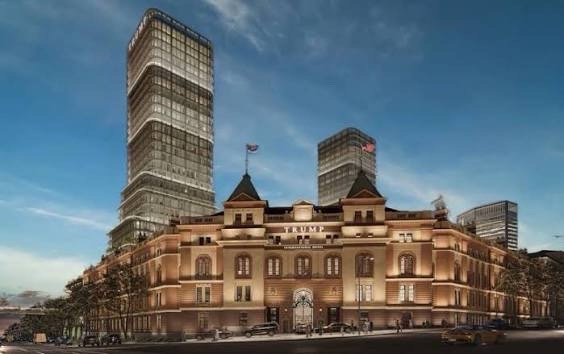

In December 2025, Affinity Partners, the investment vehicle run by Jared Kushner (U.S. President Trump’s son-in-law and sometimes Special Envoy), announced it was pulling out of the Belgrade Centrum development scheme. The project had envisioned a major complex of hotels and shopping centers in downtown Belgrade.
The firm justified its decision by emphasizing that such a major investment should bring people together rather than create division, and that it was withdrawing as a sign of respect for the people of Serbia and Belgrade.
Continuous protests broke out in Belgrade from March 2025 onward. Demonstrators were driven by city heritage concerns but also by nationalist feelings, as the development was planned on the ruins of the Yugoslav Army’s General Staff building, destroyed by NATO in 1999. Former soldiers and nationalists — groups that rarely challenge the Vučić government — rallied under the slogan “We won’t give the Americans for a penny today the land they destroyed yesterday.”
Corruption concerns and irregular handling of state property formed another major complaint, reminiscent of the earlier “Belgrade Waterfront” project launched almost a decade before.
Legal and anti-corruption scrutiny
Serbia’s Anti-Corruption Prosecution launched an investigation into the rapid, tailor-made legal amendments designed to enable the project. Many of these changes were found to be abusive and partly unconstitutional. Several public officials were arrested, and Minister of Culture Nikola Selaković was formally charged. This was the decisive moment: the following day, Affinity Partners announced its complete withdrawal.
The Albanian case in Zvërnec
A problematic legal framework is a key issue for many. Over the past few years, the administration of Prime Minister Edi Rama has altered legislation on protected natural areas, weakening protections and falling short of both international environmental norms and EU standards. The government has also extended the strategic investor law multiple times, even though it was supposed to end in 2018. These modifications have been repeatedly criticized by opposition parties, independent experts, and are consistently highlighted as issues in European Commission and European Parliament reports on Albania. The coastal Zvërnec project, near a lagoon, is built squarely on this shaky legal foundation.
Questionable land ownership
While the Belgrade project involved state land, Zvërnec involves private owners with highly problematic backgrounds. The list includes a notorious figure known for orchestrating large-scale land seizures through manipulations involving land registries, notaries, and courts. His lawyer, who was sentenced to ten years in prison for forging documents on this very property to benefit his client, is also connected to the deal. Another key name is a former appeals court judge (later dismissed during vetting) who had initially acquitted the lawyer — a ruling overturned by the Supreme Court with orders for retrial. Additional individuals with ongoing or prior criminal records are part of the ownership group.
The situation is further complicated by the presence of new post-Communist title holders and claimants with historical property rights. Such red flags would normally scare away any serious international investor due to both financial risks and inevitable reputational harm. If the Special Structure against Corruption and Organized Crime (SPAK) investigation — which started verification procedures last year — validates the findings of investigative journalism, Affinity Partners, and other international participants like the Qatari Kayyat Investments would likely distance themselves with a statement mirroring the one issued in Belgrade.
Prime Minister Rama insists these are purely private agreements. Yet given the high profile of Kushner and his partners, and Rama’s personal meetings with them despite clear awareness of the ownership irregularities, he shares significant responsibility for involving them in this legally and morally compromised situation. As a matter of fact, there is no representative of the Trump administration he will not meet with, whether U.S. based or even ambassadors operating elsewhere in Europe.
Ongoing protests
For the past several days, sizable crowds — mostly young people — have been protesting on the boulevard outside the Prime Minister’s Office. Their demands include the government’s resignation, repeal of the controversial amendments to natural protection and strategic investor laws, and the suspension of the Zvërnec project. The protests lack formal leadership, display a mix of ideologies and tactics, and have featured some immature or provocative messages. Still, the fundamental grievance driving people onto the streets is valid. The parliamentary opposition is providing measured support without compromising the civic nature of the movement.
International coverage and political context
The Zvërnec project and associated protests have drawn heavy attention from European and U.S. media outlets as well as social media platforms. Environmental concerns contribute to the interest, but the dominant factor is mainstream media’s animosity to President Trump. Rama’s attempts to control the story have not succeeded, as illustrated by his tense and poorly received CNN interview.
Kushner and Ivanka Trump’s involvement in a flawed Albanian venture offers critics an easy line of attack against Trump — particularly with congressional mid-term elections on the horizon. Democratic members of Congress are reportedly already preparing investigative moves targeting the Trump family and, in this context, claims of influence peddling or even overseas grifting by Trump family members are certain to be heard loudly.
It is clear that Albania and the Zvërnec project are being used as tools in broader American political debates. A comparable dynamic played out in Italy, where the left-of-center opposition which was supportive of PM Rama turned critical of him after his migrant camps deal with Prime Minister Giorgia Meloni, leading to renewed scrutiny and reports on alleged narcotics links by left leaning Italian media.
Regardless of these external agendas, the increased spotlight is ultimately helpful for Albania: it reveals long-hidden problems previously shielded by propaganda, disinterest, and negligence.