
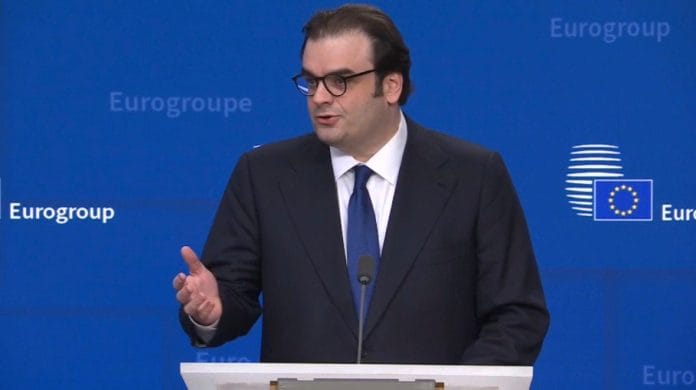
Kyriakos Pierrakakis, Minister of Economy and Finance of Greece, was elected President of the Eurogroup on December 11 in line with Protocol 14 of the EU treaties, vowing to focus on Europe’s common currency, common economic interests and the European project, grounded in the core values of the European Union.
The new President took office as of December 12 and will serve a two-and-a-half-year term. The first Eurogroup meeting under Kyriakos Pierrakakis’ presidency is currently planned for January 19, 2026, the European Council said in a statement.
“Ιn the years ahead, my aim will be to keep the Eurogroup a body of unity and shared purpose. Focusing on our common currency, our common economic interests and the European project, grounded in the core values of the Union. And if I may add, if there are two lessons, as I mentioned before in the meeting with my colleagues, that became more vivid to me in those last weeks and throughout my participation at the Eurogroup this year,” Pierrakakis said in a statement.
“The first one would be that the old distinctions which existed in Europe and within which generations of Europeans grew – the distinctions between the North and the South, the East and the West, the so-called ‘frugals’ and the so-called ‘spenders,’ seem to have subsided. This is because the challenges that we face are more or less common,” the new Eurogroup President added.
“There are common defense challenges stemming from Russia’s invasion to Ukraine, we have common technological innovation challenges, common macroeconomic imbalances, which we need to tackle. And in this regard, the policies that we will advance should be common as well. The second point touches upon exactly this: the Draghi report, the Letta report, the policies advanced by the European Commission are there. We know what we need to do, but our strategy should become a synonym of delivery,” Pierrakakis said, stressing that the EU needs more cooperation, more collaboration, and an acute focus on creating results with nimbleness and speed. “And this is what I will plan to focus on while delivering on the agendas of the Savings and Investments Union, the single market, the digital euro and strengthening of the fiscal foundations of the Eurozone while achieving growth at the same time,” he said.
From the financial crisis to becoming a European recovery story
In 2015, there was real concern about Greece falling out of the Euro zone with knock on implications for the trans-Atlantic economic relationship. “It was, I think, 10 years ago, that the debate here in Brussels was about whether or not Greece would be exiting the Eurozone. And yet, Greece withstood. And this is a testament I would say of many things. It’s a testament of the collective strength of our people. It is a testament of the European solidarity and help at the direst of times,” Pierrakakis said.
“It is the testament of the reform mindset of (Greek Prime Minister) Kyriakos Mitsotakis’ government to deliver reform and change. And it is also a testament of a collective understanding of a generation to fully metabolize both the risks of complacency and the opportunities of reform. And I’m saying this because this lesson I would say is not purely national, it is fundamentally European,” he added.
In his concluding remarks, Pierrakakis vowed to approach this responsibility with humility and determination, committed to working with all member states to deliver meaningful results for our citizens and to reinforce the foundations of a strong and confident Europe which is both future-ready and future-proof.
Pierrakakis, although not a formally trained economist by any definition of the term, has strong expertise in public policy, the development and government application of new digital platforms, and Masters degrees from both MIT (Technology and Policy) and Harvard (Public Policy and Governance) in the United States. He is relatively young (42) and sometimes mentioned in Greece as a potential successor to the current Prime Minister, bringing knowledge of computer technology and its application to government in place of a deep understanding of finance and banking that most Finance Ministers embody.
In his previous appointment as Minister for Digital Governance, he implemented multiple new government digital platforms, widely considered successful initiatives, but he did not visibly reduce the number of applications and required government documents, simply making them accessible to the public online. To some this approach has diluted his reform track record, as the technology he utilized would have made it possible to physically reduce the number of government departments and save money, as was done elsewhere.
The Eurogroup is an informal body where ministers from euro area member states discuss matters of common concern in relation to sharing the euro as the single currency. Its main task is to ensure close coordination of economic policies among the euro area member states. It also aims to promote conditions for stronger economic growth and is responsible for preparing the Euro Summit meetings and for their follow-up. It usually meets once a month, on the eve of the Economic and Financial Affairs Council meeting.