


As the Arctic region is becoming a key geopolitical hotspot, the European Union needs to strengthen cooperation with its NATO allies to contain Russian and Chinese influence and increase Europe’s security.
In a resolution adopted on November 26 in Strasbourg – by 510 votes in favor and 75 against, with 80 abstentions – Members of the European Parliament condemned the growing militarization of the Arctic, warning that Russia’s extensive military restructuring, including the establishment of its “Maritime Collegium” and China’s clear interest in the region, have escalated regional tensions and undermined regional stability.
“EU-U.S. cooperation in the area is fundamental to contain Russia and China and ensure our common security,” the European Parliament said in a press release.
“In recent years, we have experienced significant turbulence in world politics,” said Rapporteur Urmas Paet from Estonia. “This is having a clear effect on the Arctic region. The EU needs a smart strategy to face the Arctic’s growing geopolitical importance, and, among other efforts, I hope to see Iceland, Norway and Greenland joining the EU in the near future,” he added.
Protection of essential underwater infrastructure
In the light of recent incidents in the Baltic Sea attributed to Russia’s shadow fleet and Chinese vessels, the European Parliament said the EU should substantially improve its protection of essential underwater infrastructure in the Arctic, particularly submarine cables and pipelines, including those in the proximity of Greenland, and tighten the regulatory framework for sanctions and countermeasures.
The European Parliament said the legal framework for Arctic governance must remain anchored in the United Nations Convention on the Law of the Sea (UNCLOS). Pointing to increased geopolitical competition along Arctic maritime routes, particularly the Northern Sea Route, MEPs rejected unilateral territorial or navigational claims and support diplomatic dialogue. They also defended the application of international law to counter attempts to legitimize contested shipping corridors or project geopolitical influence under pretexts of scientific or economic cooperation.
On November 13, NATO Deputy Secretary General Radmila Shekerinska and Finnish Minister of Defense Antti Häkkänen joined by the Ministers of Defense from Norway, Denmark and the Minister of Foreign Affairs from Iceland discussed the strategic relevance of the Arctic region for trade, transport and communications between North America and Europe, and the challenges to Arctic security, including climate change, rising global competition in the region, and Russia’s increased military presence, NATO said in a press release.
They further explored how space-based solutions, including commercial ones, can help enhance NATO’s surveillance capacity and its broader deterrence and defense.
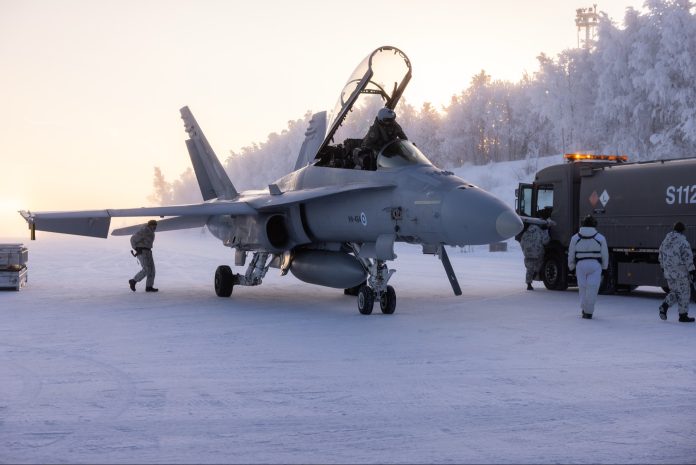
Finland has territory in the Arctic, which includes the Lapland region, making up nearly one-third of the country.
Provider of critical resources for Europe’s strategic autonomy
As the region provides critical resources for Europe’s strategic autonomy, strengthening partnerships in this domain is key to reducing reliance on external authoritarian powers, the European Parliament said.
The Arctic’s strength is key to Europe’s strategic independence.
Europe must be more invested in the region and partner with like-minded nations for a sustainable, and peaceful future for the Arctic. pic.twitter.com/e9QVioxDtQ
— European Commission (@EU_Commission) November 1, 2025
The adopted resolution stressed Norway’s crucial role in EU energy security and geopolitical resilience, as well as growing support for EU accession in Iceland and Greenland. In this context, the EU should engage in deeper strategic and economic partnerships with those partners and to promote the benefits of potential EU membership, if and when that is desired by their populations.
Impact of climate change
Given the disproportionate impact of climate change on the Arctic, MEPs called for the urgent improvement of adaptation strategies, which also have a security policy dimension. They stressed that Arctic indigenous peoples must be fully involved in decision-making processes.
At the 77th Nordic Council Summit in Stockholm on October 27, European Commission President Ursula von der Leyen said global warming brings new and dangerous risks to the Arctic. “But it also brings new responsibilities, and new opportunities. Take critical raw materials. Greenland alone holds 25 of the 34 critical materials that Europe needs – a treasure locked beneath ice and rock. Finland is already a world leader in producing and refining cobalt,” she said in her speech.
As the ice retreats, the Arctic is moving ever closer to the center of global geopolitics, Von der Leyen said, adding that Europe must be more proactive and more invested in the Arctic. “That is why we are reviewing our Arctic Policy to address new geopolitical threats. We want to strengthen our cooperation in Arctic nations and regions – from renewable energy to Earth observation, from innovation to connectivity,” she said, adding, “We want to build more digital infrastructure to connect communities. All of this, in close partnership with the local and indigenous populations. Because their knowledge and stewardship are invaluable.”