
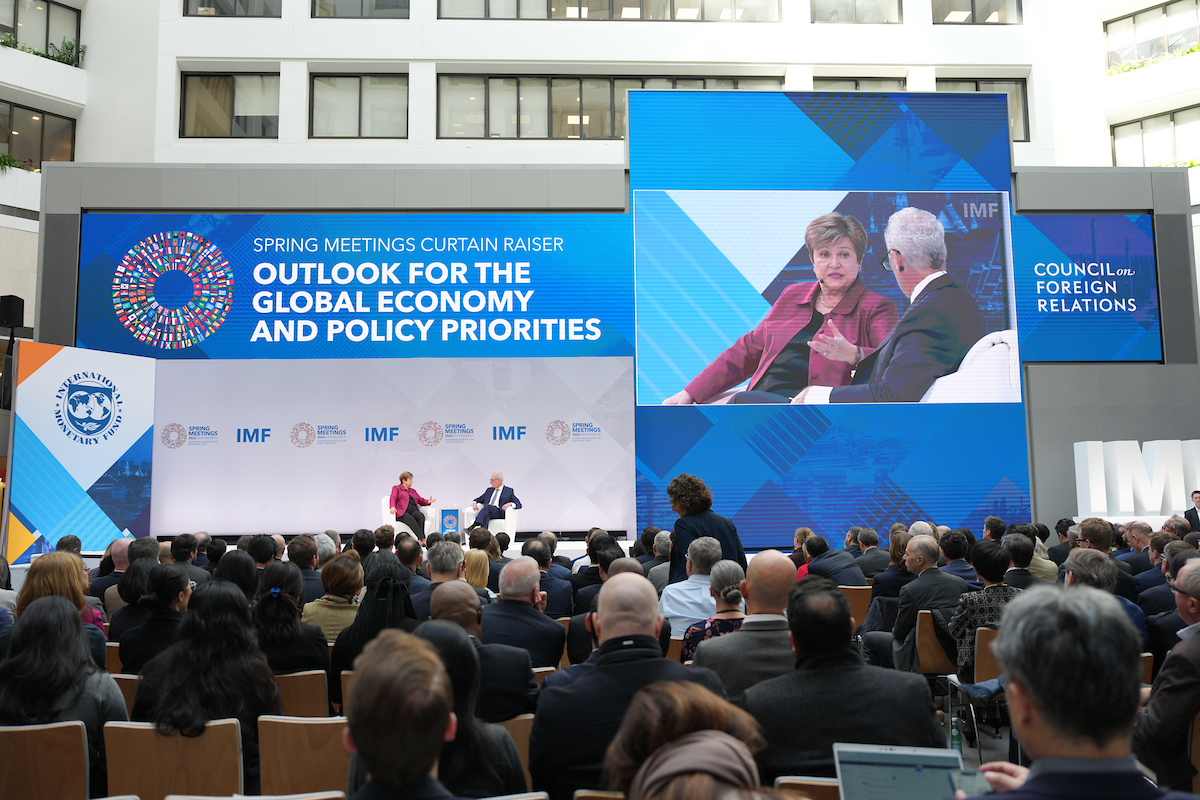
It should surprise no one that the International Monetary Fund (IMF) – World Bank Spring meetings in Washington D.C. on April 13–18 were overshadowed by the Middle East war, now uniformly viewed as the primary downside risk to the global economy. And most readers have undoubtedly tired of the daily raft of “experts” in the media telling us, “It all depends on how long the Strait of Hormuz remains closed,” with some going on to emphasize the need for an immediate restoration of oil/gas/fertilizer production and others focusing on U.S. mid-term elections in November.
Repeated crises (COVID, the Ukraine-Russia war, U.S. President Donald Trump’s trade tensions and now the Iran war) are creating a sense of permanent instability or “crisis fatigue” in the global financial system and, unfortunately, it has become completely unrealistic for anyone to approach these annual Spring Finance Minister-level meetings with a sense of optimism, beyond hoping for some form of “soft landing” as a best-case projection.
Due to the Iran war, the IMF’s narrative has shifted from a “resilient global economy” in January 2026 to a “shock-fragile system” approach in its big week of Washington meetings and side conferences. Although most media attention in Washington focused on the downside scenarios, this disturbing trajectory is not yet locked in. At the point in time when the Spring meetings started (mid-April) the global economic outlook was described as fleetingly positive but extremely fragile — essentially just one shock away from a sharp slowdown. But with each passing day of skirmishing, while talking about negotiations regarding the still-closed Strait of Hormuz, the potential for a positive outcome is shrinking.
Too early for solid economic data
For the spring meetings, the IMF released its latest projections for the global economy, emphasizing that the sky had not yet started falling. The baseline outlook for 2026 overall global growth was revised downward to 3.1 percent from the 3.3 percent projected in January. Overall projected inflation would rise to about 4.4 percent on a global level. In the worst-case energy shock scenario, following an extended Middle East war, global inflation could soar to around 6.0 percent. If the war continues, the IMF forecasts global growth dropping to 2.5 percent under prolonged disruption, and this could potentially slow to 2.0 percent in severe/extended war scenarios.
It should be noted that certain above-mentioned “experts” in the media and even some academic economists have taken issue with the IMF’s forecasting methodology which they believe substantially understates the potential downside economic risks.
For a few of them, the sky is already falling while others claim third world food riots are about to begin as reserves dwindle in some countries. Regarding energy, the refrain commonly repeated is that there has to be enough “demand destruction” to bring consumption down to match the reduced supply, however it occurs.
In terms of key regions, for the U.S., the IMF is now projecting 2.3 percent growth (a slight reduction) for 2026, with the Eurozone coming in at 1.1 percent due to its larger exposure to imported energy.
China has been the largest marginal buyer of Middle East oil and is highly dependent on the Strait of Hormuz, requiring maritime trade stability. For China, the IMF predicts growth will slow modestly (still around 4.0 – 5.0 percent, but under pressure) and industrial costs will rise due to higher energy import costs. In addition, China’s export sector is being hit by weaker global demand. The IMF sees room for monetary easing and state-led stimulus, but Beijing’s maneuver room is still restricted by long standing structural constraints.
The Global South faces different sets of challenges
For the Global South, the IMF produced the largest downward revisions, especially for major energy importers, but the group is too big to put into one large basket. The energy importing countries (such as India, Pakistan, Egypt and Kenya) are facing an energy price spike with immediate impacts on inflation, trade balances, and currency stability, triggering some capital flight. This group is top priority for World Bank support programs but there is growing concern that insufficient resources exist to manage the crisis, a growing specter said to have overshadowed the Spring meetings.
On the other hand, commodity exporters like Nigeria, Angola, Brazil and Indonesia will enjoy revenue windfalls and will likely follow previous “Boom-bust” cycles. (Russia actually fits best here and will continue to profit from high energy prices despite sanctions.)
Middle-income emerging powers such as Mexico, South Africa and Turkiye are more integrated into global financial markets. While not in crisis at this point, they will face currency depreciation pressures triggering higher interest rates in order to defend their national currencies and overall slower growth due to tighter financial conditions.
The most important warning signals were issued for the highly indebted and so-called fragile states such as Zambia, Sri Lanka and Ghana which are already in or near distress. As a result of the war, these countries are now being hit with higher import costs, rising borrowing costs and a stronger U.S. dollar. In this group of countries, the IMF sees the highest probability of systemic crises spreading such as sovereign defaults and/or widespread social instability, resulting in the need for more IMF emergency programs.
Alarm over rising food prices
A major theme at the World Bank side in Washington was how the energy shock was generating higher fertilizer and transport costs. These factors would inevitably lead to rising food prices in many countries and increased hunger risks in low-income countries. The most exposed regions to these shocks are Sub-Saharan Africa and parts of South Asia. Although not widely visible yet in terms of protests and strikes, this is already prompting a second-order humanitarian crisis, not just simple macroeconomic stress.
The IMF’s underlying message for the global audience was that the Iran war is not just a regional conflict — it is a system-wide energy and financial shock whose impact depends less on geography than on each country’s energy dependence, policy space, and financial integration.