

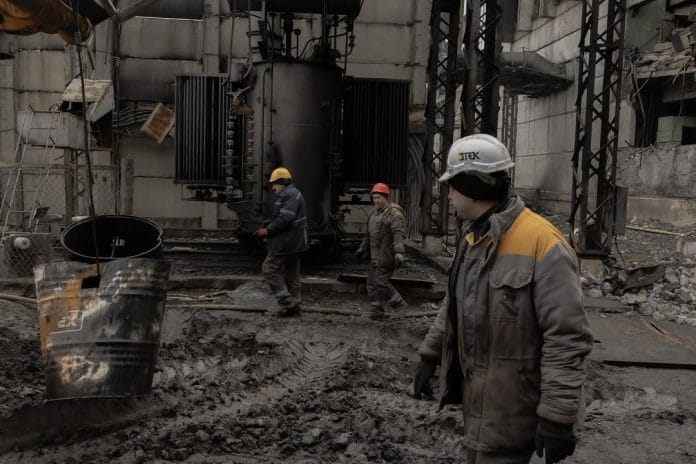

The reconstruction of Ukraine’s energy infrastructure constitutes one of the most consequential geopolitical and economic undertakings of our era. It is not merely a recovery effort, but a strategic inflection point with profound regional and transatlantic implications. The large-scale destruction of Ukraine’s energy network, combined with the imperative to transition toward a more resilient and decentralized system, has created a historic opportunity: to help shape Europe’s future energy architecture around security, innovation, and strategic autonomy.
For the United States and Greece — partners whose cooperation across energy security, defense, infrastructure development, and critical technologies has intensified markedly in recent years — Ukraine’s energy reconstruction provides a unique platform to advance shared geopolitical objectives while mobilizing complementary private-sector capabilities. This effort is inseparable from the development of the Vertical Corridor, which is emerging as a defining framework for energy, infrastructure, and strategic connectivity from the Eastern Mediterranean through Southeastern Europe to Ukraine and beyond.
Within this context, the recent trilateral agreement among Greece, Ukraine, and the United States for the supply of U.S. LNG is particularly consequential. It positions Greece as a key gateway for the region’s LNG imports, storage, and regasification, directly strengthening Ukraine’s energy security, reinforcing Greece’s leading role as a regional energy hub, and highlighting the strategic value of the U.S. – Greece partnership at a time of heightened geopolitical volatility. More broadly, the agreement anchors Ukraine more firmly within the Vertical Corridor, enhancing northbound energy flows and reducing structural dependence on hostile or unreliable sources.
The Vertical Corridor itself represents far more than a set of physical energy assets. It is a strategic axis that integrates LNG terminals, pipelines, electricity interconnections, storage facilities, and digital infrastructure across Greece, Bulgaria, Romania, Moldova, and Ukraine. By enabling bi-directional flows of gas, electricity, and data, the corridor strengthens regional resilience, enhances market integration, and provides a scalable platform for future hydrogen and clean-energy transport. For transatlantic partners, it offers a concrete mechanism for translating strategic alignment into durable infrastructure outcomes.
Ukraine is simultaneously moving toward an energy model centered on distributed generation, renewable resources, flexible production, and advanced digital infrastructure. Its pre-war trajectory — marked by an increase in renewables from 3 percent to 12.4 percent of the energy mix within a decade and significant growth in wind and solar capacity — underscores the country’s substantial, still underutilized potential. When integrated into the Vertical Corridor, Ukraine’s decentralized energy assets can contribute not only to national resilience but also to broader regional stability. Smaller, geographically dispersed production units, combined with storage solutions and smart-grid technologies, significantly reduce vulnerability to both kinetic and cyber threats while enhancing interoperability with European systems.
For U.S. companies engaged in Ukraine’s energy reconstruction, Greek industrial and energy groups represent a natural and highly reliable regional partner. Greece’s geographic position at the southern entry point of the Vertical Corridor, its deep familiarity with the EU regulatory framework, its expertise in renewables and grid modernization, and the rapid digital transformation of its corporate sector together create a strong foundation for collaboration. Just as importantly, Greece provides institutional stability and a continuously strengthening strategic relationship with the United States — key enablers for complex bilateral and trilateral investment initiatives spanning multiple jurisdictions.
The significance of this cooperation extends well beyond economics; it is fundamentally geopolitical. Greece has emerged as the most dependable anchor in Southeastern Europe, offering a secure, Western-aligned platform for projecting stability northward through the Balkans to the Black Sea region. The Vertical Corridor operationalizes this role by creating a secure North–South spine for energy and infrastructure, counterbalancing malign influence and fragmentation. For Washington, the presence of a capable Greek ecosystem able to support sophisticated energy, infrastructure, and technology projects along this axis constitutes a strategic advantage — lowering risk, accelerating deployment, and reinforcing collective security.
Moreover, Ukraine’s reconstruction broadens the scope of cooperation beyond energy alone. The development of smart infrastructure, cybersecurity for critical networks, advanced data-management systems, data centers, and the application of artificial intelligence in energy and industrial operations all align naturally with the Vertical Corridor’s logic. These capabilities transform the corridor into a digital and technological backbone as well as an energy one, creating new opportunities for Greek companies to serve as strategic intermediaries and partners for U.S. firms operating across the region.
As the war enters its fourth year, support for Ukraine is not only a moral imperative but a defining test of transatlantic cohesion. Ukraine’s energy resilience is inseparable from Europe’s security, and the Vertical Corridor is emerging as one of the most effective instruments for translating that resilience into lasting regional strength. Through its strategic partnership with the United States, its pivotal geographic position, and its increasingly dynamic business ecosystem, Greece is uniquely positioned to play a decisive role — as a bridge, an accelerator, and a hub for a new model of cooperation that will shape Europe’s security and energy landscape for decades to come.