

The European Union needs to avoid “new dependencies” as it plans to phase out Russian energy supplies and meet its green transition goals, Cyprus Energy Minister George Papanastasiou told NE Global, stressing the need for balanced approaches to climate targets that do not compromise economic competitiveness.
In an interview on the sidelines of the FT Energy Transition Summit in Athens on June 17, the same day the European Commission put forward a proposal to phase out Russian gas and oil by the end of 2027, Papanastasiou said, Cyprus has a role to play because it is strategically located. “It can be a country that interconnects regions. Interconnecting regions meaning production of hydrogen in the Middle East, it could be electricity production again in the Middle East,” he said, adding that Cyprus’ location in the middle of the Mediterranean makes it a strategic point for laying electricity cables.
“Nowadays the consumption of electricity is not where the production is and it needs to be transported somehow and the way to do it is via cables which they’re of specific technology. But long distances have challenges and certainly Cyprus can be the first point in a cable coming from the Middle East. There are many countries which are candidates to produce renewable energy: Saudi Arabia is one, Egypt is another one so getting Europe to be independent – I’m not talking about just the Russian natural gas – any dependency of Europe in anything will create challenges going forward. It so happens that the Russian natural gas is one of the dependencies and going forward I believe Europe needs to be careful not to have other dependencies on different kinds in supporting the green transition,” Papanastasiou said. “I have in mind these (rare) metals, storage, meaning batteries, materials which produce PVs so all these need to be taken care ahead of having some another dependency somewhere else. Cyprus always had a role as a contributor,” he added.
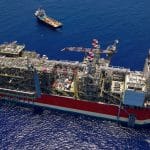
“We have natural gas in our exclusive economic zone (EEZ). I believe it may not be huge discoveries, but they are good discoveries. We are talking so far close to 17 billion cubic feet (Tcf),” Papanastasiou said, adding that the market of Cyprus does not need all this gas for conventional power generation. “Certainly, this gas can be made available for whatever is needed in Europe. Still Europe has by far higher consumption than what we have in our Exclusive Economic Zone and there are nearby countries that are interested to buy the gas,” he said.
On July 7, a Cypriot government spokesperson said a ExxonMobil-led consortium has found a reservoir of natural gas at a prospect off the Mediterranean island’s coast. Another U.S. energy giant, Chevron, is currently working on the 3.5 Tcf Aphrodite gas development in Block 12, while Italy’s ENI is finalizing a development plan for its 3 Tcf Cronos discovery in Block 6.
The Cyprus Energy Minister argued that natural gas is the cleaner of the fossil fuels, stressing that it is needed for the conventional power generation. Given today’s technologies and the penetration of renewables in the grids, you still need the production of electricity coming from convectional sources simply because you need to maintain the inertia in the grids. And yes, natural gas is to survive, and this is my personal belief it will survive for a few years more until the renewable technologies are in a kind of upscale to a degree that they can support what is needed in a grid without the support of conventional power generation,” he told NE Global.

As Cyprus prepares to assume the Presidency of the Council of the European Union in the first half of 2026, for the second time, fourteen years after the first in 2012, the energy minister said that while the EU is actively working to phase out Russian fossil fuel sources, it should avoid creating new dependencies, including the United States and China. “Europe is turning to other sources of supply at this time. Still, these are dependencies. Big contracts have been signed with Qatar and contracts with the U.S. and because of the absence of resources in Europe we understand that these dependencies will be around for many years to come. That’s why it’s important that Europe put on fast-track the development of technology to be able to be independent based on renewables. However, paying for technologies has a cost on the citizens and on the economy of Europe and this is what was mentioned in the Mario Draghi report which we all know by now that we need of think of the competitiveness of Europe as well,” he said.
Putting EU competitiveness ahead of the Green Deal
“I believe that the climate change is what has triggered this transition, I mean the Green Deal. My personal view is that we need to switch it around and put this transition as being beneficial to the European economic model and then number two climate change,” Papanastasiou argued. “Unless you are competitive with your main competitors in technologies, in high tech, this is China, the U.S., then climate change will fall very low on the priority list. You need to have the economies stable and sustainable to be able to explain the climate change,” he added.
Turning to Europe’s efforts to secure its access to critical minerals and reduce reliance on external sources, particularly China, the minister said, “Ukraine was a source and possibly still a source. There is this deal with the U.S., that the rare metals much has been allocated to the U.S. use. Still, there are other metals which they are within Europe, but not enough. China has managed very practically to secure all these rare metals in Brazil, in Africa,” he said, stressing that Europe needs to speed up its decision-making.
“The slow decision-making allows your rivals to be quicker and have the competitive advantage which at the end of the day is your competitiveness, your industry and when economies are not healthy, it impacts the citizens and the citizens cannot pay their bills and it creates civil unrest and discussions and unnecessary conversations, that is why it’s important for Europe to be a quick decision-maker,” Papanastasiou said.
The crisis in the Middle East and East Med energy supplies
“History has shown us that peace in the Middle East is a break between two wars. We need to move forward irrespective of what is happening in the Middle East. I mean we should not stall and stop taking decisions as Europeans because of what’s happening in the Middle East or because this is what is happening between Russia and Ukraine. Europe has the capability and has the mass or the dynamic and strength to be independent. However, we need a plan. Irrespective of what is happening around us, we need to have a plan and implement it very accurately and this plan is if there is a war in the Middle East just put it in your equation and handle it and manage it as part of your decision-making as well,” the Cypriot Energy Minister said.
“My only concern in that region is the instability and the absence of natural gas for the biggest country of the 135 million citizens which is Egypt. They are heavily subsidizing the electricity of their citizens. This is something that may create further instability without a war simply because the citizens of Egypt expect that the price of electricity will be low and stay low,” Papanastasiou said, adding, “With the absence of natural gas to convert it to electricity prices will go up, with the turmoil that’s in the Middle East and we heard earlier today in the panel (June 17) that the pipelines of natural gas from Israel to Egypt has been disrupted for security reasons and this will create a kind of instability in the region,” he said. During the conflict between Iran and Israel, the latter halted exports to Egypt and Jordan for over a week after closing the Leviathan field, operated by Chevron and the Karish field operated by Greece’s Energean. “This is why we keep an eye on what is happening generally in the neighborhood there because the instability can be overnight especially when it comes to 135 million citizens which are on the south of Cyprus,” Papanastasiou said.