

The European Union views Kazakhstan as an important partner in Central Asia linking East and West, advancing interregional connectivity as Brussels and Astana expand their cooperation in strategic areas such as energy, transport, logistics, critical raw materials, climate, water, digitalization, and tourism.
“Kazakhstan is the first Central Asian country that signed the Enhanced Partnership and Cooperation Agreement (EPCA) with the EU; this year, it will be 10 years,” the Head of the Delegation of the European Union to Kazakhstan Ambassador Aleška Simkić told NE Global on October 29 from Almaty. “Already back then we agreed to work on 29 different areas, including connectivity, transport, energy, climate, water, digitalization, critical raw materials, as well as people-to-people contacts and human rights. In the past 10 years, the cooperation has evolved to real partnership, with Global Gateway’s flagship projects in these areas,” the EU ambassador said, a few days after Kazakhstan celebrated its National Day on October 25.
“In addition to concrete projects, such as upgrade of Aktau port infrastructure or water filtration in Shymkent, youth employment activities in the context of project Darya, connecting several hundred schools to the internet or supporting the civil society, we cooperate with Kazakhstan in international organizations; both, the EU and Kazakhstan emphasize the importance of multilateralism and the primacy of the UN Charter,” Simkić said.
She reiterated that the EU welcomes broader regional cooperation and enhanced connectivity among Central Asian states. “Kazakhstan is crucial in this development, also due to its size and geographical position. Three elements of our cooperation with Kazakhstan: connectivity, sustainability and partnership,” she said.
On October 23, Simkić met with Kazakhstan’s Foreign Minister Yermek Kosherbayev to discuss prospects for further development of cooperation between Kazakhstan and the European Union as well as ways to strengthen interregional connectivity within the “Central Asia – EU.”
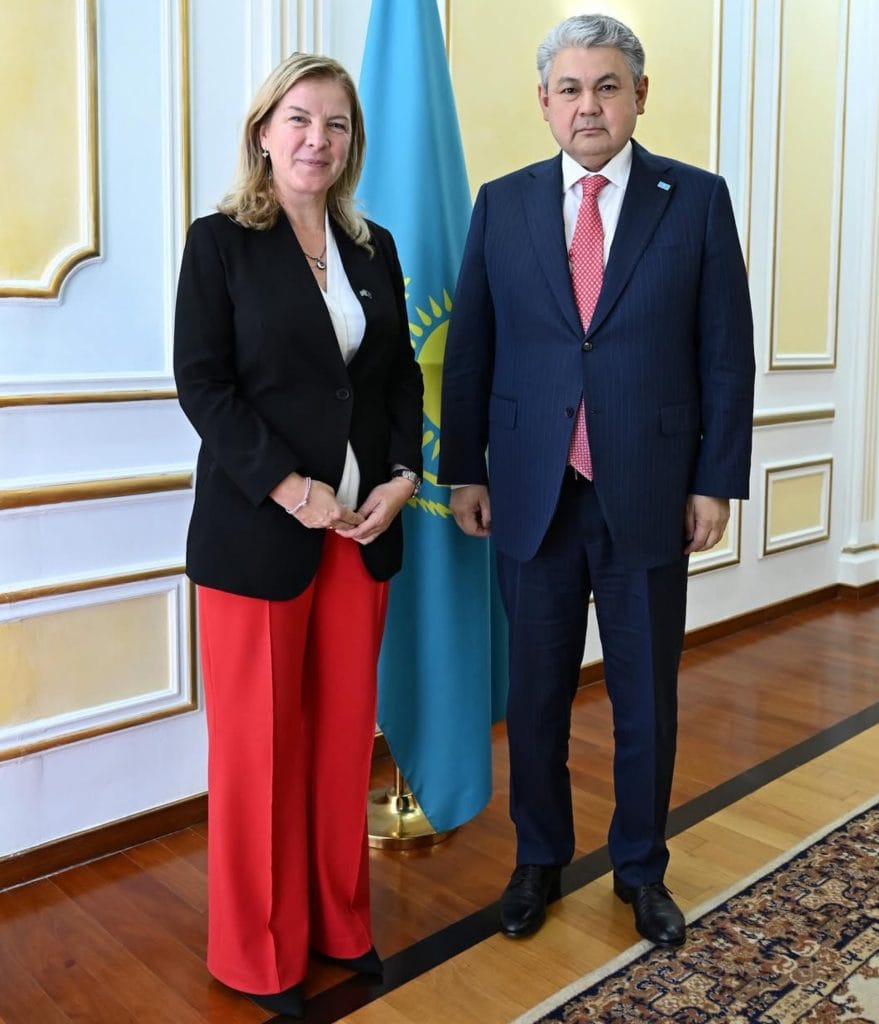
Kosherbayev noted the high level of political dialogue and sustainable dynamics of bilateral engagement emphasizing the importance of consistent implementation of the Enhanced Partnership and Cooperation Agreement between Kazakhstan and the EU signed ten years ago.
Both sides exchanged views on regional and international issues including the development of transport and logistics corridors, the green transition, digitalization, and the improvement of Kazakhstan’s business climate, Kazakhstan’s Foreign Ministry said.
Concluding the meeting, both sides reaffirmed their commitment to deepening mutually beneficial cooperation and to maintaining an active dialogue through upcoming reciprocal visits and joint events, the ministry added.
Expanded EU-Kazakhstan cooperation
“Kazakhstan is a key partner for the EU in the Central Asian region. It has been the first Central Asian country to establish an Enhanced Partnership and Cooperation Agreement, which provides the framework for a closer political dialogue and cooperation,” Anitta Hipper, EU Spokesperson for Foreign Affairs and Security Policy, told NE Global on October 29 from Brussels.
“The EU and Kazakhstan are working together in developing the Trans-Caspian Transport Corridor, to modernize infrastructure, improve logistics efficiency, and strengthen regional economic integration along the Corridor. Kazakhstan plays a strategic role in sustainable trade, transport and digital connectivity, critical raw materials and green transition,” Hipper said.
The EU is Kazakhstan’s largest trade and investment partner, with bilateral trade volumes nearing $50 billion in 2024 and continuing to grow this year.
Kazakhstan is also contributing to Europe’s energy security, supplying 13 percent of the oil and 16 percent of the uranium consumed in EU Member States. Plans are underway to establish exports of green hydrogen from Kazakhstan to Europe.
On critical raw materials, Kazakhstan already supplies rare metals such as titanium, beryllium, tantalum and others to EU countries. The Memorandum of Understanding signed between the EU and Kazakhstan in 2022 on raw materials, batteries, and renewable hydrogen supply chains is now being implemented. The European side intends to support exploration, extraction and processing of rare metals in Kazakhstan.
This year, the European Commission officially included the Sarytogan graphite mining project in the EU list of strategic projects. The granting of this status means that the European Commission has initiated the process of attracting investment for the development of this deposit located in the Karaganda region. According to estimates, total capital expenditures are expected to range from $62 million to $344 million.
Cooperation in the field of transport and logistics is also expanding. The development of transport connectivity between Kazakhstan and the EU is of strategic importance, as Kazakhstan occupies a key geographical position between Europe and Asia. The Trans-Caspian International Transport Route (TITR) also known as the Middle Corridor passes through its territory, becoming an important alternative to traditional routes across Russian territory in Siberia, especially in the context of geopolitical instability. The longest segment of the TITR crosses Kazakhstan, which makes the country a highly strategic transit hub, contributing significantly to the establishment as well as deepening of sustainable Eurasian logistics chains.