The European Union strengthened its cooperation with Kyrgyzstan, Kazakhstan, Uzbekistan, Tajikistan, and Turkmenistan in Brussels in a significant boost to energy and water security in Central Asia.
On October 10 in Brussels as part of the Global Gateway Forum, the EU showcased the impact of the regional green transition and national energy sector reforms, in the context of the Team Europe Initiative on Water, Energy and Climate Change in Central Asia. The participants also discussed the way forward for the two planned Global Gateway projects in the region: the Kambarata-1 and the Rogun hydropower plants.
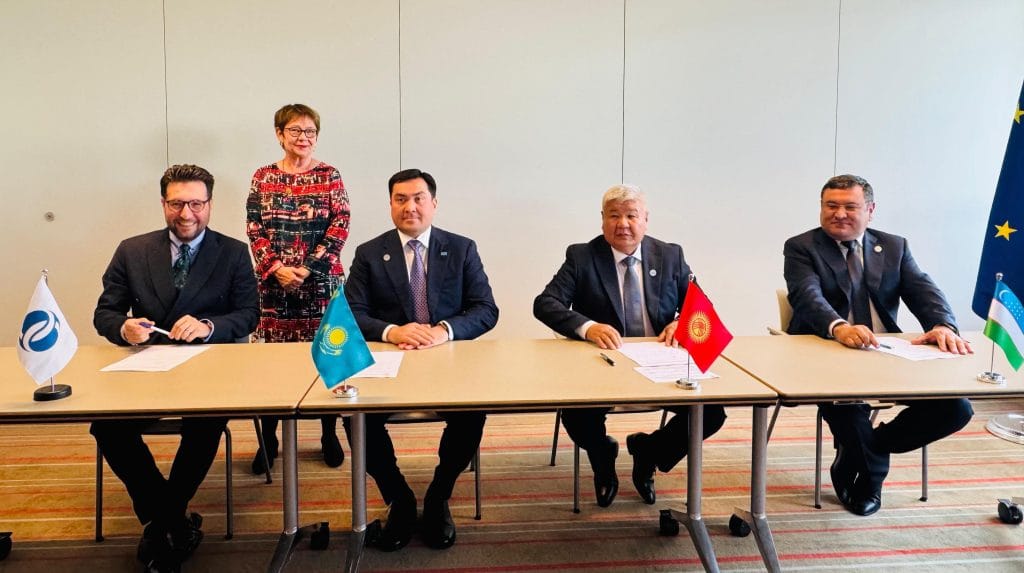
The Kambarata-1 hydropower plant megaproject in Kyrgyzstan marked noticeable progress, with a total of €900 million in Memoranda of Understanding signed between the EU, European Investment Bank (EIB), and Kyrgyzstan, Kazakhstan and Uzbekistan, and an unveiled feasibility study co-funded by the EU and implemented by the World Bank.
The European Bank for Reconstruction and Development (EBRD) also signed Memoranda of Understanding with Kyrgyzstan, Kazakhstan and Uzbekistan and is considering an overall financing package of €1.3 billion in support of the project.
These new investments will further improve electricity access and unlock economic opportunities for the local population, the European Commission and the European Investment Bank said in press releases.
“During my recent mission across Central Asia, I have very well learned the importance of water for the stability of the whole region,” EU International Partnerships Commissioner Jozef Síkela said, adding that smart investments in hydropower plants can improve the access to reliable and affordable electricity, generate income for local people, while supporting sustainable agriculture and protecting people’s health and the environment. “We are proud to support the future construction of the Kambarata-1 hydropower plant that is key to energy production in Central Asia. Our new investments strengthen the strategic partnership between the EU and Central Asian countries,” he added.
Straightening energy security cooperation in Central Asia
EIB Vice-President Kyriacos Kakouris, who oversees the Bank’s operations in Central Asia, explained that enabled by guarantees from the European Commission, the EIB as the climate bank is backing infrastructure that strengthens regional energy cooperation in Central Asia. “We see the potential of the Kambarata-1 hydropower plant project as instrumental in expanding renewable electricity trade in the region, fostering economic development, and enhancing energy security,” Kakouris said, adding that these partnerships underscore the EU’s commitment to deepening its strategic partnership with Central Asia, based on mutual respect and delivering shared benefits for people and the planet.
For her part, EBRD President Odile Renaud-Basso said Kambarata-1 hydropower plant is a flagship regional project for Central Asia, enhancing energy and water security and supporting the expansion of renewable energy. “The EBRD, as a leading investor in all participating countries, is pleased to support regional connectivity and effective water management, with the EU and partners,” she said.
The European Commission said the EU is working together with Central Asia to improve regional coordination on water management. This cooperation also unleashes the region’s hydropower potential, including through the Team Europe Initiative on Water, Energy and Climate Change. It aims to address water and energy challenges, improve regional cooperation, and foster a green and blue transition in Central Asia.
Cooperation is also established through energy-related bilateral Memorandums of Understanding with Kazakhstan, Uzbekistan and Turkmenistan, and regional projects such as Sustainable Energy Connectivity in Central Asia (SECCA).
Furthermore, all five Central Asian countries have joined the EU-U.S.-led Global Methane Pledge to reduce methane emissions worldwide by at least 30 percent by 2030.
In addition, Kyrgyzstan, Tajikistan and Uzbekistan also joined the EU-UAE-led Global Pledge on renewables and energy efficiency to triple renewable energy capacity and double energy efficiency gains worldwide by 2030 that was launched at the UN Climate Change Conference in Dubai (COP28).
The Kambarata-1 hydropower plant
This transformative energy megaproject is under preparation on the Naryn River in Kyrgyzstan. It will be the largest hydropower facility in the country and one of the most important in Central Asia. Once completed, it could significantly enhance Kyrgyzstan’s energy security, foster regional cooperation, and contribute to the region’s economic development, the EU Commission said.
As a greenfield project, it has already garnered the interest by international donors, including the EU, the European Investment Bank, the European Bank for Reconstruction and Development, and the Italian development bank Cassa Depositi e Prestiti. The first turbine unit is expected online in 2028 while full operation anticipated around 2030–2032.
The Rogun hydropower plant
This clean energy megaproject – the highest dam in the world – is key for Tajikistan and the entire Central Asia region. It could double the country’s energy production by 2032, address domestic shortages, advance the region’s decarbonisation, and allow for regional electricity export. Led by the World Bank, the EU and several donors are building together a sustainable foundation for this project. Several European companies are also actively participating in the project.
In her keynote speech at the Global Gateway Forum, European Commission President Ursula von der Leyen said the EU is adapting to the realities of this new economy. “We are trying to strengthen our autonomy in strategic sectors – from clean energy to artificial intelligence,” she said, adding, “We want to work with you to focus Global Gateway even more on key value chains – energy, clean tech, digital, critical minerals, transport, food and health. In all these fields, our goal is to combine our strengths. To build up resilient value chains together. With local infrastructure, but also local jobs, local skills, and local industries.”