

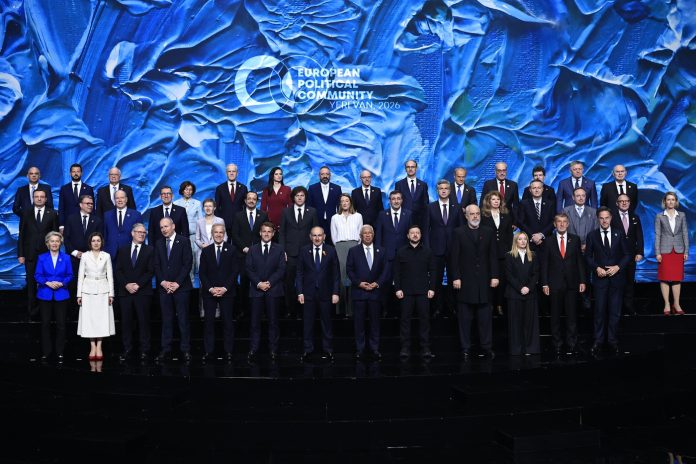

At a time of profound geopolitical transformation, the eighth summit of the European Political Community (EPC) on May 4 brought together leaders from across the continent and beyond in Yerevan, Armenia, to discuss how to cooperate more closely and coordinate action to strengthen democratic resilience, advance connectivity and reinforce economic and energy security.
Under the motto “Building the Future: Unity and Stability in Europe,” the summit was co-chaired by European Council President António Costa and Armenian Prime Minister Nikol Pashinyan, the European Council said in a press release.
“Today’s summit, in this region, shows that Europe’s way of doing things – diplomacy, multilateralism, and respect for international law – yields results, it yields peace,” Costa said in a press statement.
More than 40 heads of state and government took part in this eighth meeting of the European Political Community.
Canada’s Prime Minister Mark Carney participated in the European Political Community summit as a guest. This is the first time a non-European country has participated in the meeting.
“The participation of Canada’s Prime Minister, Mark Carney, in today’s summit is therefore politically very significant. It is a reflection of the strong and growing alignment between Europe and Canada,” Costa said.
Other leaders included British Prime Minister Keir Starmer, French Prime Minister Emanuel Macron, Italy’s Prime Minister Giorgia Meloni, Polish Prime Minister Donald Tusk, Moldova President Maia Sandu, President Guy Parmelin of Switzerland, NATO Secretary General Mark Rutte, European Commission President Ursula von der Leyen, Parliament President Roberta Metsola and Ukraine’s President Volodomyr Zelenskyy. Azerbaijan’s President Ilham Aliyev addressed the European Political Community conference via video link.
The meeting took place ahead of the first-ever EU-Armenia bilateral summit. “This first EU-Armenia Summit elevates our partnership to a new level and sets a clear direction and agenda for the coming years”, von der Leyen said.
✍️Signed!
The 🇪🇺🇦🇲 Connectivity Partnership.
From transport to energy and digital networks, it can turn Armenia into a strategic hub at the crossroads of continents.
Linking the EU, the South Caucasus & Central Asia. pic.twitter.com/4KXB0f5kWv
— Ursula von der Leyen (@vonderleyen) May 5, 2026
First meeting in South Caucasus
Leaders discussed progress made with regard to ensuring peace, security, connectivity and prosperity in the South Caucasus.
Costa highlighted the historic significance of this summit. “It is historic because for the first time the European Political Community meets here, in the South Caucasus; and because it places Armenia in the heart of Europe, which is exactly where it belongs – in light of its long and rich history,” Costa said.
The European Political Community provided a platform for initial meetings that kickstarted a peace process which culminated into a historic agreement between Armenia and Azerbaijan.
“That agreement is a story of peace in Europe that must be celebrated, in a world where escalation and war seem to dominate,” Costa said.
The EU is ready to work with Armenia and the region for peace and stability, which must be anchored in resilient democratic institutions and strong economic bonds between neighbors, Costa said.
Armenia-Azerbaijan peace treaty
Addressing the EPC conference via video link, Azerbaijan’s President said another achievement of peace is connectivity. “The Trump Route for International Peace and Prosperity will connect Azerbaijan with its exclave Nakhchivan; moreover, this route will be part of the Middle Corridor. Both Armenia and Azerbaijan already see the practical benefits of peace. Taking this opportunity, I would like to express my gratitude to the European Commission for its position on the Armenia–Azerbaijan peace process,” Aliyev said.
In August 2025, the EU welcomed the initialing of the Armenia-Azerbaijan peace treaty and the signing of a political declaration. This agreement between Armenia and Azerbaijan marks a significant breakthrough to end decades of conflict and paves the way to lasting, sustainable peace for both countries and across the entire region.
The EU said it stands ready to help develop inclusive regional connectivity through investments and the full opening of communications in the region, in support of sustainable peace and stability.
Geopolitical challenges
The European Council President underscored that the geopolitical situation Europe is facing – with the ongoing Russian war of aggression against Ukraine and the conflict in the Middle East – demonstrates that the continent needs a 360 degree vision for its security. “In a world of growing chaos, that vision must be guided by one clear, overarching principle: Europe must be at the forefront of the defense of the rules-based international order, anchored in the UN Charter as the main pillar of multilateralism,” Costa said.
The issue of EU Enlargement was not part of the official agenda of the EPC meeting, but was of course on the minds of many leaders.
NATO Secretary-General Rutte said at the opening of the EPC summit in Armenia that Europe has “heard” Washington’s frustration over its conflict with Iran and are “stepping up.”
Speaking at an EPC plenary session, Starmer acknowledged the heightened “tension” between the gathered leaders and Washington over Europe’s reluctance to participate in the war with Iran, DW reported.
“We cannot deny that some of the alliances that we have come to rely on are not in the place we would want them to be,” Starmer said, adding that “there is more tension in the alliances than there should be and it’s very important that we therefore face up to this as a group of countries together.”
DW quoted Carney as saying, “We don’t think that we’re destined to submit to a more transactional insular and brutal world and gatherings such as these point to a better way forward,” said, in what was perceived as a thinly veiled comment about the U.S.
The European Political Community
The European Political Community aims to foster political dialogue and cooperation to address issues of common interest, and strengthen the security, stability and prosperity of the European continent.
The European Political Community has met seven times since 2022 and convened for the eighth time in Yerevan on May 4. The next meetings of the European Political Community summit will take place in Ireland in November 2026 and in Switzerland in April 2027.