
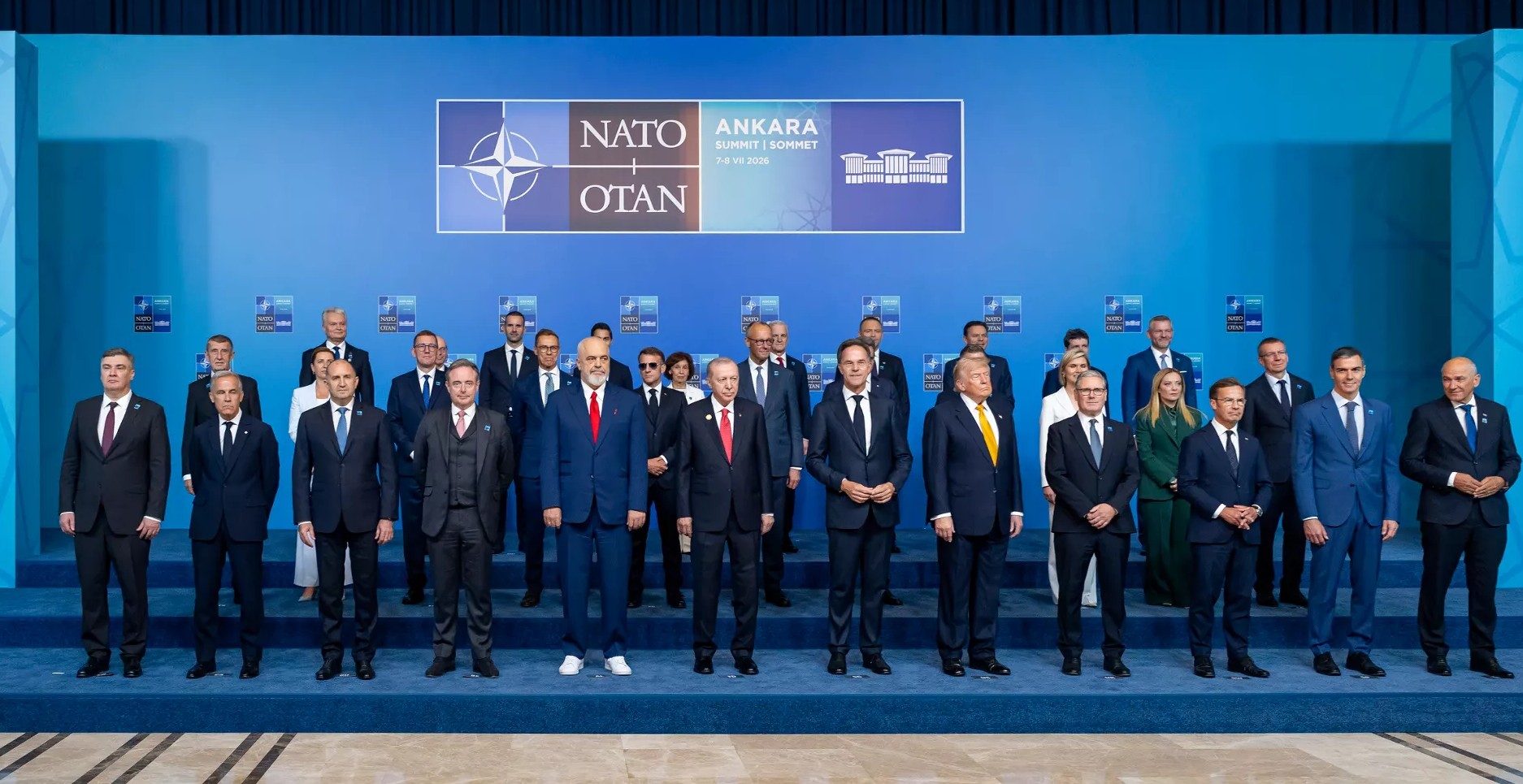
While U.S. President Donald Trump garnered the bulk of media attention with his Iran pronouncements during the July 7-8 NATO Summit in Ankara, a number of important substantive decisions were reached that will advance NATO’s ambitious modernization program, but as most are technical, they quickly dropped from the spotlight.
In a nutshell, NATO’s 2026 Ankara Summit managed to reinforce Allied unity, accelerated NATO’s transformation into a more capable and Europe-led defense alliance (aka “NATO 3.0”), expanded defense industrial cooperation, and committed €70 billion in military support for Ukraine while reaffirming collective defense under Article 5.
To place this in context, it should be recalled that many analysts have labeled last year’s (June 2025) NATO Summit in the Hague as “The Trump Summit,” noting it was “historic” and “transformational.” The key take away and a major triumph for Trump last year was the Summit’s decision to sharply ramp up allies’ defense expenditures to five percent of GDP — with several key provisos — by 2035. That magic five percent number is actually an amalgam of normal defense expenditures plus many types of strategic infrastructure projects.
Accomplishments
According to NATO documents released after the meeting, the Ankara Summit yielded numerous significant achievements and decisions:
It reaffirmed Alliance unity and collective defense, with all Allies restating their commitment to Article 5 despite political tensions within the Alliance. President Trump’s presence and endorsement of the Ankara Declaration reassured Allies that Washington remained committed to Article 5 and NATO’s collective defense.
It advanced “NATO 3.0,” focusing on stronger deterrence, accelerated military capability development, expanded defense industrial production, and greater responsibility by European Allies and Canada for regional security.
The Summit strengthened long-term support for Ukraine, pledging €70 billion in military equipment, assistance as well as training for 2026, with a commitment to sustain comparable support in 2027. Despite previous uncertainty over U.S. policy, President Trump supported the Summit’s commitment to substantial military assistance for Ukraine and offered to authorize Ukraine to produce U.S. Patriot Air defense missile systems under license.
The Summit expanded defense industrial cooperation, including major new procurement initiatives exceeding $50 billion, and discussed increased production capacity and measures to strengthen allied defense supply chains and interoperability. In fact, defense industrial cooperation was one of the central themes of the Ankara Summit. The emphasis shifted from simply increasing defense budgets to turning higher spending into faster production, joint procurement, and stronger transatlantic industrial capacity. The Summit declaration committed Allies to work to eliminate defense trade barriers among NATO members, where possible.
The Ankara Summit also confirmed continued implementation of the 2025 defense investment commitments, emphasizing the delivery of military capabilities and readiness rather than setting new spending targets.
More than promises, but no visible end to European defense industry bottlenecks
The Ankara Summit was not just a “collection of promises” to improve allied industrial cooperation. At the very least, it introduced tangible mechanisms intended to improve coordination, procurement visibility, and cross-border industrial cooperation.
However, it did not — and could not — fully resolve the structural causes of Europe’s slow defense production. The hardest problems — industrial capacity expansion, workforce development, regulatory reform, and national procurement fragmentation — remain largely dependent on sustained action by European governments and the EU itself over the coming years. But at least the EU was fully engaged in the Summit so the requirements should be understood.
While the Summit documents clearly emphasize expanding cooperation, there was no announcement of a new standing NATO–European Commission Council, Joint Secretariat, or any formal governance mechanism dedicated to resolving industrial bottlenecks. Maybe next year?
The usual Trump antics
In confrontational remarks to the media as the Summit started, Trump reaffirmed his view that European countries had not adequately backed the U.S. during the recent conflict with Iran. He singled out Spain over its low defense spending and threatened to restrict bilateral trade, using unusually sharp rhetoric during the Summit. As Spain is an EU member, Trump’s ability to directly target U.S. trade with Spain remains in question. Trump even managed to throw Greenland into the mix briefly.
Ultimately, Trump’s tone shifted over the course of the Summit, beyond the Iran war issue. After the contentious start, he later emphasized that there was “a lot of unity” and “a lot of love” among NATO leaders, portraying the meeting as a success with Washington fully on board with the carefully negotiated Ankara Summit Declaration.
Bonus points for Summit host Turkiye
Strengthening U.S.-Turkiye relations, President Trump’s bilateral discussions with President Recep Tayyip Erdogan in Ankara signaled a possible easing of tensions over long-stalled defense cooperation. This included indications that the U.S. might move to lift unilateral American CAATSA sanctions that are still penalizing Turkiye over its previous purchase of Russian S-400 air defense systems, and if they were actually removed, Washington could possibly revisit Türkiye’s participation in the F-35 program, currently frozen.
After the Summit, media reports circulated that the Turks were considering selling their S-400’s to a Persian Gulf country, ultimately (re)opening a potential pathway to Turkiye’s F-35 procurement. Whatever happens in that regard, numerous U.S. lobby groups are furiously organizing to block the potential F-35 sale, and it should be recalled that Turkiye has few friends in the U.S. Congress due to its inconsistent behavior as a U.S. ally on regional issues and mixed record on human rights and democratic development.