

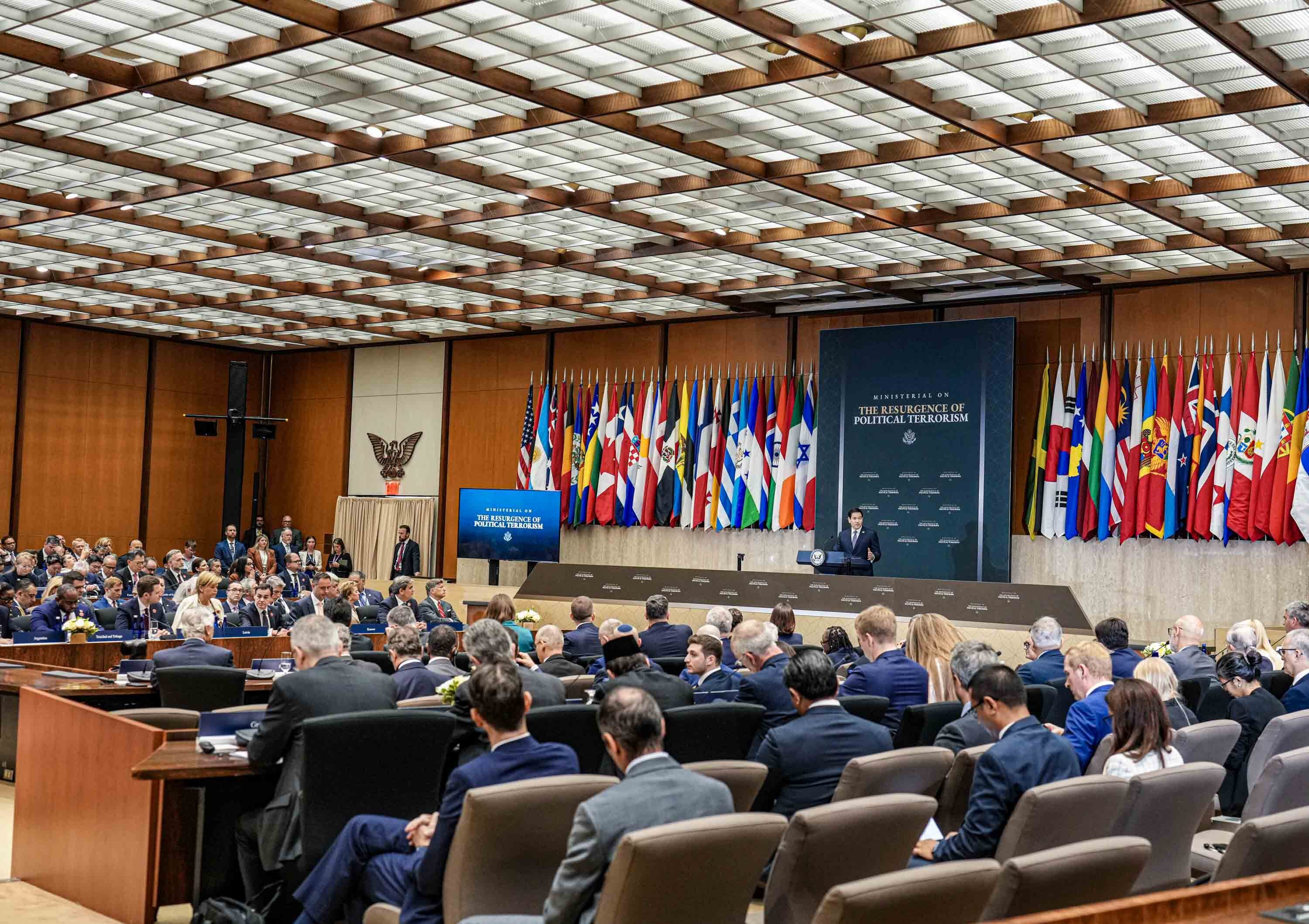

Spearheaded by U.S. Secretary of State Marco Rubio, the U.S. State Department hosted a Ministerial-level meeting on the resurgence of political terrorism on July 16. Delegations from about 65 countries attended, including foreign ministers, interior ministers, and senior counterterrorism officials.
The administration of U.S. President Donald Trump showcased the meeting to highlight a significant strategic shift, announcing that it intends to treat transnational far-left political violence as a major counterterrorism priority, arguing that previous governments and international organizations underemphasized this threat (see the State Department fact sheet below).
Despite the high-profile meeting, participants did not adopt a binding international agreement or joint declaration comparable to those issued after some multilateral ministerials.
With sweeping statements about the “alarming rise” of political violence by the left, Rubio and other U.S. officials painted a dark image of the future if the “communists and Marxists” perpetrating these supposed acts are not defeated. Rubio urged officials in attendance — mostly from European and Latin American countries — to unite to address the issue, which he says has been a “blind spot” in counterterrorism doctrine.
Critics — including civil liberties organizations and terrorism researchers — have questioned whether the new Trump administration initiative was redirecting attention and resources away from other threats, particularly Islamist terrorism and far-right extremism, which many studies have historically identified as more lethal in Western countries.
A global or domestic campaign?
Coming just months before U.S. mid-term elections, some observers note an important domestic angle to this new campaign.
A widely reported Rubio quote from the ministerial’s opening session has highlighted the ideological flavor of this event. “So many people in positions of power have repeatedly dismissed acts of violence and even terrorism as legitimate forms of political expression, so long as they served a left-wing cause,” Rubio said. He added, “A bomb planted by a neo-Nazi group was ‘a nefarious and murderous act of evil.’ It is, but a bomb planted by a Marxist revolutionary; well, that’s just merely a tragic excess of idealism.”
The Trump administration’s ideological focus conflates so-called “democratic socialism” — which normally focuses on securing universal healthcare, higher taxes on the wealthy and stricter corporate regulation — with communism, which is not strictly accurate. This has only intensified in the last year, following the election of “democratic socialist” Zohran Mamdani to become New York City mayor and several of his allies winning in New York City congressional primaries last month, beating out incumbent Democrats.
Key outcomes
While there was no agreed ministerial statement or “outcome document,” several important policy changes on the U.S. side have been keyed to the ministerial meeting.
On the top of the list, Secretary Rubio announced a visa restriction policy targeting individuals associated with what the Trump administration describes as “far-left terrorist and other aligned groups.” According to the State Department, the policy is intended to deny U.S. entry to foreign nationals who support or facilitate politically motivated terrorist violence. This will inevitably bring the administration into conflict with various academic institutions and research organizations, but restrictions on U.S. entry by declared communists have long been in place, unless waiver is given.
Secretary Rubio also stated the administration intends to designate additional organizations as Foreign Terrorist Organizations or under other counterterrorism legal authorities, following earlier designations of several European extremist groups. U.S. officials indicated further announcements are expected but did not identify all prospective groups.
Regarding expanded international coordination, U.S. officials have described the July 16 meeting as the beginning of an expanded network for ongoing counterterrorism cooperation on a range of topics rather than a one-time event.
State Department Addresses International Resurgence of Far-Left Political Terrorism
Office of the Spokesperson
Fact Sheet
Today (July 16), the United States Department of State under the leadership of Secretary Rubio is convening governments from across the globe at the Ministerial on the Resurgence of Political Terrorism to address the rise of far-left political terrorism as a transnational threat.
This Ministerial brings together partners from across the Western Hemisphere, Europe, and Asia to expand coordination, enhance information sharing, and strengthen international law enforcement mechanisms to counter the threat.
The Resurgence of Far-Left Terrorism
The resurgent threat of transnational far-left terrorism is characterized by violent attacks against private citizens, government officials, police and law enforcement, businesses, and critical infrastructure across the globe.
Historically, most politically motivated terrorism in the West has been carried out by violent far-left groups and individuals. Between 1970 and 1980, far-left terrorists were responsible for 93 percent of terrorist attacks and 58 percent of terrorism-related deaths.
Since 2016, far-left terrorist plots and attacks have sharply increased in the United States and Europe, with a growing trend of violence against individuals.
Far-left anti-government terrorism now accounts for more attacks and plots in the United States than any other ideological category. Far-left actors were responsible for 63 percent of all recorded anti-government attacks or plots as well as three out of the four anti-government fatalities in the United States in 2025.
In 2024, there were 21 attacks in the European Union attributed to far-left and anarchist terrorists, as compared to 24 attacks from jihadist terrorists that same year. Of the 45 reported terrorist attacks in Europe in 2025, 12 were attributed to far-left and anarchist actors.
Over the past three years, Europe has experienced a record high number of terrorist attacks targeting rail networks, critical infrastructure, and private businesses, resulting in millions of euros in damage and economic disruption, with most attacks attributed to far-left and anarchist actors.
Previous State Department Actions to Combat Far-Left Terror
The State Department designated four violent far-left groups as Foreign Terror Organizations and Specially Designated Global Terrorists, with additional designations under review.
In December 2025, the State Department announced Rewards for Justice offers of up to $10 million for information disrupting the financial mechanisms supporting designated far-left terrorism groups.
The State Department has engaged foreign partners through bilateral diplomatic engagements and demarches, with many partner countries reporting a rise in far-left terrorist activity, including targeted violence against government officials, economic sabotage, attacks on critical infrastructure, the use of improvised explosive and incendiary devices, and the convergence of violent anti-American, antisemitic, or anti-tech movements with far-left terrorist networks.
The Department hosted the inaugural Counter Terrorism Law Enforcement Workshop in May 2026, a practitioner-focused forum bringing together U.S. and foreign law enforcement and counterterrorism practitioners to share threat assessments and operational best practices.
The United States Government is coordinating with foreign partners to restrict terrorist travel, enhance information sharing, and improve law enforcement cooperation to counter transnational far-left terrorists.
End Text.