



Ending a nearly 10-day journey, the first astronauts to travel to the Moon in more than half a century returned to earth April 10 on the Artemis II test flight which surpassed the record for human spaceflight’s farthest distance from Earth, which was previously set by the Apollo 13 mission in 1970.
“With Artemis II complete, focus now turns confidently toward assembling Artemis III and preparing to return to the lunar surface, build the base, and never give up the Moon again,” NASA Administrator Jared Isaacman said.
NASA’s record-breaking Artemis II mission is being closely watched in China, which hopes to land astronauts there by 2030.
During their mission, the NASA astronauts flew 694,481 miles in total. The trip took Reid Wiseman, Victor Glover, and Christina Koch, and CSA (Canadian Space Agency) astronaut Jeremy Hansen 252,756 miles from home, farther into space than humans have ever gone before. The astronauts splashed down at 5:07 p.m. PDT Friday (April 10) off the coast of San Diego, NASA said in a press release.
“Reid, Victor, Christina, and Jeremy, welcome home, and congratulations on a truly historic achievement. NASA is grateful to President Donald Trump and partners in Congress for providing the mandate and resources that made this mission and the future of Artemis possible,” Isaacman said. “Artemis II demonstrated extraordinary skill, courage, and dedication as the crew pushed Orion, SLS (Space Launch System), and human exploration farther than ever before. As the first astronauts to fly this rocket and spacecraft, the crew accepted significant risk in service of the knowledge gained and the future we are determined to build. NASA also acknowledges the contributions of the entire NASA workforce, along with our international partners, whose expertise and commitment were essential to this mission’s success,” he said.
After successful splashdown in the Pacific Ocean, the astronauts were met by a combined NASA and U.S. military team that assisted them out of the spacecraft in open water and transported them via helicopter to the USS John P. Murtha for initial medical checkouts and were expected to return to NASA’s Johnson Space Center in Houston on Saturday, April 11.
The first crewed Artemis mission launched on NASA’s SLS rocket at 6:35 p.m. April 1, from Launch Pad 39B at the agency’s Kennedy Space Center in Florida. With 8.8 million pounds of thrust at liftoff, the American-built rocket propelled the crew inside the Orion spacecraft to space, delivering it to orbit with pinpoint accuracy after a smooth countdown conducted by the agency’s Artemis launch control team.
During the first day in space, the astronauts and teams on the ground checked out the spacecraft — named Integrity by the crew — to confirm all systems were healthy ahead of the transit to the Moon.
On the second day of the test flight, with all systems go, Orion’s European-built service module fired its main engine, placing the astronauts on a trajectory that brought them 4,067 miles above the lunar surface at their closest approach.
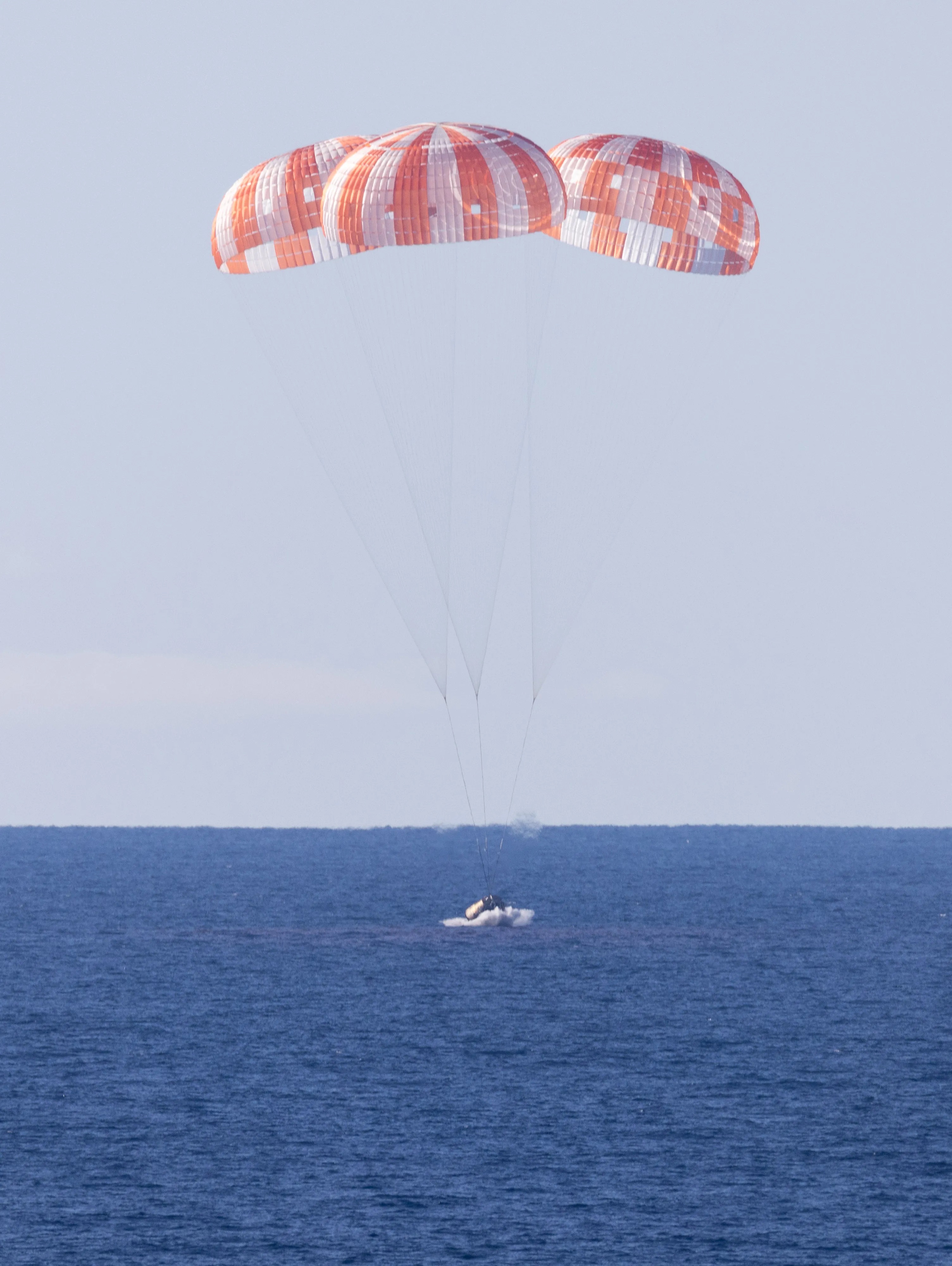
“The Artemis II crew is home. The entry, descent, and landing systems performed as designed and the final test was completed as intended. This moment belongs to the thousands of people across fourteen countries who built, tested, and trusted this vehicle. Their work protected four human lives traveling at 25,000 miles per hour and brought them safely back to Earth,” NASA Associate Administrator Amit Kshatriya said.
“Artemis II proved the vehicle, the teams, the architecture, and the international partnership that will return humanity to the lunar surface. Reid, Victor, Christina, and Jeremy carried the hopes of this world farther than humans have traveled in more than half a century. Fifty‑three years ago, humanity left the Moon. This time, we returned to stay. The future is ours to win.”
With astronauts aboard the capsule for the first time, engineers put Orion through a full in‑flight evaluation. The test pilot crew intensively tested the spacecraft’s life support systems, confirming Orion can sustain humans in deep space. During several piloting demonstrations, crew members took manual control of the spacecraft, flying Orion to validate its handling and collect data that will guide future rendezvous and docking operations with lunar landers during the Artemis III test mission (2027) and beyond.
The crew completed a series of equipment tests needed for future moon missions, including evaluations of how the spacecraft operates during crew exercise periods, various emergency equipment checks and procedures, in flight examination of the Orion crew survival system spacesuits, and other critical spacecraft systems.

Wiseman, Glover, Koch, and Hansen also supported ongoing scientific investigations to help NASA prepare astronauts to live and work on the Moon as the agency hopes to build a Moon Base and looks toward Mars. These experiments — including the AVATAR investigation, which studies how human tissue responds to microgravity and the deep space radiation environment, and other human research performance studies — are gathering essential health data for long-duration missions.
Far side of the moon
During their April 6 lunar flyby, the astronauts captured more than 7,000 images of the lunar surface and a solar eclipse, during which the Moon blocked the Sun from Orion’s vantage point. The imagery includes striking views of “earthset” and “earthrise,” impact craters, ancient lava flows, our Milky Way galaxy, and surface fractures and color variations across the lunar terrain.
They documented the topography along the terminator — the boundary between lunar day and night — where low-angle sunlight casts long shadows across the surface, creating illumination conditions like those in the South Pole region where Artemis IV astronauts are scheduled to land in 2028. The crew also proposed potential names for two lunar craters and reported meteorite impact flashes on the night side of the Moon.
Next Artemis mission should be right around the corner
With the crew safely on Earth, NASA and its partners now will turn attention to preparing for next year’s Artemis III mission, when a new Orion crew will test integrated operations with commercially built Moon landers in low Earth orbit, NASA notes.
“At NASA, we dare to reach higher, explore farther, and achieve the impossible. That’s embodied perfectly by our Artemis II astronauts – Reid, Victor, Christina, and Jeremy. They are charting new frontiers for all humanity,” said Dr. Lori Glaze, acting associate administrator for Exploration Systems Development Mission Directorate at NASA Headquarters in Washington. “Their dedication is about more than breaking records – it’s fueling our hope for a bold future. Their mission is carrying our promise to return to the Moon’s surface, this time to stay as we establish a Moon Base.”
Artemis II astronauts have traveled 252,756 miles from Earth, flown around the Moon, and observed the lunar surface like never before. Now, they’re coming home. 🌎
Watch the crew splash down on Friday, April 10, around 8:07pm ET (0007 UTC April 11). https://t.co/Ccsk5Z3HFS pic.twitter.com/QoJW2oYVFG
— NASA (@NASA) April 10, 2026
As part of a Golden Age of innovation and exploration, NASA will send Artemis astronauts on increasingly challenging missions to explore more of the Moon for scientific discovery, economic benefits, to establish an enduring human presence on the lunar surface, and lay the groundwork for sending the first astronauts – American astronauts – to Mars.
Controversy over the program
The Artemis program as currently established was approved by then-President Trump in his first term. In Washington there has been some political sniping over the program as conservatives loudly charge that the Obama administration tried to cancel NASA’s lunar programs. In fact the Obama administration did cancel the previous “Constellation” Moon exploration concept, authorized under then-President George W. Bush in 2004 after the Challenger shuttle disaster, due to large cost overruns, but the core element – the Orion lunar spacecraft – was carried forward to the Artemis program, resembling in many ways earlier Apollo program architecture.
What has actually disappeared was the earlier launch system then in development, the Constellation program’s so-called Ares heavy launch system (using two different boosters), replaced by the now-proven Space Launch System which actually utilizes some earlier Space Shuttle program hardware/technology and retains strong congressional support.
NASA is significantly expanding its cooperation with the private sector for future space projects, and plans to use a privately-developed lunar module for the 2028 landing and other projects (Artemis IV), with two U.S. firms competing.