

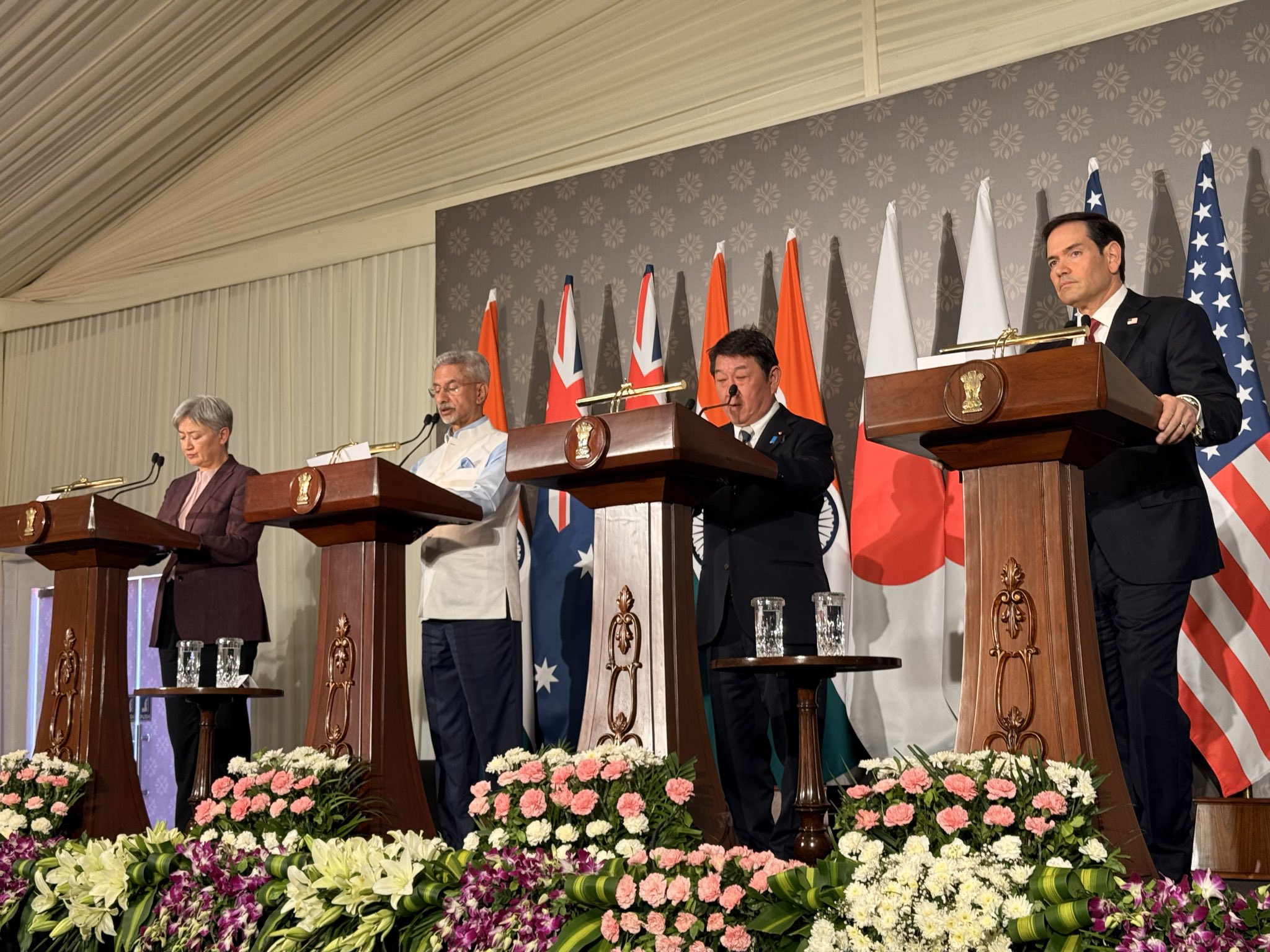

In the midst of conflicts, geopolitical tensions, and increased pressure on global supply chains, the Foreign Minister of Australia, the External Affairs Minister of India, the Foreign Minister of Japan, and the Secretary of State of the United States gathered in New Delhi, India, on May 26 on the occasion of the Quad Foreign Ministers’ Meeting to discuss pathways to peace, prosperity, and stability across a free and open Indo-Pacific region.
Indian Foreign Minister Subrahmanyam Jaishankar hosted Australian Foreign Minister Penny Wong, Japanese Foreign Minister Toshimitsu Motegi, and U.S. Secretary of State Marco Rubio.
The joint statement issued at its conclusion reiterated that many of the grouping’s long-held ideals of peace, stability, and prosperity of the Indo-Pacific hinge on upholding international law, and the peaceful resolution of disputes. “We reaffirm our commitment to defending the rule of law, sovereignty, and territorial integrity. We recognize the immense potential of innovation, emerging technologies, and trusted partnerships to drive economic prosperity across the Indo-Pacific and beyond. We strongly oppose any destabilizing or unilateral actions that seek to change the status quo, including by force or coercion, which escalate tensions and undermine regional peace and stability,” the statement read.
The Quad countries reaffirmed their support for a free and open Indo-Pacific that allows countries to develop resilience and to strengthen capacity to determine their own paths. The ministers acknowledged developments in key maritime regions have underscored the vulnerability of critical sea lanes and the risks posed to the uninterrupted flow of commerce. “These challenges carry significant implications for the Indo-Pacific, which remains central to global trade and connectivity. Disruptions to maritime transport and supply chains have far-reaching consequences for global fuel, food and fertilizer security as well as the safety of seafarers,” the statement read.
The foreign ministers discussed the situation in the Middle East and reaffirmed their support for ongoing diplomatic efforts and hope for lasting peace in the region. “We reiterate the importance of adhering to international law as reflected in the United Nations Convention on the Law of the Sea (UNCLOS) with respect to navigational rights and freedoms, and the safety and uninterrupted flow of global commerce through the Strait of Hormuz and the Red Sea. We condemn the attacks on commercial shipping vessels and oppose any future measures that are inconsistent with UNCLOS, including imposition of tolls,” the ministers said.
Turning to the worrisome situation in the East China Sea and the South China Sea, the foreign ministers of Australia, India, Japan, and the U.S. reiterated their strong opposition to any destabilizing or unilateral actions including by force or coercion that threaten peace and stability in the region. “We express our serious concerns regarding dangerous and coercive actions, including interference with offshore resource development, the repeated obstruction of freedom of navigation and overflight, and the dangerous maneuvers by military aircraft and coast guard and maritime militia vessels, especially the unsafe use of water cannons and flares, and ramming or blocking actions in the South China Sea. We are seriously concerned by the militarization of disputed features,” the statement read.
They also reaffirmed their commitment to the complete denuclearization of North Korea in accordance with relevant UNSCRs and urge North Korea to abide by all its obligations under the relevant UNSCRs.
Maritime and Transnational Security
Addressing maritime security challenges, the ministers welcomed India’s operationalization of the Indian Ocean Region program of the Quad Indo-Pacific Partnership for Maritime Domain Awareness (IPMDA) through the Information Fusion Centre – Indian Ocean Region in Gurugram.
Following the success of the first-ever Quad-at-Sea Ship Observer Mission from Palau to Guam in July 2025, India will host the next edition of the Mission to strengthen interoperability and knowledge-sharing to best address unlawful maritime activities across the region.
The Quad remains deeply concerned about the proliferation of online scam centers within Southeast Asia and surrounding regions which are linked to the spread of other transnational crime, including trafficking in persons, drug trafficking, sexual extortion, illicit financing, and other forms of cybercrime, the statement read.
Critical Minerals Deliverable
The ministers reiterated their “grave concerns over the use of economic coercion and non-market policies and practices including arbitrary export restrictions, price manipulation, and disruptions particularly on critical minerals that impact global supply chains and critical industrial sectors. We underscore the importance of diversified and reliable global supply chains and the need to avoid reliance on any one country.”
“To advance our vision for fair and diversified critical minerals markets, the ministers announced the Quad Critical Minerals Framework, which will guide how Quad partners can leverage economic policy tools and coordinate, including in concert with the private sector, investment to strengthen critical minerals supply chains, including in mining, processing, and recycling,” the ministers said.
Energy and Fuel Security
Disruptions to global markets for energy products and important downstream derivatives such as fertilizers, fall heavily on the Indo-Pacific region. “Recognizing shifts in the global energy landscape, we are launching the Quad Initiative on Indo-Pacific Energy Security to cooperate on energy security and resilience. Quad partners will work together to ensure open, well-functioning and stable energy markets, and resilient and diversified supply chains,” the statement read, adding that maintaining open trade flows in essential goods is critical for the security and prosperity of the Indo-Pacific region.
Critical and Emerging Technology
The ministers reaffirmed their commitment to building secure, resilient digital ecosystems and supporting next-generation technologies, including 5G, 6G, and AI. “In this context, we recognize that open, and interoperable architectures built on sound technical standards can help enhance network security and foster innovation and reduce reliance on single-vendor systems,” the statement read.
“We recognize that AI represents a transformative force for our long-term prosperity — and reliable supply chains are indispensable to securing its benefits. We welcome efforts to deepen partnership across the full technology stack, from critical minerals and advanced manufacturing to compute, semiconductors, and trusted networks,” the Quad foreign ministers said, adding, “Together, we welcome efforts to advance a comprehensive economic partnership grounded in trust, technological complementarity, and a shared commitment to lasting prosperity.”