


In the middle of America’s long Memorial Day weekend, U.S. President Donald Trump himself announced on May 23 that a peace deal is “largely negotiated,” but then posted on social media one day later that he had instructed his representatives “not to rush into a deal” and “time is on our side.”
The Iranians have agreed in principle to a framework deal that would include the disposal of highly enriched uranium, a senior U.S. administration official revealed on May 24, but said talks are still underway, now in Qatar, to finalize the agreement.
U.S. Central Command (CENTCOM) said that it launched new strikes on southern Iran on May 25 , targeting Iranian missile sites and boats attempting to place mines. CENTCOM said the strikes were taken in “self-defense” and were designed “to protect our troops from threats posed by Iranian forces.” Iran has yet to respond to the strikes.
Little accurate information about the state of negotiations
As far as is currently known, a final agreement would include Iran reopening the Strait of Hormuz in exchange for the U.S. lifting of its blockade of Iranian ports, and also the U.S. making accommodations on sanctions relief if Iran agrees to make accommodations on the question of nuclear enrichment. The first part of the deal, essentially a tit-for-tat removal of twin blockades by both sides, raises the important question of whether Epic Fury and the last month of diplomacy have achieved anything. Some reports suggest the nuclear issue will be managed on a separate track from the Hormuz closure/blockade removal question.
There is broad commitment on the principles, the senior U.S. official said, and the Trump administration feels positive about where things stand even as efforts to finalize the details continue.
The official indicated that Iran appears more willing to compromise than before the military campaign. It is also unclear if China played any role in bringing more flexibility to the Iranian positions after Trump’s May 13-15 Beijing visit.
Iran confirmed on May 25 that Tehran and Washington had reached understandings on many issues in exchanges over a deal for ending the war, but also stated that an agreement was not imminent.
Oil prices fell below $100 a barrel on May 25 on hopes that the U.S. and Iran are moving closer to a peace deal, but rose slightly on reports of the U.S. strikes against southern Iran late on May 25.
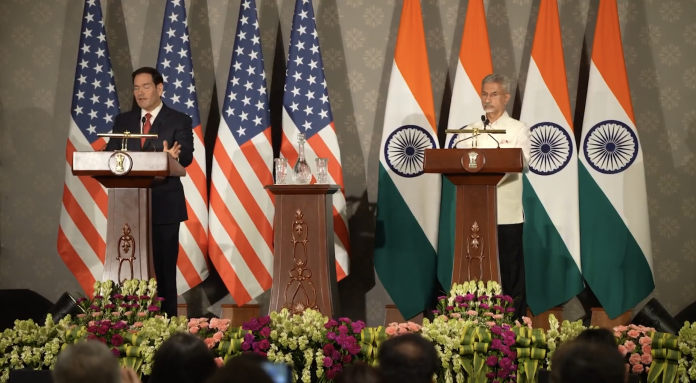
“We thought we might have some news last night, maybe today; I wouldn’t read too much into it,” Secretary of State Marco Rubio said on May 24 while in New Delhi, referring to the potential agreement. “We have what I think is a pretty solid thing on the table in terms of their ability to open up the straits, get the straits open,” he told media as he departed the Indian capital.
“It has a lot of support in the Gulf. Every country that we’ve walked through it (with) understands it’s not just very reasonable, but it’s the right thing for the world to get done.” Rubio also voiced confidence that Iran would “enter into a very real, significant, time-limited negotiation on the nuclear matter.”
But, he said the U.S. will either have a good accord with Iran or deal with the country “another way,” according to media sources traveling with Rubio.
Congressional reaction emerging
Trump wrote on Truth Social that “after all the work done by the United States to try and pull this very complex puzzle together, it should be mandatory that all of these countries, at a minimum, simultaneously, sign onto the Abraham Accords” as part of U.S. efforts to reach a deal with Iran.
Republican Senator Lindsey Graham of South Carolina asked President Trump to “stick to (his) guns while negotiating with Iran, and urged the U.S.’ allies in the Middle East to join the Abraham Accords. “President Trump: Stick to your guns in getting a good deal with Iran,” Graham said in a post on X. “Equally important, stick to your guns in insisting Saudi Arabia and others join the Abraham Accords as part of these negotiations.”
Graham said if as a result of negotiations to end the war with Iran, the U.S.’ allies in the region agree to join the Abraham Accords, which normalized diplomatic relations between Israel and four Arab nations in 2020, the agreement would be “one of the most consequential in the history of the Middle East.” “Saudi Arabia, Qatar, and Pakistan joining the Abraham Accords would be beyond transformative for the region and world,” Graham argued. “It is a brilliant move by President Trump.”
A number of Republican senators, and many other observers, are strongly opposed to any unfreezing of billions of dollars of frozen Iranian assets under U.S. sanctions, something Iran has pressed for repeatedly and aggressively, but has almost zero actual leverage to obtain, unless Trump capitulates in order to clinch a deal. This indicates Tehran’s true desperation.
It is highly significant that Iran routinely includes its Central Bank Governor in its senior negotiating team for the talks with Washington, as it did this weekend in Qatar. If the Trump administration is negotiating from a position of strength and not planning to capitulate to Iran and unfreeze some Iranian assets in order to get a deal, why are Central Bank officials involved at this stage of the talks? And why is Washington allowing Tehran to keep economic topics high on the initial agenda even without including the subject of Iranian reparations for war damages and lost oil revenues for the region?
Democratic Senator Chris Van Hollen of Maryland criticized the emerging agreement with Iran, saying “when you’re digging a hole, you should stop digging.”
“That’s what this agreement sounds like,” Van Hollen said on a May 24 television broadcast. “It sounds like we will go back to opening the Strait of Hormuz, which, of course, was open before the war started.” Van Hollen added “it looks like Iran will retain more control over those straits,” while noting that “we also know Iran has an even more hardline regime in place now, and we’re talking about releasing some of Iran’s frozen assets.”
Lebanon question unresolved
A senior Israeli political source was quoted by CBS News early May 24 saying that they have “made it clear to the Americans” that if a deal is reached with Iran, Israel must still maintain “our operational freedom of action in all sectors, including in Lebanon, to protect our citizens and soldiers and prevent threats from developing against us.”
The source added that “this is acceptable to Trump.” Israeli Prime Minister Benjamin Netanyahu and Mr. Trump spoke on May 23 and Netanyahu “emphasized that Israel will maintain freedom of action against threats in all arenas, including Lebanon.” Israeli military activity actually intensified on May 26.