

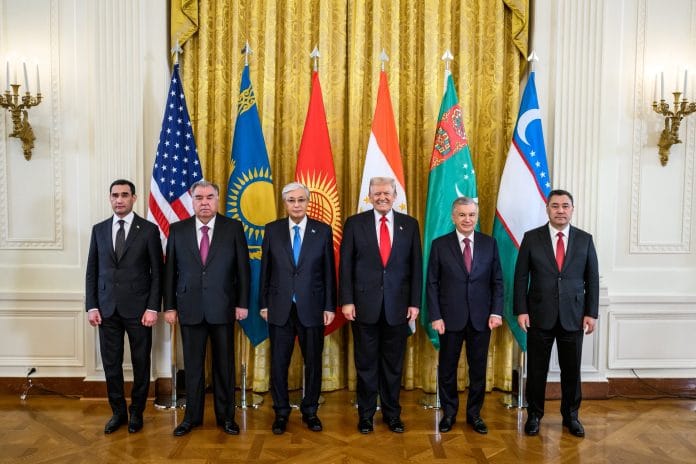

U.S. President Donald Trump presided over a historic meeting with five Central Asian leaders on November 6 at the White House in a period of increasing big power competition for access to critical minerals, Central Asian markets and geostrategic land trade corridors across Eurasia.
Launched in 2015 under then-President Barack Obama, the so-called C5+1 platform brings together the United States and the five Central Asian states (Kazakhstan, Kyrgyzstan, Tajikistan, Turkmenistan and Uzbekistan) to promote joint efforts on economic, energy and security issues.
The November 6 White House meeting was the second leaders-level C5+1 meeting with an American president — the first took place on the sidelines of the UN General Assembly in 2023 — and it was the first time the format was hosted in the American capital. The gathering also marks the 10th anniversary of the C5+1 diplomatic platform that works to connect Central Asia with Washington.
The C 5+1 Summit came at a pivotal moment geopolitically; the world is buffeted by Trump’s tariff agenda, Russia remains consumed by its invasion of Ukraine, whilst China works to expand its Belt and Road Initiative footprint across Eurasia. “One of the key items on our agenda is critical minerals,” Trump explained. “In recent weeks, my administration has strengthened American economic security by forging agreements with allies and friends across the world to broaden our critical mineral supply chains.”
“These nations were once home to the ancient Silk Road connecting the East and West,” Trump said, while injecting “Sadly, previous American presidents neglected this region completely. I understand the importance of this region; a lot of people don’t know that.”
Between a rock and a (sanctioned) hard place
Endowed with large deposits of minerals and energy, the five nations remain economically tied to Russia, their former Soviet ruler, while neighboring China has expanded its influence through large-scale infrastructure and mining investments. Together, the region is home to 84 million people and holds substantial deposits of uranium, copper, gold, rare earths and other strategic minerals essential to global efforts to transition to cleaner forms of energy. Western sanctions on Russia have not been sufficient to counteract Moscow’s economic influence, although some transactions appear to have been carefully moved out of the public eye, and a number of companies in Central Asia have been hit with sanctions, as new Russian trade diversion channels are constantly emerging.
Kazakhstan, the region’s largest economy, is noted as the world’s leading uranium supplier, producing nearly 40 percent of global output in 2024, while Uzbekistan ranks among the top five. Together, they account for just over 50 percent of the world’s uranium production — a vital resource for U.S. nuclear power, which is a significant source of U.S. electricity.
Russia supplies roughly 20 percent of America’s imported uranium, making diversification of suppliers increasingly urgent for Washington as U.S. boosts its existing sanctions on Russia.
Focus on results
Washington leaders’ summits focus on building personal contacts, especially with President Trump, but more importantly also on so-called “deliverables.” These are the outcomes both sides want, and these items need a hard deadline like a summit meeting to overcome bureaucratic inertia so as to conclude agreements and issue new laws and regulations. For the United States, this summit has been about converting diplomatic engagement into these deliverables. U.S. officials wanted to see results in three main areas: critical minerals, regional connectivity, and security coordination, none of which are a surprise.
Congress and the Trump administration view the region’s reserves of antimony, tungsten, uranium, and rare earth elements as essential to securing U.S. supplies. During his October 2025 visit to Kazakhstan and Uzbekistan, Deputy Secretary of State Christopher Landau emphasized expanding cooperation on critical minerals and trade diversification and promised further senior U.S. officials will visit. The Trump administration has prioritized these topics as part of a broader global effort to reduce dependence on China, but this is by no means a Trump administration invention, as previous American presidents have supported significant U.S. engagement in the region for decades.
Infrastructure investments that bypass Russia are strategically important, and, in coordination with the EU, the U.S. hopes to help harmonize customs and logistics to make the so-called “Middle Corridor” connecting China to Turkey through Central Asia more viable. These priorities form part of a wider push to anchor the region into transparent, market-driven supply chains that link Central Asia more directly with Western markets.
In recent meetings with President Trump, Uzbekistan’s President Shavkat Mirziyoyev proposed around 10 key initiatives for the C5+1 grouping. Those include the establishment of a permanent secretariat to ensure continuous coordination among member countries, creating a coordination council on investment and trade to strengthen economic ties and the launch of a Central Asian Investment Partnership Fund to attract and manage joint investments in key projects.
President Trump had short individual meetings with all of the Central Asian leaders, a number of which he has known for years. He met with Turkmenistan’s President Serdar Berdimuhamedov to discuss enhanced regional trade connectivity as well as cooperation on energy and critical minerals. The President of Turkmenistan said he intended to consider the possibility of implementing the Trans-Caspian Gas Pipeline Project as well as new opportunities for trade and transportation in the Central Asia-Caucasus region arising from the Trump Route for International Peace and Prosperity (TRIPP) between Azerbaijan and Armenia.
In partnership with the Kennedy Center, the State Department hosted the C5+1 Tenth Anniversary Business Conference on November 6, which appears to be the Trump administration’s new wrapping for the pre-existing Business 5+1 (B5+1) private sector-led process, which is nonetheless continuing its work.
Key outcomes
On the political side, Kazakhstan’s President, Kassym-Jomart Tokayev, himself a former senior UN official, agreed that his Muslim-majority country will join the Trump-led Abraham Accords. After meeting with Tokayev, Trump posted word of the agreement before the working dinner began on November 6, generating a number of headlines. Kazakhstan has had diplomatic relations with Israel since 1992 and retains a small Jewish minority (4000) residing in 10 different cities.
Kazakhstan’s helpful move is aimed at re-energizing an initiative that was the main foreign policy achievement of Trump’s first term, when his administration forged diplomatic and commercial ties between Israel and the United Arab Emirates, Bahrain and Morocco. Trump remains hopeful that Saudi Arabia will soon join the accords, while the White House has hinted the same might be possible for Indonesia, if the Gaza ceasefire continues to hold. In this context, Kazakhstan’s bold move to sign up will no doubt be highly appreciated by the U.S. President.
🇰🇿🇺🇸 President Kassym-Jomart Tokayev took part in the “Central Asia – United States” Summit held at the White House, where he emphasized the beginning of a new era in C5+1 cooperation and reaffirmed #Kazakhstan’s commitment to strengthening the Enhanced Strategic Partnership with… pic.twitter.com/PR6U8FHX1R
— Press Office of the President of Kazakhstan (@aqorda_press) November 7, 2025
One day before the White House meetings, a bipartisan group of senators introduced legislation to repeal Soviet-era trade restrictions that some lawmakers say are holding back American investment in the Central Asian nations, which became independent with the 1991 collapse of the Soviet Union. This would eventually provide the countries with Most Favored Nation (MFN) trading status.
On the commercial side, while many deals were announced, some details remain scarce or general, so information is lacking in a number of cases as we saw after the Trump Middle East trip last spring. The State Department issued a number of joint statements and media releases as well.
In Kazakhstan, a deal was announced with a U.S. mining-investment firm to develop a tungsten deposit (Northern Katpar) under a joint venture (U.S. firm to take a 70 percent stake). The development cost is estimated at about US$1.1 billion.
A memorandum of understanding (MoU) on cooperation in the field of critical minerals between the U.S. and Kazakhstan was signed.
Kazakhstan announced an investment deal worth about US$2.5 billion with U.S. agricultural and construction-machinery manufacturer John Deere.
Uzbekistan announced eight deals covering geological surveying for critical minerals, water-conservation technologies, soybean purchases, cotton exports and artificial intelligence.
A large aircraft-sale package was announced, including up to 37 jets from Boeing to airlines in Kazakhstan, Tajikistan and Uzbekistan:
–Air Astana (Kazakhstan) plans to acquire up to 15 Boeing 787-9 Dreamliners.
–Somon Air (Tajikistan) plans to buy up to 14 aircraft: 4 Boeing 787-9s and 10 Boeing 737 MAX. The widebody jets will allow Somon Air to initiate intercontinental services.
–Uzbekistan Airways converted options into a firm order for eight additional 787 Dreamliners, bringing its total orders to 22.