

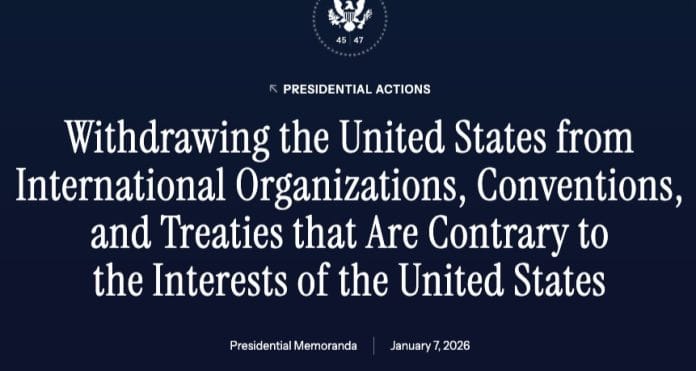

Following on U.S. President Donald Trump’s highly political decisions in early 2025 to withdraw the United States from the UN’s Intergovernmental Panel on Climate Change (IPCC), the Paris Agreement and UNESCO (for the third time in UNESCO’s case), Trump signed a presidential memorandum on January 7, 2026 directing his administration to begin withdrawing from 66 international organizations, conventions, and treaty-related bodies that, the White House has declared, “no longer serve American interests.”
The Presidential Memorandum directs all federal departments to cease participation in, and funding for, these entities as soon as legally possible.
The withdrawals include (complete list in links below):
–35 non-UN organizations and 31 United Nations-related bodies, spanning institutions on climate, environment, development, democracy, education, and human rights.
–Among them are major multilateral commitments like the U.N. Framework Convention on Climate Change (UNFCCC) — the foundation for global climate cooperation — and scientific bodies like the Intergovernmental Panel on Climate Change (IPCC) as well as the UN Conference on Trade and Development (UNCTAD).
The January 7 action flows from an earlier comprehensive review of U.S. membership in international bodies mandated by Executive Order 14199 (2025), which has taken most of the previous year to finalize.
Trump decisions should not be a surprise
These general direction of these actions should come as no surprise to anyone observing the Trump administration’s approach to international relations over the past year, but the scale of the withdrawals does mark one of the most sweeping revisions of America’s participation in the global institutional system in decades. It pulls the U.S. out of many cooperative frameworks once central to areas like climate diplomacy, global health, migration, gender equality, and counterterrorism cooperation. It also makes it clear to all that most of these areas (e.g., four out of the five topics listed above) are of minimal concern to the Trump White House.
It should be noted that a number of the so-called “exits” are essentially longstanding UN working groups that U.S. diplomats will simply stop attending and the organizations/groupings will not collapse. Also, reversing many if not most of these withdrawals would be on top of the “first tasks” list the next time a Democrat returns to the White House.
Some of the organizations and agreements being exited (especially treaty-based ones like UNFCCC) involve formal legal obligations that were previously ratified with Senate approval. Legal experts point to questions about whether a president can unilaterally terminate such treaties and note that courts or Congress could become involved.
As one would expect in the highly polarized world of Washington policy makers, the decision’s detractors argue that Trump’s orders diminish U.S. leadership on world issues, reduce U.S. influence in shaping international norms, and cede vital diplomatic space to other powers. On the other hand, Trump supporters describe the new policy as protecting U.S. sovereignty, national security, and economic interests, while preventing taxpayer funds from supporting what the Trump administration, and numerous independent observers, see as ineffective or ideologically driven agendas. Time will tell.
January 7 Department of State Press Statement, signed by Secretary Marco Rubio:
Withdrawal from Wasteful, Ineffective, or Harmful International Organizations
“Today, in furtherance of Executive Order 14199, President Trump announced the withdrawal of the United States from 66 international organizations identified as part of the Trump Administration’s review of wasteful, ineffective, and harmful international organizations. Review of additional international organizations pursuant to Executive Order 14199 remains ongoing.
The Trump Administration has found these institutions to be redundant in their scope, mismanaged, unnecessary, wasteful, poorly run, captured by the interests of actors advancing their own agendas contrary to our own, or a threat to our nation’s sovereignty, freedoms, and general prosperity. President Trump is clear: It is no longer acceptable to be sending these institutions the blood, sweat, and treasure of the American people, with little to nothing to show for it. The days of billions of dollars in taxpayer money flowing to foreign interests at the expense of our people are over.
As such, the United States will be withdrawing from the 66 organizations that can be found here.
As this list begins to demonstrate, what started as a pragmatic framework of international organizations for peace and cooperation has morphed into a sprawling architecture of global governance, often dominated by progressive ideology and detached from national interests. From DEI mandates to “gender equity” campaigns to climate orthodoxy, many international organizations now serve a globalist project rooted in the discredited fantasy of the “End of History.” These organizations actively seek to constrain American sovereignty. Their work is advanced by the same elite networks—the multilateral “NGO-plex”— that we have begun dismantling through the closure of USAID.
We will not continue expending resources, diplomatic capital, and the legitimizing weight of our participation in institutions that are irrelevant to or in conflict with our interests. We reject inertia and ideology in favor of prudence and purpose. We seek cooperation where it serves our people and will stand firm where it does not.”