

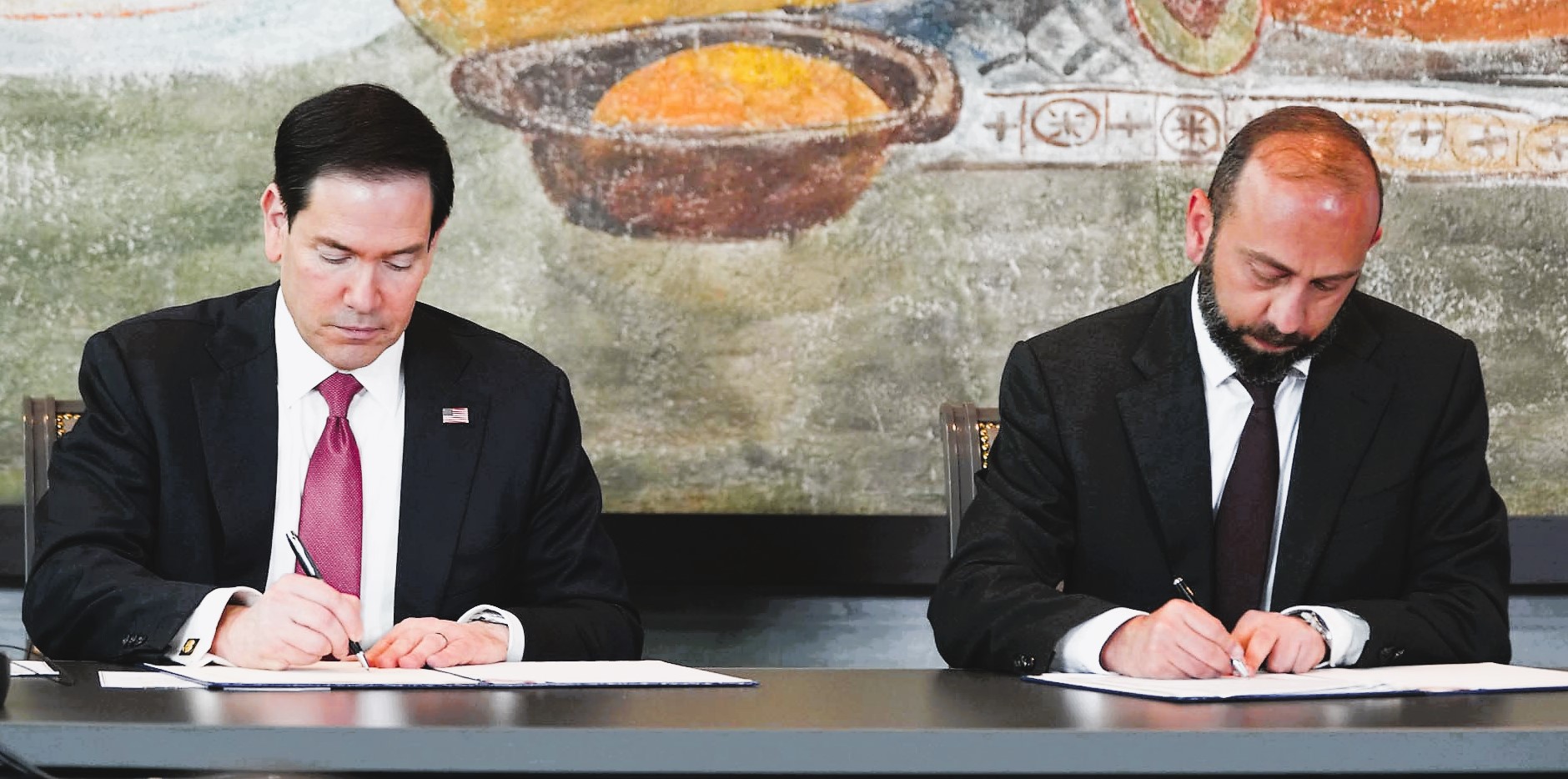

U.S. Secretary of State Marco Rubio’s May 26 Yerevan stopover, en route from his recent India visit, was one of the highest-level senior level U.S. visits to Armenia in years and occurred just before Armenian parliamentary elections set for June 7. The so-called “lightning visit” lasting less than 90 minutes was completely staged at Yerevan’s airport which Rubio never left.
Brief as it was, it publicly demonstrated American backing for Prime Minister Nikol Pashinyan and his policy of reducing dependence on Russia while expanding ties with the United States and Europe, drawing threats from Russia that gas prices could be increased. Russia’s reaction suggests Moscow viewed the brief Rubio visit, and the documents signed, as strategically important rather than merely ceremonial.
Armenia hosted a significant meeting of the European Political Community on May 4, followed by an EU-Armenia summit.
Strategic Partnership Charter
Three significant agreements (deliverables) emerged from the Rubio visit, also described in some detail in the State Department media note included below.
First, Rubio and Armenian Foreign Minister Ararat Mirzoyan signed a new “Charter on a Comprehensive Strategic Partnership.” This moves the relationship beyond ad hoc cooperation and creates a broader political framework for security, economic, and diplomatic ties and sets out routine consultations. In media briefings, Armenian officials described the Charter as elevating relations to an unprecedented level, but this is generally the sentiment in any country the U.S. signs such agreements with. The number is steadily increasing.
TRIPP project progresses
Perhaps the most important outcome from the visit was the signing of another framework agreement connected to the 2025 Trump Route for International Peace and Prosperity (TRIPP) project. This corridor would run through southern Armenia and connect Azerbaijan with its exclave of Nakhchivan and onward to Turkey, where a connection is proposed to already existing major trans-Eurasia transport links like the Middle Corridor.
Rubio called the agreement one of the largest steps so far toward making the project a reality. The agreement outlines, but does not actually establish, the TRIPP Development Company (TDC), a joint venture between the United States and Armenia intended to support trade, transport, and economic development. TRIPP proponents in Yerevan argue it could transform Armenia into a regional transit hub rather than a geopolitical dead end; at the very minimum it will shift a portion of the trans-Eurasian rail traffic reaching Azerbaijan onto an alternate and shorter route to Europe, bypassing Georgia, and help relieve congestion.
Currently, the TRIPP project appears to be in the planning, surveying, and institutional setup phase, rather than the full construction-contract phase. Although the U.S.-controlled TRIPP Development Company has been outlined, Washington, Yerevan, and Baku have not yet publicly announced the complete list of major American contractors, financiers, operators, or engineering consortium members. The project’s detractors argue that the U.S. will exercise too much control of the TDC governing mechanism and be able to overrule the regional partners on key decisions.
Critical Minerals/Rare Earths Memorandum of Understanding
The two governments also signed a memorandum covering critical minerals and rare earth supply chains. This fits into a broader Trump administration strategy of developing alternative sources of strategic minerals outside China and bypassing rival supply networks. Armenia possesses several mineral resources that Washington views as potentially important in future supply chains, but it is unclear at this point whether the framework document signed was more detailed than Washington’s standard boilerplate MOU that is now widely used by the Trump administration almost everywhere critical minerals are found.
The framework, which also references the TRIPP corridor as a potential transit route for critical minerals from the South Caucasus and Central Asia, sets out nine areas of intended cooperation, most notably investment mobilization, permitting reform, and geological mapping.
Begin Text of May 26 Media Note:
The United States and Armenia Announce TRIPP Framework Agreement and Sign the Strategic Partnership Charter and Critical Minerals MOU
“Secretary of State Marco Rubio and Republic of Armenia Foreign Minister Ararat Mirzoyan met today in Yerevan and announced developments that advance the U.S.-Armenia relationship.
First, the Secretary and Foreign Minister announced a bilateral framework agreement on the Trump Route for International Peace and Prosperity (TRIPP). This is a crucial accomplishment towards realizing the prosperous future envisioned in the historic commitments made on August 8, 2025, at the White House. The United States and Armenia are now one step closer to establishing unimpeded, multimodal transit connectivity within the region while respecting the sovereignty and territorial integrity of Armenia.
The text also describes the contours of the TRIPP Development Company (TDC), a joint venture between the United States and Armenia intended to support trade, transport, and economic development while enhancing international, inter-state, and intra-state transportation connectivity. The United States is also working closely with the Armenian government on a TRIPP engineering survey. The United States remains committed to expanding global trade, peace, stability, and prosperity in the region.
Additionally, the Secretary and Foreign Minister signed the Charter on a Comprehensive Strategic Partnership between the Republic of Armenia and the United States, and the United States of America-Republic of Armenia Framework for Securing of Supply in the Mining and Processing of Critical Minerals and Rare Earths. With these developments, the United States and Armenia demonstrate their joint commitment to expanding the bilateral relationship and continue to fulfill the promises made in the Memoranda of Understanding signed by President Trump and Prime Minister Pashinyan on August 8, 2025.”
End Text.