

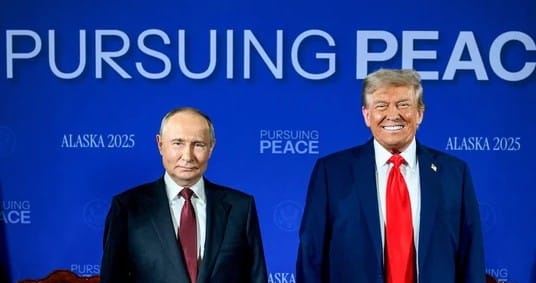

U.S. President Donald Trump and his Russian counterpart Vladimir Putin met for the first time in six years to discuss peace for Ukraine in Anchorage Alaska on August 15, 2025, but without announcing immediate results. The meeting was held at the largest U.S. military base in Alaska, Joint Base Elmendorf‑Richardson (Air Force/Army) just outside Anchorage, operating since 1940 in one form or another. As Putin and Trump walked on the red carpet a B-2 stealth bomber flanked by military jets flew overhead, underlining to Putin America’s unsurpassed military strength and technology.
In essence, the lack of concrete results constituted good news for Ukraine, Europe and most of the world as it, momentarily at least, appeared to rule out the pre-emptive surrender to Moscow that many had long feared was the essence of Trump’s strategic approach, especially in view of his team’s severe lack of Russia expertise. But deep concerns about Trump’s actual intentions remain, as he quickly arranged a meeting with Ukrainian President Volodymyr Zelenskyy for August 17 in Washington.
Red carpet treatment for a war criminal
The red-carpet treatment Putin received in Alaska was seen as a major victory, as Putin remains under indictment by the International Criminal Court (ICC), whose authority both the U.S. and Russia reject. Most commentators saw Trump’s matter of fact termination of Russia’s diplomatic isolation as a major gain for Moscow, for which Russia paid nothing in terms of diplomatic concessions. Some observers believe the Alaska meeting will actually open multiple travel options for Putin, including visits to the “Global South” where his political gravitas has been gradually improving as Trump’s tariffs steadily cost Washington its remaining friends.
Trump pivots away from ceasefire demand
Observers across the globe are mystified by Trump’s apparent decision to stop pressing Russia for an immediate ceasefire as a first step to peace, which he has stated was his objective going into the small meeting with Putin, in a three-on-three format, which was actually a last-minute change from the planned one-on-one session.

Setting participation in summits and high-level presidential meetings is often the deciding factor in a meeting’s outcome and the number of participants is usually agreed in advance, after careful negotiation. Trump clearly had the advantage in Alaska as host. In any event, Trump was flanked by National Security Adviser/Secretary of State Marco Rubio and Special Emissary (for everything) Steve Witkoff, neither being Russia experts but with Cuban American Rubio at least having strong feelings about Russian policies. Putin was flanked by long-serving Foreign Minister Sergei Lavrov and Putin aide Yuri Ushakov, an undisputed expert (and former Ambassador to the U.S.) in American affairs.
The spinmeisters weave their web
In term of results, in the joint press conference after the meeting Putin claimed there was an “understanding,” while Trump maintained that no agreement had been made. Details were not available as the official “press conference” as such did not allow reporters to ask questions.
It remains unclear why Trump shifted the U.S. position toward supporting a broader “peace agreement” framework once he left the closed meeting. In terms of explanations, Trump posted after the meeting on his Truth Social site: “It was determined by all that the best way to end the horrific war between Russia and Ukraine is to go directly to a Peace Agreement, which would end the war, and not a mere Ceasefire Agreement, which often times do not hold up.”
Reportedly, in the three-hour meeting Putin was unable to move the conversation from Ukraine to U.S.-Russia bilateral issues, for which he had a range of attractive proposals on bilateral cooperation to gain Trump’s support, but at the same time the subject of new U.S. sanctions just disappeared, yielding a major victory for Putin, leaving many observers dumfounded.
Security guarantees for Ukraine outside of NATO
With the Zelenskyy August 18 Washington meeting as the immediate focus of world attention, the question of security guarantees for Ukraine has moved to center stage. Little is known about Trump’s position on the subject, but in an interview with Fox News’ Sean Hannity on August 16, Trump signaled that he and Putin had discussed land transfers and security guarantees for Ukraine and had “largely agreed.” U.S. security guarantees (presumably outside of NATO) for Ukraine would constitute an important step forward for Trump.
With that as background, it is fair to say Trump provided the world with an important hint as to how he wants the August 18 White House meeting to play out, unless higher powers intervene.
Europe is already mobilizing and UK Prime Minister Sir Keir Starmer, French President Emmanuel Macron, German Chancellor Friedrich Merz, Italy’s Prime Minister Giorgia Meloni, Finland’s President Alexander Stubb, European Commission President Ursula von der Leyen and NATO Secretary-General Mark Rutte are planning to join Zelenskyy in Washington on August 18.
It is unknown if there will be any attempt by the Trump White House to hold a one-on-one session with Zelenskyy, something guaranteed to give the still-suspicious Europeans nightmares. At the very least, the European presence in all discussions will prevent Trump from pressuring Zelenskyy to immediately accept the Putin-Trump “peace deal” while the fighting continues.
Why abandon the strategy of staged sanctions rollbacks for returned Ukrainian territory and peace and move towards Munich-style appeasement of an aggressor?