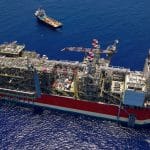

The European Union is reportedly considering counter sanctions against the US if the latter targets European companies over the controversial Nord Stream-2 pipeline from Russia to Germany.
Some Members of the European Parliament have asked for actions to defend European companies and countermeasures, including purchases US LNG, against sanctions.
Nord Stream 2 EU representative Sebastian Sass reminded the EU has always opposed extraterritorial sanctions by third countries as a breach of international law. “This does not concern only Nord Stream 2, but it applies also to this project,” he told New Europe on July 2. “We welcome that the EU continuously reiterates its opposition against extraterritorial sanctions also in the context of Nord Stream 2, as expressed for example by High Representative (Josep) Borrell in his statements last Thursday, in February 2020 and by former Commission President (Jean-Claude) Juncker already in 2017,” Sass said.
He argued that it is not just a question about Nord Stream 2, it is a question of European sovereignty. Companies, citizens and investors that comply with all applicable laws in Europe must have legal certainty and be able trust the rule of law, Sass argued. “Over 120 companies from over 12 European countries could become directly affected. This is bad for the economy, for employment and European prosperity,” he claimed.
Katja Yafimava, a senior research fellow at the Oxford Institute for Energy Studies (OIES), told New Europe on July 2 the latest draft US Nord Stream 2 sanctions legislation – Protecting Europe’s Energy Security Clarification Act (PEESCA) – is likely to catalyse a response from Europe. “The exact form of such response is hard to predict, but I think it is more likely to be a shield rather than a sword, meaning that it is more likely to be of protective/defensive, rather than offensive, nature. The EU Blocking Statute and Instex / Special Purpose Vehicle come to mind and provide foundations for such a response,” Yafimava said.
The European aim is to ensure that its companies are not hurt by any new US sanctions legislation and that the Nord Stream 2 pipeline construction is finalised, she said. Germany, which has assumed the EU presidency from 1 July, has been calling for an EU-wide response, with German Chancellor Angela Merkel saying extraterritorial sanctions are not consistent with her understanding of the law, and Borrell, the head of European External Action Service (EEAS), saying the European Commission makes preparations for a mechanism strengthening resilience against extra-territorial sanctions, Yafimava said.
According to the Oxford energy expert, these statements aim at discouraging the US from adopting additional sanctions legislation and demonstrating that a European response will follow if such legislation, endangering European companies, is adopted.
“I think counter-sanctions are unlikely, first of all because it is difficult to see how such measures would protect the European companies involved in Nord Stream 2 while also could expose other European companies to potential retaliation by the US,” Yafimava said. “Also, given that the EU has repeatedly stated it considers extra-territorial sanctions illegal, it is unlikely to resort to similar measures vis-à-vis the US companies. Furthermore, it might want to maintain a high moral ground by not resorting to the US tactics i.e. ‘when they go low, we go high’ etcetera,” she said.
On July 1, a hearing about sanctions against Nord Stream 2 took place in the German Parliament where MPs, government representatives and external speakers unanimously rejected the threats of sanctions. However, Yafimava noted that US pressure has not caused a knee-jerk reaction from Germany. “Germany has always been overwhelmingly in favour of Nord Stream 2, and such support is bipartisan and cuts across party lines. With this in mind, it is not at all surprising that Germany vows to defend Nord Stream 2, particularly as US has clearly demonstrated that it intends to use all means to make finalisation of Nord Stream 2 construction as difficult and as delayed as possible,” Yafimava said.
Some critics of US efforts to stop Nord Stream 2 have claimed the sanctions seem driven by American efforts to promote its own liquefied natural gas in Europe. Washington has pushed the purchase of US LNG and some European countries have already committed to buying US volumes. Asked how would this affect US liquified natural gas (LNG), which is seen as an effort to reduce reliance on Russia, Yafimava said US LNG will continue to be bought as long as it remains available and competitive. She added that, notably, Nord Stream-2 will strengthen flexibility and competitiveness of Russian gas in Europe.
follow on twitter @energyinsider