

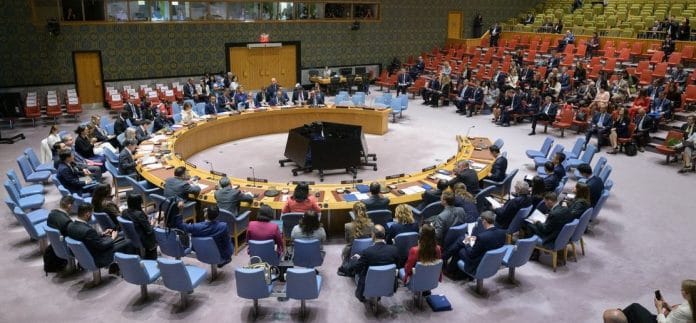

Back on August 28, France, Germany, and the UK (the so-called “E3”) formally initiated the process to reimpose UN sanctions on Iran aka “snapback.” They accused Iran of breaches of its commitments under the Joint Comprehensive Plan of Action (JCPOA — also known as the 2015 Iran nuclear deal), including restricting cooperation with the IAEA and building up enriched uranium stockpiles beyond agreed limits.
Under UN Security Council Resolution 2231 (which formalized the JCPOA), the E3 action started a 30-day period during which either a resolution must be passed to continue sanctions relief, or, failing that, the previous UN sanctions are automatically reinstated (e.g., snapped back).
Iran’s allies try but fail to prevent snapback
Several states, including Russia, China, Pakistan, and Algeria, have opposed and/or sought to delay the reinstatement process. They raised legal objections about whether the “E3” had the standing to invoke the snapback, and whether the process under Resolution 2231 has been properly observed.
Russia circulated a draft UN Security Council resolution proposing a six-month extension of the relevant parts of Resolution 2231 (which would delay the onset of the snapback sanctions). This was rejected because it could not get the required votes.
Anti-snapback resolution fails
On September 19, a draft compromise resolution proposed by South Korea (then Security Council president) that would have permanently lifted the sanctions (i.e., prevented snapback) was put to a vote. It failed because it did not receive the nine votes needed. Only Iran’s four allies on the Security Council voted in favor (China, Russia, Pakistan, Algeria).
After that, the handwriting was on the wall. All involved knew that unless some last-minute diplomatic deal was made at the UNGA High-level week, the snapback sanctions would take effect. That is what happened – no deal, despite an eleventh hour attempt to delay the snapback in the Security Council on September 26 by China and Russia.
Harsh reaction from Tehran
So far, Iran has reacted strongly — recalling ambassadors from the E3 states, denouncing the UN’s decision as illegal and provocative, and threatening to withdraw from or reduce cooperation with the International Atomic Energy Agency (IAEA), possibly even to consider exiting the Nuclear Non-Proliferation Treaty (NPT).
Iran’s economy is being strained further by the snapback: the Iranian rial has weakened significantly, inflation is rising, and there is concern over worsening economic hardship. Time will tell how the resumed sanctions and concomitant hardships will influence political stability, public sentiment, and policy decisions.
This evening, the UN triggered snapback sanctions on Iran. We commend France, Germany, and the United Kingdom on their decisiveness and resolve. Six UN resolutions have been reactivated, prohibiting Iranian nuclear enrichment and restoring restrictions on Iran’s nuclear and…
— Secretary Marco Rubio (@SecRubio) September 28, 2025
U.S. statement released under the name of Secretary of State Marco Rubio
Completion of UN Sanctions Snapback on Iran
“This evening (September 27), at 8:00 p.m. EDT, the United Nations reimposed sanctions and other restrictions pursuant to six UN Security Council Resolutions — 1696, 1737, 1747, 1803, 1835, and 1929 — based on Iran’s continuing “significant non-performance” of its nuclear commitments. Their reactivation concludes the snapback process initiated on August 28, 2025, in an act of decisive global leadership on the part of France, Germany, and the United Kingdom.
The provisions enumerated in the restored resolutions address the threats posed by Iran’s nuclear, ballistic missile, conventional arms, and destabilizing activities. Notably, they require Iran to suspend uranium enrichment-, heavy water-, and reprocessing-related activities; prohibit Iran from using ballistic missile technology; embargo the export of conventional arms to Iran; reimpose travel bans and global asset freezes on listed individuals and entities; and authorize the seizure of weapons and other prohibited cargo being transferred by Iran to state and non-state actors.
The Security Council’s decision on September 19 — reaffirmed on September 26 — to restore these restrictions sends a clear message: the world will not acquiesce to threats and half measures — and Tehran will be held to account.
President Trump has been clear that diplomacy is still an option — a deal remains the best outcome for the Iranian people and the world. For that to happen, Iran must accept direct talks, held in good faith, without stalling or obfuscation. Absent such a deal, it is incumbent on partners to implement snapback sanctions immediately in order to pressure Iran’s leaders to do what is right for their nation, and best for the safety of the world.”
Release date: September 27, 2025
On October 1, the U.S. announced the imposition of additional sanctions in support of the snapback of UN sanctions and restrictions on Iran for “significant non-performance” of its nuclear commitments. Washington designated 44 individuals and entities involved in Iran’s nuclear program and weapons procurement networks supporting ballistic missile and military aircraft programs.