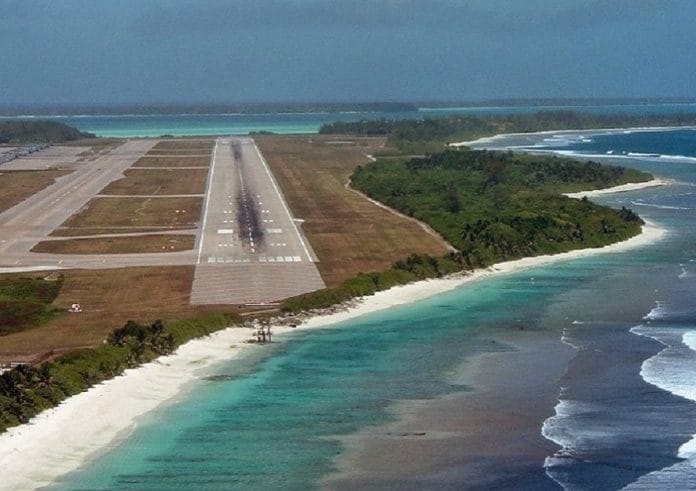

The United Kingdom agreed on May 22 to transfer sovereignty of the Chagos Islands to Mauritius, after a last-minute legal challenge was thrown out by the UK High Court.
The UK has officially handed sovereignty of the archipelago to Mauritius, but will lease the use of Diego Garcia for a period of 99 years – at an average cost of £101 million per year. Window dressing for the deal was the creation of a new UK-Mauritius Strategic Partnership Framework (full details below).
The transfer of sovereignty comes in the wake of a 2019 advisory opinion by the International Court of Justice, backed by the United Nations, which called on the UK to return the islands and bring an end to its colonial administration.
Terms of the deal for Diego Garcia
The UK will pay £165 million in each of the first three years. From years four to 13, it will pay £120 million a year. After that, payments will be indexed to inflation.
UK authorities have said that continued use of Diego Garcia as a military base had been signed off by members of the “Five eyes alliance” – the UK, the United States, Canada, Australia and New Zealand. UK Prime Minister Kier Starmer has also revealed that the U.S. will be paying for the running costs of the massive base, which will be jointly administered by the UK and U.S.
The agreement also includes a £40-million trust fund to support Chagossians.
Mauritian Prime Minister Navin Ramgoolam said the agreement completed “the total process of decolonization.” Starmer says the 99-year agreement to lease back Diego Garcia will cost the UK £101 million a year, and is necessary to protect the base from “malign influence.”
Short geographic update
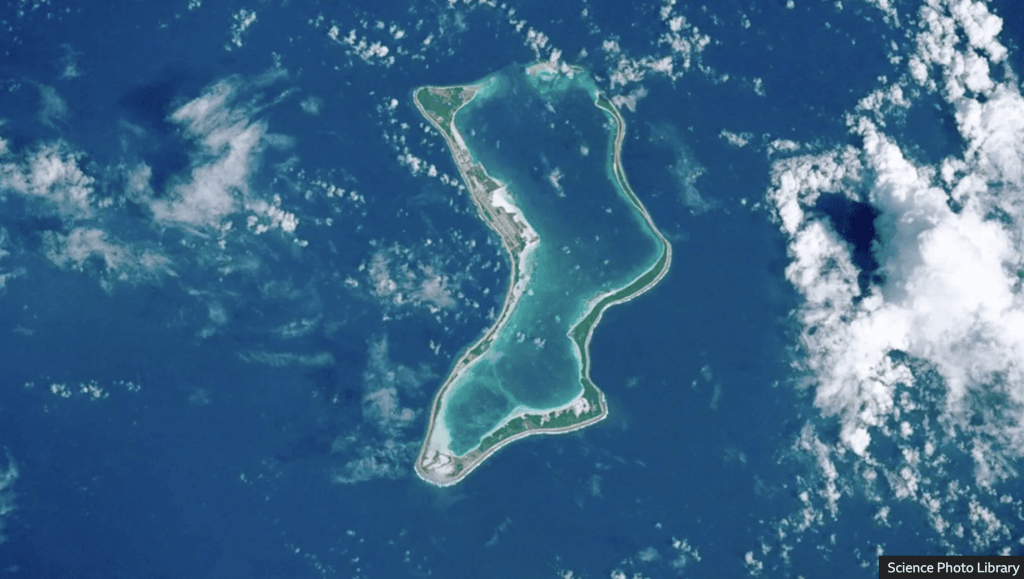
The Chagos Islands are officially known as the British Indian Ocean Territory. They are located in the Indian Ocean about 9,300 km south-east of the UK, and about 2010 km northeast of Mauritius. The islands, also known as the Chagos Archipelago – comprised of seven atolls with about 60 individual islands – were separated from Mauritius in 1965, when Mauritius was still a UK colony.
Britain purchased the islands for a mere £3 million but Mauritius has consistently argued that it was illegally forced to give them away as part of a deal to gain independence from Britain. In the late 1960s, Britain invited Washington to build a military base on Diego Garcia, the largest of the Chagos Islands, forcibly removing thousands of people from their homes in the process.
Since the base became operational, only official visitors/staff are permitted, there is no tourism and no commercial flights. The U.S. dollar is the official currency on base.
On May 22, U.S. Secretary of State Marco Rubio issued a statement in support of the Chagos island agreement. The key point in that statement notes, “We commend both the United Kingdom and Mauritius for their leadership, vision, and commitment to ensure that Diego Garcia remains fully operational for the duration of this agreement. We look forward to working closely with both governments to strengthen our collaboration in support of regional peace and stability.”
Text of UK-Mauritius joint communique issued on May 22 follows:
“UK-Mauritius Strategic Partnership Framework
Today, with the conclusion of the agreement on the exercise of sovereignty over the Chagos Archipelago, relations between the United Kingdom of Great Britain and Northern Ireland and the Republic of Mauritius enter a new era. In recognition of this, we – the Secretary of State for Foreign, Commonwealth and Development Affairs for the United Kingdom, and the Minister of Foreign Affairs, Regional Integration and International Trade for Mauritius – agree to a new Strategic Partnership Framework, to cement and boost our flourishing relationship for the benefit of both nations.
The United Kingdom and Mauritius enjoy deep historical ties and strong partnerships across a full range of shared strategic interests including economic growth, security, and climate change. We are both Commonwealth democracies, committed to upholding human rights, the rule of law, and the rules-based international system.
Our new governments will work together to deliver the clear mandates for reform we were given in our elections last year, to support the change our people want to see. In agreeing to this partnership, we also demonstrate our continued shared commitment to the pursuit of a free and rules-based Indo-Pacific that delivers security and prosperity for all.
From 2025, the United Kingdom and Mauritius will strengthen our cooperation, addressing the challenges and seizing the opportunities of our time, with a particular focus on: boosting mutual economic growth and trade, strengthening the international rules-based system, reinforcing maritime security, and tackling climate change.
Building on our vibrant bilateral trade relationship currently worth £1.2 billion annually, we will increase mutual trade and investment to boost long-term growth for both our countries, supporting Mauritius’s aim to transition to a high income country and putting more money into hardworking people’s pockets. This will include:
Deepening our existing trade relationship under the United Kingdom-Eastern and Southern Africa Economic Partnership Agreement
Maximising growth and development by cooperating on competitive financing through UK Export Finance, with at least £5 billion in market risk appetite, to deliver British business opportunities and growth and jobs in Mauritius
New government-to-government initiatives on digital trade and health, and a United Kingdom/Mauritius Business Forum
Delivering a set of formal partnerships with Mauritian and British institutions across priority sectors, including hospitals, the civil and public service, universities, and City of London financial institutions
We also commit to work together to strengthen the international rules-based system and in particular to build resilience against corruption and illicit finance, including by enhancing Mauritius’s status as a regional financial hub and instilling further confidence in Mauritius as an investment destination. This will include:
Developing a bilateral Economic Security Partnership to counter corruption and illicit finance, including measures to support Mauritius’s next Financial Action Taskforce review
Expanding law enforcement cooperation, in particular cyber training and investigations, to reduce crime
Identifying opportunities for Mauritian judicial reform and support
We will explore ways to strengthen our democracies and shared values by forging deeper connections between our Parliaments and increasing our collaboration in international and multilateral fora such as the Commonwealth and regional Indian Ocean organisations.
On maritime security and irregular migration, we will deepen our cooperation to fight the scourges of irregular migration, drugs trafficking, piracy, and illegal, unregulated and unreported fishing, supporting safer streets in our countries and protecting mutual prosperity. This will include:
Cooperation agreements and capacity building to secure Mauritius’s Exclusive Economic Zone
Consideration of patrolling capability across the Chagos Archipelago to support a secure maritime domain
Cooperation to counter and manage irregular migration
Provision of training and institutional partnerships to boost Mauritian maritime security capability and strengthen fisheries protection
We further commit to tackle one of the defining global challenges of our time together: climate change. Our shared objectives are to deliver Mauritius’s transition to energy independence through sustainable renewable energy, to protect biodiversity including rare indigenous species, and to increase Mauritius’s long-term climate resilience. This will include:
A £12 million Access to Climate Finance programme, to unlock hundreds of millions of pounds through private sector partnerships and international green funds
Mitigation and adaptation projects to tackle the immediate effects of climate change including coral restoration, coastal erosion and indigenous species conservation
Technical expertise to develop and manage the Chagos Archipelago Marine Protected Area, pursuant to the agreement on the exercise of sovereignty over the Chagos Archipelago
The new UK-Mauritius Strategic Partnership Framework will provide a comprehensive mechanism for delivering, together, for our countries. Our Ministers will meet in the coming months to finalise the partnership and will then meet in an Annual Strategic Dialogue to review and keep evolving it as necessary to support the security and prosperity of our countries into the future.”