

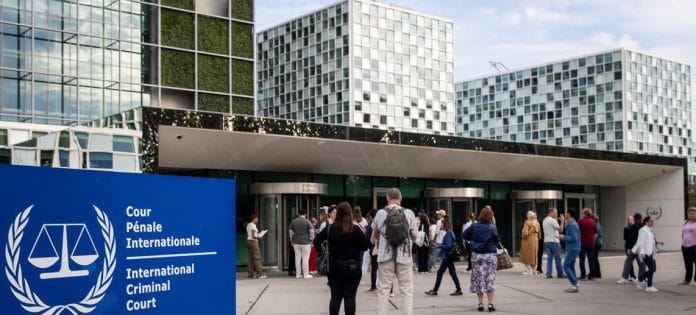

On June 5, the United States announced sanctions against four judges currently serving as International Criminal Court (ICC) judges for what it described as “transgressions against the United States and Israel.”
This is not the first time sanctions have been employed by Washington in America’s long and often tense relationship with the ICC; the first Trump administration made use of the sanctions option, but they did not outlast Trump’s first term in office.
The European Union “deeply regrets” the United States sanctions placed on four judges at the ICC, European Commission President Ursula von der Leyen stated. Responding to the announcement on June 6, von der Leyen said the Hague-based court had the “full support” of the EU.
EU member Slovenia, home country of one of the sanctioned ICC judges (Beti Hohler), said it “rejects pressure on judicial institutions” and called on the EU to use its blocking statute. The blocking statute mechanism lets the EU ban European companies from complying with U.S. sanctions that Brussels deems unlawful. The statute has been used in the past to prevent Washington from banning European trade with Cuba and Iran, but it is extremely risky for Brussels to employ the mechanism in the middle of tense trade negotiations with the Trump administration.
The ICC was established by the Rome Statute in 1998 to prosecute individuals for genocide, crimes against humanity, war crimes, and aggression. The U.S. signed the Rome Statute in 2000 (under then-President Bill Clinton) but never ratified it. In 2002, under then-President George W. Bush, the U.S. “unsigned” the treaty and passed the American Service-Members’ Protection Act, aimed at shielding U.S. personnel from ICC jurisdiction.
Despite its opposition, the U.S. has sometimes cooperated with the ICC, especially on cases involving other countries, such as the Darfur genocide in Sudan or the Joseph Kony/LRA situation. This reflects a pragmatic approach: the U.S. supports accountability for atrocities but remains highly wary of the court’s reach over its own citizens.
As noted previously, the first Trump administration imposed sanctions on ICC officials in 2020 after the court investigated alleged U.S. war crimes in Afghanistan and Israeli actions in Palestine. As observed in several other U.S. sanctions cases, the Biden administration reversed the Trump ICC sanctions in 2021, signaling a more cooperative tone but still maintaining a non-member status and voicing concerns over ICC jurisdiction over non-state parties.
The State Department fact sheet dated June 5 follows:
“Imposing Sanctions in Response to the ICC’s Illegitimate Actions Targeting the United States and Israel
Today, the United States is sanctioning four individuals, currently serving as judges of the International Criminal Court. We do not take this step lightly. It reflects the seriousness of the threat we face from the ICC’s politicization and abuse of power. The Department of State’s designations are made pursuant to Executive Order (E.O.) 14203, which authorizes sanctions on foreign persons engaged in certain efforts by the ICC and aims to impose tangible and significant consequences on those directly engaged in the ICC’s transgressions against the United States and Israel.
The Department is designating the following individuals pursuant to section 1(a)(ii)(A) of E.O. 14203, for having directly engaged in any effort by the ICC to investigate, arrest, detain, or prosecute a protected person without consent of that person’s country of nationality:
SOLOMY BALUNGI BOSSA, Judge, Appeals Division, International Criminal Court
LUZ DEL CARMEN IBANEZ CARRANZA, Judge, Appeals Division, International Criminal Court
REINE ADELAIDE SOPHIE ALAPINI GANSOU, Judge, Pre-Trial and Trial Division, International Criminal Court
BETI HOHLER, Judge, Pre-Trial and Trial Division, International Criminal Court
Bossa and Ibanez Carranza ruled to authorize the ICC’s investigation against U.S. personnel in Afghanistan. Alapini Gansou and Hohler ruled to authorize the ICC’s issuance of arrest warrants targeting Israeli Prime Minister Benjamin Netanyahu and former Minister of Defense Yoav Gallant.
Sanctions Implications
As a result of today’s sanctions-related actions, all property and interests in property of the sanctioned persons described above that are in the United States or in possession or control of U.S. persons are blocked and must be reported to the Department of the Treasury’s Office of Foreign Assets Control (OFAC). Additionally, all individuals or entities that are owned, either directly or indirectly, individually or in the aggregate, 50 percent or more by one or more blocked persons are also blocked.
All transactions by U.S. persons or within (or transiting) the United States that involve any property or interests in property of designated or otherwise blocked persons are prohibited unless authorized by a general or specific license issued by OFAC or exempt. These prohibitions include the making of any contribution or provision of funds, goods, or services by, to, or for the benefit of any blocked person and the receipt of any contribution or provision of funds, goods, or services from any such person.
Petitions for removal from the SDN List may be sent to: [email protected]. Petitioners may also refer to the Department of State’s Delisting Guidance page.
Fact Sheet – June 5, 2025”