

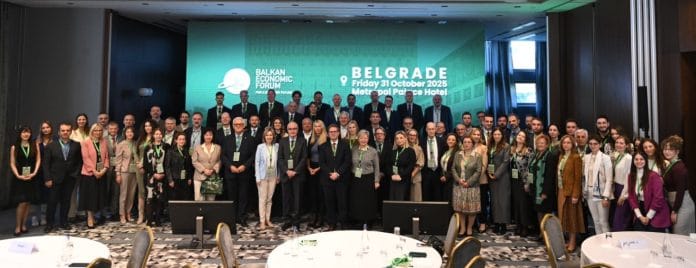

The Balkan Economic Forum (BEF) 2025 annual conference, held in Belgrade under the auspices of the Central European Initiative (CEI) and under the auspices of and co-financed by the Western Balkans Forum and Red Hat, brought together regional leaders, policymakers, academics, and private-sector stakeholders to examine the Balkans’ most pressing economic, digital, environmental, and governance challenges.
The overarching mission was to translate expert dialogue into actionable recommendations that can assist policymaking across the region and strengthen cooperation, stability, and long-term development. The one-day Forum (October 31) covered four major topics in separate panels, summarized below. The conference was recorded and can currently be viewed here.
Across all four panels, several crosscutting themes emerged:
–Regional cooperation is essential for progress. No single country can address digital, environmental, or connectivity challenges alone.
–Institutional capacity and credible long-term planning determine whether reforms succeed or fail.
–Talent, data, and innovation ecosystems are the engines of future competitiveness.
–Climate resilience and sustainable infrastructure are now economic imperatives, not optional goals.
–EU alignment provides structure and opportunity, but countries must improve administrative capacity and reduce corruption to absorb available funding.
Accelerating Digital Transformation
Digitalization is advancing across the Western Balkans but remains uneven and slowed by legacy systems, institutional fragmentation, and a widening digital skills gap. While ICT exports — particularly from Serbia and North Macedonia — outperform European averages considerably, the region still lacks essential capabilities in digital literacy, B2B sales, and modern tech talent. Experts stressed the need to leapfrog outdated IT architecture by adopting cloud-native and open-source solutions, while also addressing resistance to change in public administration and traditional industries. Strengthening education, informal training ecosystems, and cross-sector strategic leadership is critical to prevent further talent drain and boost competitiveness.
Infrastructure & Connectivity as Drivers of Integration
Transport connectivity was identified as a foundational pillar for economic growth and EU convergence. Despite progress in motorway development, rail infrastructure is outdated, border-crossing procedures remain slow, and institutional coordination is weak. Sustainable improvements require harmonizing technical standards, streamlining border and toll-collection procedures, and investing in low-carbon, multimodal transport. Long-term planning, cross-border collaboration, and alignment with EU policy frameworks are essential for enhancing mobility, trade, and regional integration.
Data-Driven Sustainable Development
The Forum highlighted the central role of high-quality, reliable data in evidence-based policymaking. As AI, big data, and real-time analytics reshape statistical systems, maintaining transparency, methodological rigor, and public trust becomes increasingly important. Statistical institutions face challenges in bridging communication gaps with policymakers and adapting to new data environments while ensuring ethical governance. Strengthening data literacy across society — especially among policymakers and younger generations — is vital for informed decision-making and combating misinformation. It was noted that Generation Z consumes data visually and socially, demanding new communication approaches.
Blue and Circular Economy: Unlocking Regional Potential
The Balkans’ extensive marine and freshwater resources offer major opportunities for sustainable growth, climate resilience, and green transition. However, environmental infrastructure gaps, high investment needs for EU alignment (e.g., wastewater and water supply), institutional weaknesses, and fragmented policies hinder progress. The region faces transboundary challenges such as pollution, climate-related risks, and underutilized inland waterways. BEF commentators called for integrated water and coastal management, nature-based solutions, better use of EU funds, and stronger cooperation among governments, academia, and the private sector. Moving from strategy development to implementation is a critical shift needed for real impact.
Strategic imperatives for progress
The Forum concluded that the Balkans’ success depends on strong leadership, shared regional vision, and a shift toward practical implementation of existing solutions. A short after movie is available here.
Embracing cooperation, evidence-based policy, and sustainable development will allow the region to build a resilient, prosperous, and fully European future, even as EU enlargement negotiations continue seemingly with no end-date in sight. Stressing a cooperative focus, a memorable quote emerging from the conference was an old African proverb that said “if you want to go fast, go alone…but if you want to go far, go together.”
Closing the conference on a high note, BEF President Dr. Sasho Kjosev revealed a new set of BEF projects was in the final stages of preparation and would be launched in 2026. Details will be released shortly.