

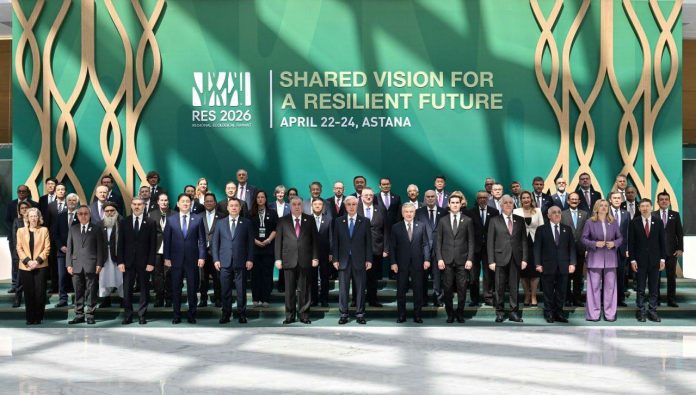
Addressing climate and environmental challenges across Central Asia, the Regional Ecological Summit RES 2026 in Astana on April 22-24 hosted by the Government of Kazakhstan, in partnership with the UN, the OECD, the IEA and IRENA, stood out for its substantive agenda, establishing an open platform for translating dialogue into practical solutions to climate and ecological challenges, bringing together a broad range of countries, regions, and partners.
“Kazakhstan is a player in the region, I think that’s undisputed fact,” Aleška Simkić, Ambassador of the European Union to Kazakhstan, told NE Global in Astana on April 22. “It’s biggest country geographically, it has been affected by climate in all the possible ways so I would say that Kazakhstan and Uzbekistan arguably have to be leaders; here we always look at it regionally as well, so Kyrgyzstan, Tajikistan and Turkmenistan have to participate but there has to be a country which is middle income, a country which has natural resources to also be the leader on such topics,” she said at the packed plenary hall of the Astana Congress Center before RES 2026 kicked off.
“Environmental cooperation must serve as a reliable instrument of unity and should not divide us,” Kazakhstan President Kassym-Jomart Tokayev said in his opening speech at the summit.
Under the banner Bin Tamyr (shared roots), the Regional Ecological Summit brought together the region’s top leaders, including Uzbekistan President Shavkat Mirziyoyev, Kyrgyzstan President Sadyr Japarov, Tajikistan President Emomali Rahmon, Turkmenistan President Serdar Berdimuhamedov, Mongolia President Ukhnaagiin Khürelsükh, Armenia President Vahagn Khachaturyan, Georgia President Mikheil Kavelashvili and Azerbaijan’s Prime Minister Ali Asadov, all of which made opening remarks, calling for collaborative action.
One of the key outcomes of the Summit was the adoption of the “Environmental Solidarity of Central Asia” Declaration, reinforcing joint commitments to address biodiversity, pollution, air quality, and land degradation. The Declaration also reflects the initiative of President Tokayev to establish an International Water Organization under the UN.
“Water and environment is a big topic in the region and the countries are trying to see how better to cooperate in order to manage all ecological risks that are happening,” Simkić said. “As we all know there is dependency on energy sources that are not of the cleanest way and it’s difficult to go for renewables, it’s difficult to manage with the water situation here but, at the same time, they’re all aware that this region is going to be probably most affected by climate change. We already see floods and droughts in different parts of it. As far as the EU is concerned, we always support regional corporation on such topics,” she said.
EU-Central Asia meeting on water, energy and climate change
On the second day of the Regional Ecological Summit in Astana, high-level representatives of the European Union, its EU Member States, the Central Asian countries and international financial institutions convened for the Team Europe Initiative (TEI) High-Level Meeting on Water, Energy and Climate Change in Central Asia.
Participants reaffirmed their shared commitment to strengthening regional cooperation and advancing coordinated responses to interlinked challenges in water security, green energy transition, and climate resilience.
Sitting next to Simkić at the meeting, Eduards Stiprais, the EU Special Representative for Central Asia, noted that the High-level meeting in Astana is a further step in enhancing the cooperation between the EU and Central Asia in energy, water and climate following the first EU-Central Asia summit in April 2025.
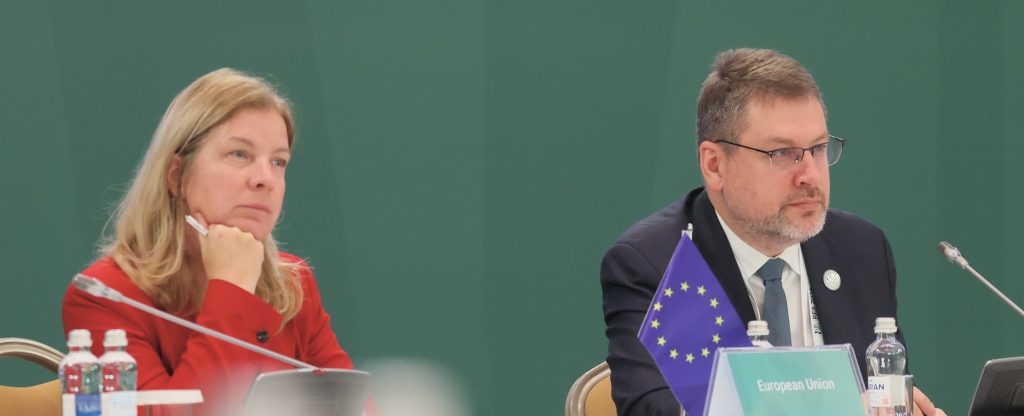
“The Team Europe Initiative Water, Energy and Climate is the largest EU initiative in Central Asia and is underpinned by significant investments of 4.8 billion Euros in concrete water, renewables and climate projects. We are proud of the good cooperation with our Central Asian partners to increase water cooperation and to support the green transition of energy systems in the region,” Stiprais said, who also contributed to a side event dedicated to the Aral Sea Basin during RES 2026.
Simkić referred to Kambarata hydropower plant in Kyrgyzstan, which is the biggest project ever in the context of Global Gateway. “There are some challenges because the three countries that are affected have to agree on water, etcetera but as far as the European Union is concerned, we see this as an important and necessary cooperation, collaboration,” she told NE Global.
The Caspian Sea is one of the defining issues. Its declining level calls for urgent and coordinated action, including strengthened joint oversight of river inflows and more effective regional coordination.
Following a thematic session of the Summit, the agreements “Caspian Sea Action Week 2026” and “Green Aral: Volunteers for Life” were signed, aimed at boosting citizen engagement in environmental volunteering and advancing joint actions to address pressing issues in the Caspian and Aral regions.
“Caspian is an important environment. Caspian, we see it as an opportunity also for our transport corridor but, of course, anything that you do at the Caspian will have certain environmental consequences, so we are very aware of that,” Simkić said. “There is evidence that the water level of the Caspian Sea is lowering. There are different factors, but climate change is one of them as well and if you continue to increase the traffic on it, it’s going to have environmental consequences and we are fully aware and so are Central Asian countries,” Simkić said. “No one wants a repetition of the Aral Sea story. There is now some success on the Kazakh side of the Aral Sea,” she added.
Alongside the Caspian Sea, the Aral Sea restoration program was presented at RES 2026 as a counterpoint to more traditional narratives of degradation, demonstrating that environmental damage, while severe, is not always irreversible.
“The Aral Sea remains a stark reminder of the consequences of unsustainable policies, but also of what determined, science-based action can achieve,” Tokayev said. “So far, we have restored about 36 percent of the Northern Aral Sea, improving water quality, fish stocks, and enhancing living conditions,” the President added.
“There is IFAS, the International Fund for Saving the Aral Sea, which has much wider format than just Aral Sea and we would like the five countries cooperating on other water issues and energy issues on that. Those are the things we are working on – they support IFAS as well as the EU,” Simkić said.
Turning to the possibility of transporting electricity from renewable sources in the region to Europe, Simkić said the transport of energy is still a big topic. “Critical raw materials is a big environmental topic for battery building, so that’s where we’re also very active,” the EU Ambassador said, adding, “Everything is so interconnected, all our topics – energy, transport, environment, water – so interconnected and that’s where the EU thinks that we have to cooperate and each country of Central Asia has its own priority in a way, but Kazakhstan has all of them as a priority and that’s why Kazakhstan has to be the leader.”
In the evening before the summit at the Ministry of Ecology and Natural Resources of Kazakhstan, Minister Yerlan Nyssanbayev noted that a strategic project to lay high-voltage, direct-current submarine cables along the Caspian seabed to transport renewable electricity from Kazakhstan and Uzbekistan through Azerbaijan to Europe “depends on the volumes of the energy that could be exported.”
Asked by NE Global how the EU could help Kazakhstan implement its environmental goals, Nyssanbayev quipped, “Technology and financing. We have been talking about the environmental issues a lot and it is now high time to move to practical actions and to achieve our goals we need to get financing from international financial organizations to implement our ecological projects. We see that in the past 10 years green financing has been growing very fast and I’m sure it will be rapidly growing in the future, too. Without the support of international financial organizations, it would be very hard to achieve our ambitious goals. So, developing countries, our neighbors are actively working but we need financing and we’re actively negotiating with international financial organizations and European banks.”