

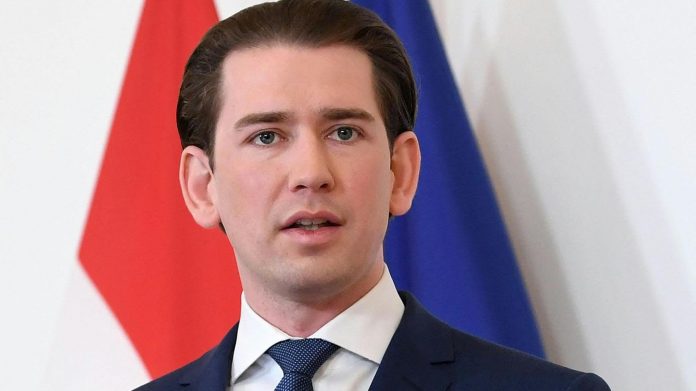

The surprise was great, and he staged it in his usual professional manner. Sebastian Kurz, who at 31 became Austria’s youngest-ever chancellor, announced his retirement from political life on December 2.
Having already resigned as head of government on October 9, this time he stepped down as head of the “Austrian People’s Party” (ÖVP) and as head of the ÖVP parliamentary group. He justified his decision to step away from political like by linking the move to the birth of his son, Konstantin, and with the ongoing judicial investigations against him for embezzlement and corruptibility as well as for false testimony in a parliamentary investigation committee. “I am neither a saint nor a criminal,” Kurz said, while also admitting mistakes.
This ends the career of a political wunderkind, which began in 2009 as head of the “Young ÖVP” in the Vienna City Council. Kurz burst on the scene with a strange publicity stunt featuring light-haired ladies in front of a black SUV car called the “Geilomobil”. In 2011, at the age of only 24, the “man in black” switched to the federal government of the Social Democratic Party of Austria (SPÖ) with the ÖVP as State Secretary for Integration. Two years later, he became Foreign Minister.
From 2017, he meticulously and ruthlessly implemented his cleverly planned rise to the top of the country with a small team by first cleareing out the ÖVP party leader and Vice-Chancellor, Reinhold Mitterlehner, with falsified polls. He then called new elections, changed his party’s traditional brand color from black to turquoise and to a more modern “List Sebastian Kurz – the new people’s party”. He also skilfully emancipated himself from the party’s traditional masterminds – the provincial leaders and heads of the confederation – and received the party’s nomination for all of the important political posts.
After his election victory, which lifted his party to first place ahead of the Social Democrats for the first time since 1969, he entered into a controversial coalition with the right-wing Freedom Party (FPÖ). Kurz then launched a few initiatives on the European level and in Germany, the tabloid media there often said it “would like to see someone like Kurz here too”, mainly because of his strong statements against immigration and debt policy.
At first, Kurz boasted that he had closed the traditional Balkan route for refugees. He later formed a group called the “Frugal Four” in which he successfully campaigned against higher spending with Denmark, Sweden and the Netherlands in negotiations over the EU’s budget. Kurz also spoke out against EU criticism of the course taken by the governments of Hungary and Poland. He also had a penchant for issuing strong anti-EU statements when he would denounce Brussels’ “bazaar methods” for the distribution of the first vaccine supplies.
In May 2019, the publication of the “Ibiza video” upsets the whole country. Kurz’s vice-chancellor, FPÖ leader Heinz Christian Strache, was secretly filmed promising state contracts and a crackdown on key media outlets to a woman who was alleged to be the niece of a Russian oligarch. Strache resigned, but shortly afterwards, parliament cast a vote of no confidence in the entire government. A cabinet of experts followed for a few months, but after another election victory, with 37.5 per cent of the vote and in a coalition with the Greens, Kurz became chancellor for a second time.
Since the beginning of 2021, the public prosecutor Wirtschafts- und Korruptions-Staatsanwaltschaft (WKStA) has intensified its investigations against Kurz and some of his close friends for post-fixing and, in the case of Kurz, false testimony before an investigative committee on the Ibiza affair.
Recovered WhatsApp messages on the confiscated mobile phone of Kurz’s close confidant, Thomas Schmid, who heads the state-owned investment company ÖBAG, revealed dubious practices. In the messages, Kurz appears to be happy to have prevented subsidies for after-school care for small children.
The public prosecutor’s office is also investigating allegations that taxpayers’ money from the Ministry of Finance was used to buy polls and to then have them published in the tabloid “Österreich”. This has led to calls that Kurz was involved in embezzlement schemes, which he denies.
As more details became known, the Green coalition partner demanded Kurz’s resignation, which eventually occurred on October 9. Kurz followed up by handing over his position to Foreign Minister Alexander Schallenberg. The latter remained in office for barely two months and had to make room for the previous Minister of the Interior, Karl Nehammer, because the party chair and the Chancellor’s office was merged again.
Nehammer had previously been known for his hard line on immigration, ordering nightly deportations of teenagers to Georgia. It was also under his leadership that the police failed to thwart a deadly terrorist attack by a radical Islamist in Vienna on November 2, 2020. Police investigators did not follow up on tips from Slovakia’s intelligence services after the Vienna attacker tried, on several occasions over many months, to buy ammunition for an assault rifle.
In November, a new wave of COVID infections throughout Austria resulted in a fourth lockdown of the country. This came after Kurz erroneously declared last summer that the pandemic was over for those who were vaccinated, despite the fact that Kurz had failed to open more testing facilities and to provide incentives for vaccinations.
Kurz leaves behind a disoriented ÖVP party that has fallen behind the SPÖ in the polls. Before Kurz, the provincial governors (six out of nine Bundesländer were from the ÖVP) determined the government’s reshuffles with several new ministers, according to the politicians’ origins.
Whether a reshuffled government will be able to fend off re-election demands from the opposition in the coming year remains to be seen.