

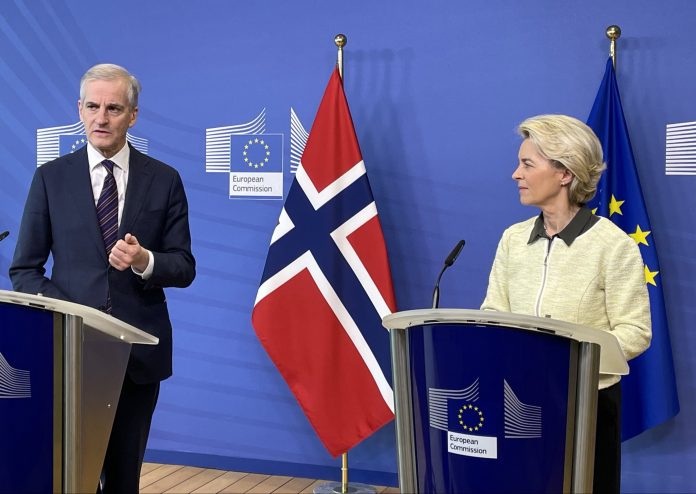
A delegation of the Norwegian government led by Prime Minister Jonas Gahr Store with European Commission President President Ursula von der Leyen and with Executive Vice-President Frans Timmermans, discussed on February 23 ways to enhance the EU-Norway dialogue and cooperation on climate, energy, and industrial transformation.
Von der Leyen said the EU must become more energy independent from Russia and fossil fuels. She noted that she sees great potential for a stronger EU-Norway cooperation on the green transition.
“Together, the EU and Norway will drive even more strongly the ambition we share for achieving climate neutrality,” von der Leyen said. “We will work more closely together to unfold the potential for decarbonizing our economies, and in particular our energy systems, making them more resilient to climate change and to global tensions. The EEA agreement is an excellent basis for strengthening our EU-Norway cooperation on climate. We are keen to firm up our joint action for the European Green Deal even more and explore establishing a Green Alliance,” she added.
For his part, Store said Norway and the EU support shared ambitions for cutting emissions and creating jobs, initiating enhanced cooperation and joint efforts to facilitate the establishment of a Green Alliance. “Focus would in particular be on sustainable energy and industry, facilitating technologies and markets essential to speed up the green transition. We will promote a sound transition, climate neutral growth and energy security, drawing on existing and new relevant frameworks in robust and close Norway-EU relations,” he said.
Acknowledging the urgency to act in order to drastically cut our greenhouse gas emissions in this decade, to improve Europe’s resilience to the negative consequences of climate change, and to increase energy independence, the EU and Norway reaffirmed their resolve to reduce emissions pursuing a joint path towards achieving domestic climate-neutrality by 2050.
In a statement, the two sides reiterated their commitment to reduce greenhouse gas emissions in a coordinated manner by at least 55% by 2030 compared to 1990 following a do-no-harm principle and making sure the transition to a decarbonized economy is fair.
The EU and Norway enjoy a particularly strong relationship as neighbours, partners, and allies, sharing common fundamental values and a common regulatory framework through the European Economic Area (EEA), cooperating to fulfil common climate targets by 2030, and Norway participates in several key pieces of climate legislation such as the EU Emissions Trading Scheme (ETS). The Fit-for-55 package will amend key EEA wide policy instruments.
Specific areas of particular mutual interest will be discussed in detail, such as sustainable technologies and markets, essential to speed up the green transition towards 2030 and beyond, development and deployment of green and low-carbon hydrogen, offshore wind energy, carbon capture and storage (CCS), minerals, batteries and green shipping.
These areas are key for reaching the 2030 climate objectives and towards 2050, and for further strengthening Europe’s competitiveness and open strategic autonomy. Similarly, both parties are working to significantly enhance their domestic actions on adaptation to climate change, with particular reference to polar and sub-polar regions as Norway prepares to take over the chairmanship of the Arctic Council in 2023, and on protecting oceans, the statement read.
Norway is committed to remaining a reliable partner during the transition towards a decarbonized economy and beyond, making Europe greener, more resilient and contributing to energy security.
The EU and Norway will explore ways to consolidate this collective vision and put their climate engagement on an even firmer footing, exploring to establish a Green Alliance between the EU and Norway. Such enhanced engagement would leverage green industry, renewable energy, green and low-carbon hydrogen and CCS, including through existing and new relevant frameworks for policy exchange, regulatory activity and stakeholder networks, in an inclusive and mutually beneficial manner, the statement read.
The EU and Norway are also discussing the next steps of international negotiations, reaffirming their commitment to the Paris Agreement, calling on all Parties to enhance their ambition ahead of COP27, in line with the latest science and the 1.5 degrees centigrade temperature limit as agreed in Glasgow. As two essential contributors to international climate finance, the EU and Norway will keep working towards reaching USD100 billion per year for developing country Parties and will play an active role in the discussions around the post-2025 climate finance goals.
Cap8
Norwegian Prime Minister Jonas Gahr Store at a press conference with European Commission President President Ursula von der Leyen, Brussels, February 23, 2022.